Teach Me First Comic Review: The Tutoring Manhwa Where Every Lesson Hides a Second Agenda
Heads-up: this series is rated 18+. This guide analyses story, craft and themes — no explicit content ahead.
Introduction
Few adult manhwa understand tension like this one — a closed room, a study desk, and two people pretending the textbook is the point. The Teach Me First comic takes the most overused setup in Korean webtoon romance and squeezes real friction out of it. It’s not the premise that hooks readers. It’s the pacing, the sightlines, and the way the artist lets silence sit for three panels too long.
I’ve read a lot of tutor-trope manhwa. Most collapse by chapter twelve. This one keeps finding new pressure points.
In this breakdown you’ll get:
- The full story outline and how the early setup misleads you
- A character dynamics analysis that explains why the leads actually work
- An honest art style and paneling review, including vertical-scroll craft
- A mature themes assessment — what’s earned, what’s filler
- A spoiler-light arc-by-arc reading guide
- Straight answers on where to read it legally and whether it’s worth your time in 2025
Let’s open the textbook.
What Is the Teach Me First Comic? A Quick Breakdown
Teach Me First is a Korean adult webtoon (manhwa) built around a private tutoring arrangement that spirals well past academics. It’s published in full colour, vertical-scroll format, the standard for Korean digital comics.
Genre-wise, it sits in a crowded lane:
- Primary genre: Mature romance / drama
- Format: Full-colour webtoon, vertical scroll
- Origin: South Korea (manhwa)
- Reading direction: Top-to-bottom, single infinite panel column
- Audience rating: Strictly 18+
- Typical chapter length: Short-to-medium scroll, roughly a 5–8 minute read
A quick note on naming. Adult manhwa titles frequently get re-translated by different aggregators, so you may see this series listed under slightly different English names or with alternate romanised Korean titles. Cast names also shift between fan scanlations and official releases. Always cross-check the cover art, not just the title text.
Story Outline: What Actually Happens (Spoiler-Light)
The Setup — One Room, Two Agendas
The engine is simple. A young man takes on a private tutoring job. The household he walks into is not as ordinary as the job listing suggested.
What separates this from a hundred lookalikes is the power inversion. The tutor is supposed to hold authority. He doesn’t. Within a handful of chapters, it’s obvious he’s the one being managed, tested and out-manoeuvred.
That’s the real hook. The title says Teach Me First — but the question of who is teaching whom stays genuinely unresolved.
The Escalation — When the Lie Gets Load-Bearing
Around the early-middle stretch, the story stops being about attraction and starts being about maintenance. Everyone is now protecting a version of events that isn’t true.
The writing here is smarter than the genre average. Secrets in this series have logistical consequences:
- Schedules have to be coordinated
- Excuses have to stay consistent
- Third parties start noticing gaps
Most adult manhwa treat secrecy as background flavour. Here it generates the actual plot beats.
The Midpoint Shift
There’s a clear tonal pivot roughly halfway through the run. The comedy thins out. The consequences arrive.
Characters who were played for laughs get interiority. A supporting figure you dismissed becomes a genuine threat to the arrangement. If you drop the series early because it feels shallow, this is the section you’re missing.
The Back Half
Later chapters trade novelty for emotional stakes. The tutoring pretext becomes almost vestigial — everyone knows what this is now.
That’s a risk. Some readers prefer the tension of the early chapters to the messier drama that follows. I’d argue the back half is where the writing finally justifies itself.
Character Dynamics: Why the Cast Isn’t Cardboard
The Male Lead — Reactive by Design
He’s passive. That’s a deliberate choice, and it’s the single most divisive thing about the series.
He doesn’t drive scenes. He absorbs them. Every major development happens to him, and his defining trait is a delayed reaction shot.
Critics call this weak writing. I’d push back. A proactive lead would collapse the central tension instantly, because he’d simply leave. His paralysis is the plot.
The Female Leads — Where the Real Writing Lives
The women in this series are given significantly more agency and more contradiction. Notable strengths:
- Distinct motivations. Each one wants something different from the arrangement — validation, control, distraction, or genuine connection.
- Visual differentiation. The artist gives each a separate silhouette, wardrobe language and colour temperature. You never confuse them in a thumbnail.
- Non-linear likability. They’re allowed to be unpleasant, then sympathetic, then unpleasant again.
That last point matters. Adult manhwa usually flattens female characters into a single note. This one doesn’t.
The Supporting Cast — Underused
This is the weak link. Side characters exist mainly to create scheduling problems and near-miss discoveries.
A few get promising introductions and then vanish for a dozen chapters. It’s the most common structural complaint in reader discussions, and it’s a fair one.
Art Style & Paneling: The Craft Review
Line Work and Character Design
The linework is clean, confident and modern — no over-rendered noise, no muddy shading. Faces are the priority. Expressions carry a huge amount of narrative weight here, and the artist knows it.
Character proportions stay consistent, which sounds like a low bar. It isn’t. Long-running webtoons routinely drift, especially when assistants rotate in.
Standout technical touches:
- Eye rendering with layered highlights that shift with mood
- Hair as a mood indicator — loose vs. tied signals emotional state
- Hand acting — a genuinely rare strength in the format
Colour, Lighting and Atmosphere
This is the series’ biggest flex. The colour scripting is doing real storytelling work.
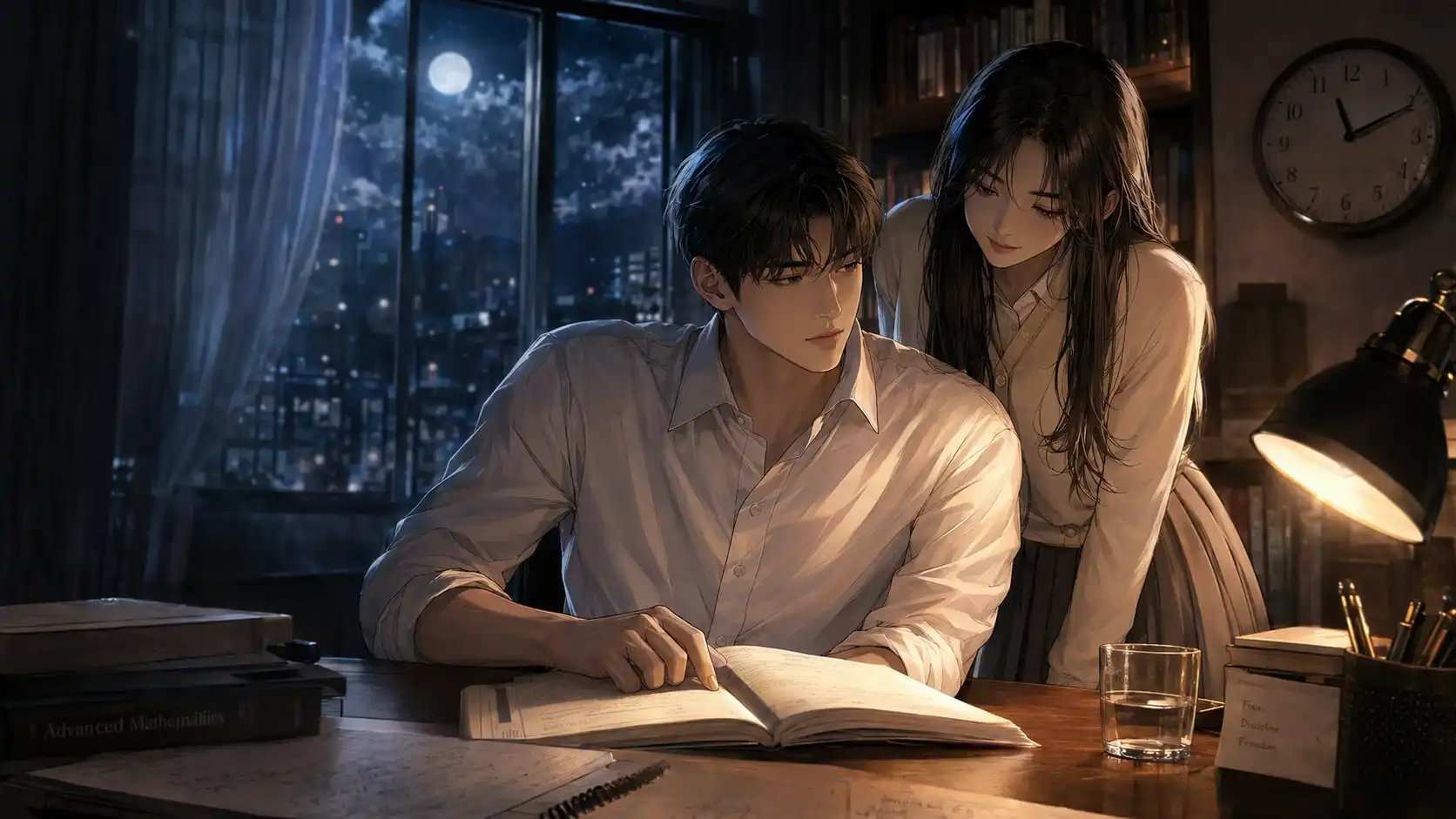
Study-room scenes lean into warm desk-lamp amber against cool blue window light. Public scenes flatten out into neutral daylight. The temperature difference tells you which world a character is currently in before you read a single word.
Late-night sequences use heavy contrast and negative space. It’s cinematic without being show-offy.
Vertical Scroll Paneling
Good webtoon paneling is invisible. This series mostly nails it.
- Long empty gutters are used to stretch a pause before a reveal
- Full-width establishing shots reset the reader between locations
- Stacked reaction crops create a rhythm like quick cuts in film
- Scroll-triggered reveals — a panel that only completes as you keep swiping
That last technique is used sparingly, which is why it lands. Overused, it becomes a gimmick.
Where the Art Slips
Backgrounds are inconsistent. Interior sets are detailed; exteriors and crowd scenes often go soft or get replaced with gradient washes.
There’s also visible fatigue in some later chapters — a common reality of weekly webtoon production schedules.
Mature Themes Review: What You’re Actually Signing Up For
Let’s be direct. This is an adult title and the mature content is central, not incidental.
But there’s a meaningful difference between adult manhwa that’s only adult content and adult manhwa that uses it as characterisation. This one leans toward the second category, especially after the midpoint.
Themes the series genuinely explores:
- Power imbalance in teacher-student and employer-employee dynamics
- Emotional dependency disguised as convenience
- Secrecy as slow corrosion — the cost of maintaining a lie
- Loneliness in domestic spaces — several characters are surrounded by people and completely isolated
Content warnings prospective readers should know:
- Explicit sexual content throughout
- Significant power-imbalance dynamics
- Emotional manipulation and coercion elements
- Infidelity themes
- Occasional dubious-consent framing in earlier chapters
That last point is the honest sticking point. Some early sequences are framed for titillation in ways the story later treats as serious. Readers sensitive to those dynamics should approach with that expectation set.
The series does not present itself as a moral document. It presents itself as a messy drama about people making bad decisions, and it’s better when it commits to that.
Featured Snippet: Is the Teach Me First Comic Worth Reading?
Yes — the Teach Me First comic is worth reading if you want an adult manhwa with real narrative structure rather than a loose string of scenes. Its strengths are colour-driven atmosphere, expressive character art and a midpoint tonal shift that adds genuine emotional stakes. Its weaknesses are a passive male lead and underdeveloped supporting characters, so readers who prioritise a proactive protagonist may find the first ten chapters slow.
Arc-by-Arc Reading Guide (No Major Spoilers)
Use this to decide where to commit.
Arc 1 — The Arrangement (Early Chapters)
Setup, tone-setting, and the first boundary breach. Fast, light, heavily reliant on visual comedy.
Verdict: Necessary but the weakest writing in the series. Push through.
Arc 2 — The Cover-Up (Early-Middle)
Logistics of secrecy. Near-misses. The supporting cast gets teeth.
Verdict: Where the series proves it has a plot. Tension peaks here.
Arc 3 — The Fracture (Midpoint)
The tonal pivot. Comedy recedes, consequences land, a key relationship reframes entirely.
Verdict: The best-written stretch. If you only read one arc, read this.
Arc 4 — Fallout (Back Half)
Emotional aftermath, shifting alliances, characters forced into honesty.
Verdict: Strong character work, slower pacing. Divisive among readers.
Ongoing Chapters
The series continues to release, so the ending remains unwritten at time of publishing. Chapter counts vary between hosting platforms due to differing split conventions — don’t panic if your chapter numbers don’t match a forum thread.
How It Compares to Other Tutor-Trope Manhwa
The private-tutor premise is a full sub-genre in Korean adult webtoons. Here’s where this one sits.
Better than average at:
- Colour and lighting direction
- Facial expression range
- Structural plotting across arcs
- Female character differentiation
Average at:
- Dialogue writing
- Comedic timing
- Background art
Below average at:
- Male lead agency
- Supporting cast payoff
- Pacing in the first ten chapters
If you rank adult manhwa purely on art quality, this lands in the upper tier. If you rank on narrative ambition, it’s upper-middle. That combination is rarer than it sounds.
Where to Read the Teach Me First Comic Legally
I’ll say the unpopular thing: use official platforms.
Korean adult webtoons live or die on paid readership. Aggregator sites strip creators of revenue, and they routinely serve mistranslated, mis-ordered or chapter-skipped versions of the exact series you’re trying to follow.
How to find the legitimate release:
- Check major licensed adult webtoon platforms that operate in your region
- Search the original Korean title alongside the English title for better results
- Verify the publisher credit on the title page of chapter one
- Confirm age-verification is required — legitimate 18+ platforms always gate access
Red flags that you’re on a pirate mirror:
- Aggressive pop-up redirects
- Chapters uploaded within hours of Korean release
- No publisher or studio credit anywhere
- Inconsistent translation voice between chapters
Regional licensing for adult titles changes frequently. Availability in your country may differ from a friend’s.
Common Mistakes New Readers Make
Dropping it at chapter five. The opening arc is the weakest. The series has not shown you its hand yet.
Reading it on mobile at low brightness. The colour work is the main artistic achievement. Dim screens flatten the entire lighting design.
Expecting a conventional romance resolution. This isn’t a romance in the structural sense. It’s a drama about entanglement.
Trusting fan chapter numbering. Scanlation splits differ from official releases. Use scene descriptions when discussing plot points online.
Binge-reading the back half. The later arcs are built on slow emotional beats. Binging flattens them.
Frequently Asked Questions
Is the Teach Me First comic finished?
The series is ongoing at time of writing, with chapters releasing on a rolling schedule. No official completion announcement has been made, so treat any “final chapter” listings on aggregator sites with heavy scepticism.
Is Teach Me First a manhwa, manga or webtoon?
It’s a manhwa — a Korean comic. Because it’s published in full-colour vertical-scroll digital format, it’s also correctly described as a webtoon. It is not manga, which specifically refers to Japanese comics.
Is there an anime adaptation?
No. Adult manhwa of this type very rarely receive animated adaptations, and no adaptation has been announced.
Do I need to read anything before this series?
No. It’s a standalone title with no prerequisite reading, shared universe or spin-off dependency.
Is Teach Me First safe to read at work?
Absolutely not. It contains explicit content on the majority of pages. Read it privately.
How long does it take to catch up?
Chapters run roughly 5–8 minutes each. A dedicated reader can reach the midpoint arc in a single evening.
Is the official translation better than fan versions?
Generally, yes. Official translations maintain a consistent character voice across the full run. Fan versions frequently change translators mid-series, which flattens characterisation and creates naming inconsistencies.
The Final Verdict
Teach Me First is a better comic than its premise deserves. The tutoring setup is a Trojan horse — what you actually get is a slow-burn drama about people who keep choosing the option that costs them the most.
The art carries it. That colour scripting, those expression sheets, that restrained use of scroll-triggered reveals — this is a team that understands the vertical format as a medium, not just a delivery method.
The male lead’s passivity will frustrate a chunk of readers, and the supporting cast never fully cashes the cheques it writes. Those are real flaws, not nitpicks.
But the midpoint arc is legitimately good comics writing. It reframes everything before it, and it earns the emotional weight it asks for. In a genre where most titles stop trying after chapter twenty, that’s worth something.
Read it if you want: atmospheric adult manhwa with actual structure, standout colour work, and female characters who get to be complicated.
Skip it if you want: a decisive protagonist, a tidy romance arc, or a story that resolves quickly.
Now I want to hear from you — did the midpoint shift work for you, or did you prefer the tension of the early tutoring chapters? Drop your take in the comments, and tell me which character you think is actually running the whole arrangement.
Bookmark the site and check back weekly. We break down mature manhwa, webtoons and adult comics with full arc guides, art analysis and legal reading directories — no filler, no fluff, no dead aggregator links.