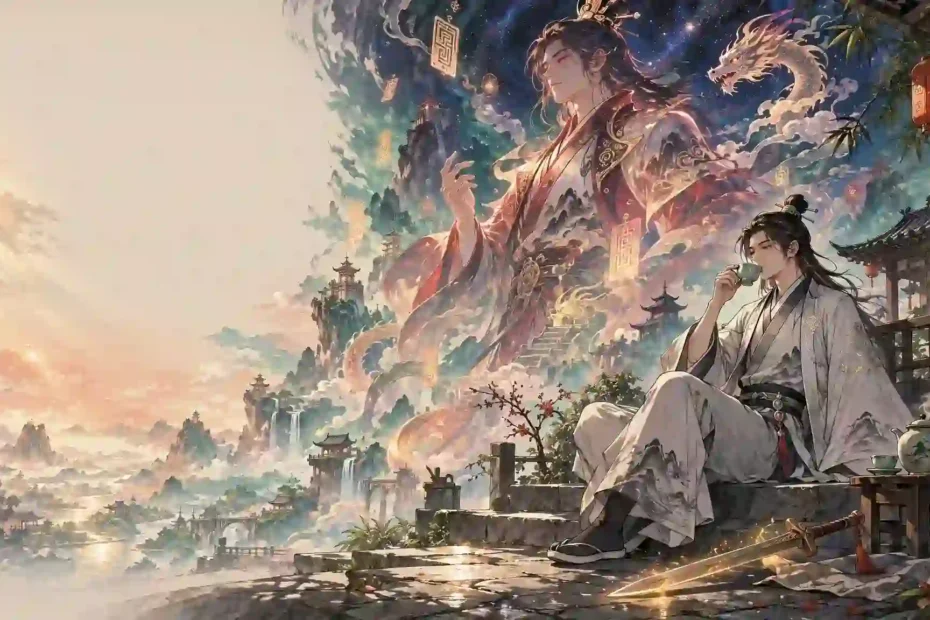
A Cultivation Master Starts A New Account In Another World is a Chinese manhua about a legendary cultivator who grows tired of total power and creates a fresh, weaker identity in a parallel world. He walks in as a beginner, hides his real strength, and discovers that the new world holds secrets his old one never did.
The Hook Nobody Warns You About
You have already won. That is the problem. When a cultivator reaches the top of his world, every fight ends before it starts, every rival bows, and every day feels like a rerun. So he does the one thing no master in his position would consider: he wipes the slate clean.
What Is A Cultivation Master Starts A New Account In Another World?
A Cultivation Master Starts A New Account In Another World follows a man who has mastered his original world’s cultivation system and now wants a challenge he cannot predict. Instead of chasing another peak, he opens a second life in a different reality, one where his fame means nothing and his body starts weak.
The Chinese title, 修仙大佬异世界开小号, translates roughly to “a big-shot cultivator opens a small alt account in another world.” That phrase tells you the whole idea. “Alt account” is gamer language for a spare profile, and the series treats a whole lifetime as that spare profile.
Readers meet three things on page one: a bored god-tier lead, a lower-powered world, and a running joke about how badly a top player handles beginner life. The humor lands because the setup is honest. Anyone who has ever restarted a game on hard mode just to feel something will recognize the impulse.
At a Glance
| Detail | What You Get |
|---|---|
| Full English title | A Cultivation Master Starts A New Account In Another World |
| Original Chinese title | 修仙大佬异世界开小号 |
| Format | Full-color Chinese manhua (webtoon-style vertical scroll) |
| Core genres | Cultivation, action, fantasy, adventure, comedy, martial arts |
| Status | Ongoing with steady chapter drops through 2026 |
| Launch window | Early 2026 |
| Chapter length | Short, typically a two to four minute read |
| Lead character | An unnamed-in-English master hiding extreme power |
| Point of view | Third person, tightly focused on the master and his new identity |
| Tone | Playful, fast, occasionally sharp about ego and boredom |
| Best for | Readers who like overpowered leads, disguise plots, and cultivation satire |
| Weak spot | Short chapters make single-chapter reading feel thin |
Translation groups localize character names differently, so treat any single name list as one version rather than gospel. The premise, the mechanics, and the humor stay consistent across editions.
The Story Premise in Plain Words
The master begins with a decision, not a crisis. He has no rival left worth fighting, so boredom becomes the villain. He chooses a new world the way a wealthy collector chooses a new hobby, then discovers the hobby has teeth.
His new body and new rank put him at the bottom of a ladder he once owned. He cannot simply announce who he is, because that would end the game he came to play. So he conceals his power, learns local rules that differ from his own, and lets people underestimate him.
That gap between what he can do and what he pretends to do drives every scene. A local bully mocks a “nobody,” and readers know the punchline is coming in three panels. The pleasure is not in whether he wins. It is in watching him decide how much to reveal and when.
The twist the synopsis teases matters more than any single fight. Something in this parallel world refuses to behave like a normal training ground. A master who thought he had seen every trick learns he has been reading the wrong rulebook his entire life.
Why the Setup Earns Its Tension
Most overpowered-lead stories create danger by inventing an even stronger enemy. This one creates danger from self-restraint. The master could end a conflict instantly, and every scene asks him to choose patience instead.
That choice produces real stakes. Reveal too much and his quiet experiment collapses. Reveal too little and people he could protect get hurt. Each chapter nudges that dial, which keeps a comedy premise from turning weightless.
Inside the Cast: Who Drives the Story
The cast works as a comedy machine with a serious spine. Each role exists to test the master’s disguise in a different way.
- The Master: A veteran of an entire cultivation ladder. He reads people instantly, and his biggest weakness is impatience with slow, ordinary life.
- The Alt Identity: A weak beginner with a clean record. This is the mask, and the mask keeps slipping in small, funny ways.
- The Local Rivals: Big fish in a small pond. They give readers the satisfaction of watching a loud ego meet a quiet wall.
- The Observers: Sharp-eyed characters who sense something off about the “newbie.” They turn each quiet scene into a guessing game.
- The Protectors: Weaker people the master chooses to shield. They give his power a moral direction instead of a vanity one.
- The Unknown Force: The mystery the synopsis dangles in front of readers. It pulls the plot from comedy toward something bigger.
The master carries the story, but the observers carry the suspense. A scene where two bystanders argue about whether the new guy is hiding something does more narrative work than a chapter of punching.
Character Roles, Not Fixed Names
Because English translations handle names differently, this guide describes each figure by function. That approach also keeps spoilers out of your first read. When you meet a character who feels suspiciously perceptive, you will know exactly which role they fill.
The Power System, Explained Without Jargon Overload
Cultivation stories run on ranks, and newcomers often bounce off the vocabulary. The system here is friendlier than most because the lead already understands it and the story uses his confidence as a teaching tool.
Think of cultivation as a savings account for life energy. You train, you refine qi, you break through to a higher stage, and each stage raises what your body and spirit can hold. Power in this genre is not a lucky gift. It is accumulated work plus a moment of insight.
The twist in A Cultivation Master Starts A New Account In Another World is that the lead owns two ledgers at once. One ledger holds centuries of experience, technique, and mental discipline. The other holds a beginner’s body with almost nothing banked. His knowledge outruns his stamina, and that mismatch creates both comedy and craft.
| Layer | What It Means | Why It Matters Here |
|---|---|---|
| Qi | The raw energy a cultivator refines and stores | The beginner body cannot hold much, so the master must ration it |
| Realm or stage | A ranked tier of power marked by breakthroughs | Local stages look familiar but behave differently in this world |
| Technique | Learned methods for using qi in combat or healing | The master knows advanced forms, yet his vessel limits output |
| Foundation | The quality of the base a cultivator builds | His old foundation does not transfer, so he rebuilds better than anyone |
| Insight | The mental leap that unlocks a breakthrough | Experience gives him an unfair advantage at every bottleneck |
| Concealment | Hiding one’s true realm from other cultivators | This is the mechanic the entire plot leans on |
The Rule That Keeps Fights Interesting
Every strong cultivator story needs a cost, or fights become noise. Here the cost is exposure. Spending real power risks blowing his cover, so the master fights with precision, misdirection, and the smallest possible effort.
Watching an expert solve problems with minimal force is more satisfying than watching raw numbers go up. It also keeps an overpowered lead from flattening the plot. When a character can win any fight, the interesting question becomes who he protects and what he refuses to show.
How the “Alt Account” Mechanic Changes Everything
The alt-account idea is the series’ best invention, and it does more than supply jokes. It reframes the entire cultivation genre’s obsession with rank.
Classic cultivation fiction treats rank as identity. You are your realm. People bow or sneer based on a number. This series pulls that number away from the master and asks what is left of him. The answer is a personality built over centuries, and that personality is needier than he expected.
His disguise also creates a rare kind of tension in the genre. Readers know the truth, the world does not, and every social scene becomes a small heist. A polite introduction carries more suspense than a duel because one wrong instinct can end the mask.
The Gamer Metaphor, Used With Care
“New account” is a gaming phrase, and the story leans on it without becoming a video game. There are no stat screens or level-up menus here. The metaphor works as shorthand for starting over with knowledge intact, which is exactly what makes the premise sting.
That stinging quality is the point. A fresh account is fun for an evening and lonely by the end of the week. The master’s new life gives him something his old one lacked, and the series slowly uncovers what that something costs.
A Chapter-by-Chapter Reading Order That Saves Time
Chapters run short, so batching them improves the experience. A single chapter often ends mid-beat, which feels choppy on its own but flows when read in groups.
- Chapters 1 to 3: Read together. They set the boredom, the jump, and the new-world rules in one sitting.
- Chapters 4 to 8: Read in pairs. The disguise starts meeting friction, and the local hierarchy comes into focus.
- Chapters 9 to 14: Read in threes. Antagonists escalate, and the master begins bending the rules of his new body.
- Chapters 15 to 20: Read in fours. The mystery from the synopsis moves from background to foreground.
- Beyond chapter 20: Follow the release schedule. The arc structure rewards fresh chapters read the day they drop.
Track your progress with a series database like AniList or MyAnimeList so you never lose your place when a translation group changes hosts. A simple reading log works just as well.
Reading Rhythm That Matches the Medium
Full-color vertical manhua rewards momentum. Set aside fifteen to twenty minutes and clear three or four chapters. The art carries jokes that land better when panel rhythm stays unbroken, and the cliffhangers feel like pacing rather than teasing.
Genre Blend: Why Cultivation Meets Comedy Here
A Cultivation Master Starts A New Account In Another World stacks genres on purpose. Cultivation supplies structure and stakes. Comedy supplies oxygen. Adventure supplies movement. Martial arts supplies the physical set pieces readers came for.
The mixture solves a common genre problem. Straight cultivation stories often drown in training arcs. Comedy lets the series skip grind while keeping the growth. Straight comedy often loses stakes. Cultivation keeps a threat on the table.
Readers who usually avoid the genre because of endless tournament arcs will find this one easier to enter. Readers who love dense power scaling might find the comedy an adjustment. Both groups get something they rarely get together: a lead who is genuinely strong and genuinely unsure of himself.
Where the Humor Comes From
The jokes here are situational, not random. Most come from a mismatch between the master’s instincts and a beginner’s circumstances. He reaches for a technique he can no longer support or answers a question with knowledge no novice should have.
That style of humor ages well. It does not depend on dated references or shock gags. It depends on character, which means it still works on a reread.
Themes That Give the Series Its Weight
Strip away the fights and the disguise, and this is a story about what a person does after reaching the finish line. That question gives the series its staying power.
- Boredom as a real enemy: The master’s problem is not weakness but sameness. Repetition can hollow out a life even when that life looks perfect from outside.
- Identity beyond rank: When the number disappears, character remains. The series keeps testing whether the master likes who he actually is.
- The ethics of hidden power: Watching someone choose restraint raises a real question about responsibility. If you can help and you stay quiet, what does that cost?
- Second chances without erasure: A new account is not a new soul. The master carries every habit and harm from his first life into the second.
- Ego in a mask: Concealment changes how a person hears praise. The comedy sharpens into insight when the master notices he misses being seen.
The Most Human Thread
The strongest thread is loneliness dressed as adventure. A master with no equal has no one to talk to honestly. His new identity creates the possibility of real relationships, and that possibility terrifies him more than any enemy.
Where the Series Sits in the 2026 Manhua Lineup
Cultivation manhua in 2026 leans hard on overpowered leads and system mechanics. A Cultivation Master Starts A New Account In Another World stands apart through restraint. It gives readers a strong protagonist and then asks him to act weak.
That choice fits a broader shift in reader taste. Audiences reward stories where power has a cost and where humor comes from character rather than from chaos. A lead who wins easily but suffers socially feels fresher than a lead who simply wins.
The series also benefits from its format. Vertical color manhua travels well on phones, which suits short attention windows and quick rereads. Readers who discover it through a single chapter can catch up in an evening.
| Reader Type | Fit | Why |
|---|---|---|
| New to cultivation | Strong | The lead explains the world from the inside without lectures |
| Veteran genre fans | Strong | The disguise mechanic twists familiar tropes |
| Comedy-first readers | Good | Humor is constant but never random |
| Readers who want long chapters | Weak | Chapters are short |
| Readers who want romance focus | Weak | The plot prioritizes growth and mystery |
| Binge readers | Strong | Short chapters stack into fast progress |
How It Compares to Similar Cultivation Series
Every reader arrives from somewhere else, so comparison saves time. The table below maps this series against the kinds of stories people usually read before finding it. It compares categories, not titles, so no spoilers leak in.
| Story Shape | Lead’s Starting Power | Main Tension | Reading Feel |
|---|---|---|---|
| This series’ alt-account setup | Extremely high, hidden | Exposure and boredom | Playful with a mystery spine |
| Classic rise-from-weakness | Very low | Survival and growth | Grinding, steady escalation |
| Reincarnation into a new body | Mixed | Adapting old knowledge to new rules | Strategic and curious |
| System-driven leveling | Low, boosted by rewards | Optimization and quotas | Fast, numbers-forward |
| Tournament-focused cultivation | Mid-tier | Ranking up through brackets | Competitive and repetitive |
The closest experience is a reincarnation story where the hero keeps his memory but loses his strength. The difference sits in motive. Most reincarnation leads want to survive or return. This one wants to feel something again, which is a stranger and more interesting goal.
Who Should Read It and Who Should Skip It
Honesty helps here. No series fits everyone, and a clear picture beats a hype paragraph.
Read it if you enjoy a competent lead who hides his cards, jokes that come from character, and mysteries that build slowly under a light surface. Read it if you like watching a system get quietly outsmarted.
Skip it if you need long chapters with heavy prose, if hidden-identity plots frustrate you, or if you want a lead who struggles physically from chapter one. Skip it too if comedy in the middle of a fight disrupts your immersion.
The Test Chapter
Give the first three chapters a fair run. They are short, and they show the premise, the world, and the humor in miniature. If the third chapter does not make you smile at least once, the series is not your shape.
A Reader’s Checklist for a Clean, Safe Reading Session
Manhua fans spend real time on aggregator sites, and some of those pages carry aggressive ads. A few habits protect your device and your eyes.
- Turn on a reputable ad blocker before opening unfamiliar readers.
- Avoid any page that demands payment or a login for “verification.”
- Check a series database for the current chapter list instead of trusting a random mirror.
- Use an official or well-established platform whenever the publisher offers one.
- Keep your browser updated, and close tabs that trigger surprise downloads.
- Never install a “reader extension” pushed by a pop-up.
Respect the Creators
The original Chinese team earns nothing from unlicensed mirrors. Support official channels where they exist, and share the series by name rather than by pirated mirrors. Good series continue when readers fund the people making them.
Cultivation Glossary for New Readers
Cultivation fiction carries its own vocabulary, and a short glossary removes the friction. These terms appear across the genre and shape how this story reads.
| Term | Meaning |
|---|---|
| Cultivation | The practice of refining body and spirit to extend life and power |
| Qi | The energy a cultivator gathers, refines, and spends |
| Realm | A ranked tier of cultivation achievement |
| Breakthrough | The moment a cultivator advances to the next realm |
| Foundation | The quality of the base built in early stages |
| Dao | A path or principle a cultivator follows and deepens |
| Tribulation | A dangerous trial that tests a cultivator before advancement |
| Sect | An organized school or faction that trains cultivators |
| Pill refining | Crafting medicine that supports training and healing |
| Concealment | Techniques for hiding true strength from observers |
| Alt account | A secondary profile, borrowed here as a metaphor for a second life |
| Face | Social standing and the cost of losing it publicly |
Myths and Misreads Worth Dropping
Misinformation about this title spreads fast because many sites recycle identical blurbs. Clearing three common misconceptions saves readers from wrong expectations.
Myth one: it is a litRPG with stat screens. It is not. The “new account” language is a metaphor, and the story never adopts game interfaces.
Myth two: the lead is weak and grows slowly. He is strong on arrival. The drama comes from hiding that strength, not from acquiring it.
Myth three: it is pure comedy with no plot. The comedy is real, but an ongoing mystery pulls the story forward. Readers who stay for jokes find a plot waiting.
Why These Misreads Happen
Aggregator pages copy one another, and short synopses flatten nuance. The original Chinese description is barely a sentence long, which invites guesswork in translation. Reading three chapters resolves more confusion than reading ten reviews.
What to Watch for in Future Chapters
The premise sets up several promises, and how the series pays them off will decide its ceiling. These are the threads worth tracking.
- The nature of the parallel world. The synopsis hints that the master’s discovery changes his plan. That payoff deserves real weight, not a throwaway reveal.
- The first genuine threat. A hidden master eventually meets something his experience cannot solve. That moment defines the series.
- The relationships he builds. Real bonds make the disguise cost something. Watch whether those bonds deepen or stay decorative.
- The moral line. Every hidden-power story must decide how much suffering the hero tolerates. That choice shapes his character.
- The return question. Does he ever go back, and would he want to? The answer could reframe everything before it.
How to Judge the Arc
A good test is re-read value. If the early chapters still land after the mystery resolves, the writer built something durable. If they only worked as setup, the series will feel thinner on a second pass.
Frequently Asked Questions
Is A Cultivation Master Starts A New Account In Another World finished or ongoing?
It is ongoing. New chapters have arrived steadily through 2026, and chapter counts differ slightly by platform because translation groups publish at different speeds. Check a series database for the most accurate list before you binge.
What is A Cultivation Master Starts A New Account In Another World about?
A legendary cultivator grows bored with unmatched power and creates a second identity in a parallel world. He hides his true strength, lives as a beginner, and uncovers a mystery that his original world never prepared him for.
Do I need to know cultivation novels to enjoy it?
No. The lead already understands the system, so the story explains rules through his choices instead of lectures. A short glossary covers the vocabulary, and the comedy works even if you have never read a cultivation story.
How many chapters of A Cultivation Master Starts A New Account In Another World are out?
Multiple scans list more than twenty chapters as of late 2026, with the exact number shifting as new entries drop. Vertical color manhua chapters run short, so twenty chapters take roughly an hour to read.
Is A Cultivation Master Starts A New Account In Another World safe for younger readers?
It is a martial arts fantasy with stylized combat and no graphic gore in most editions. Parents should still preview a few chapters, since scanlation sites carry intrusive ads that have nothing to do with the story.
Where can I read A Cultivation Master Starts A New Account In Another World legally?
Check the publisher’s official platform for your region first, then any licensed app that carries Chinese manhua. Series databases list official sources alongside community chapters, which makes them a reliable first stop before you search elsewhere.
Your Next Move
You now have the premise, the cast structure, the power system, the reading order, and the traps to avoid. Everything else lives in the panels, and no summary beats the moment a beginner says something no beginner should know.
Open the first chapter today and read three in a row. Then decide whether the master’s quiet experiment earns your attention, and share this guide with the friend who keeps asking what “alt account cultivation” even means.
Great stories spread through readers who talk about them. Read it, judge it honestly, and pass the recommendation along with the source that deserves your support.