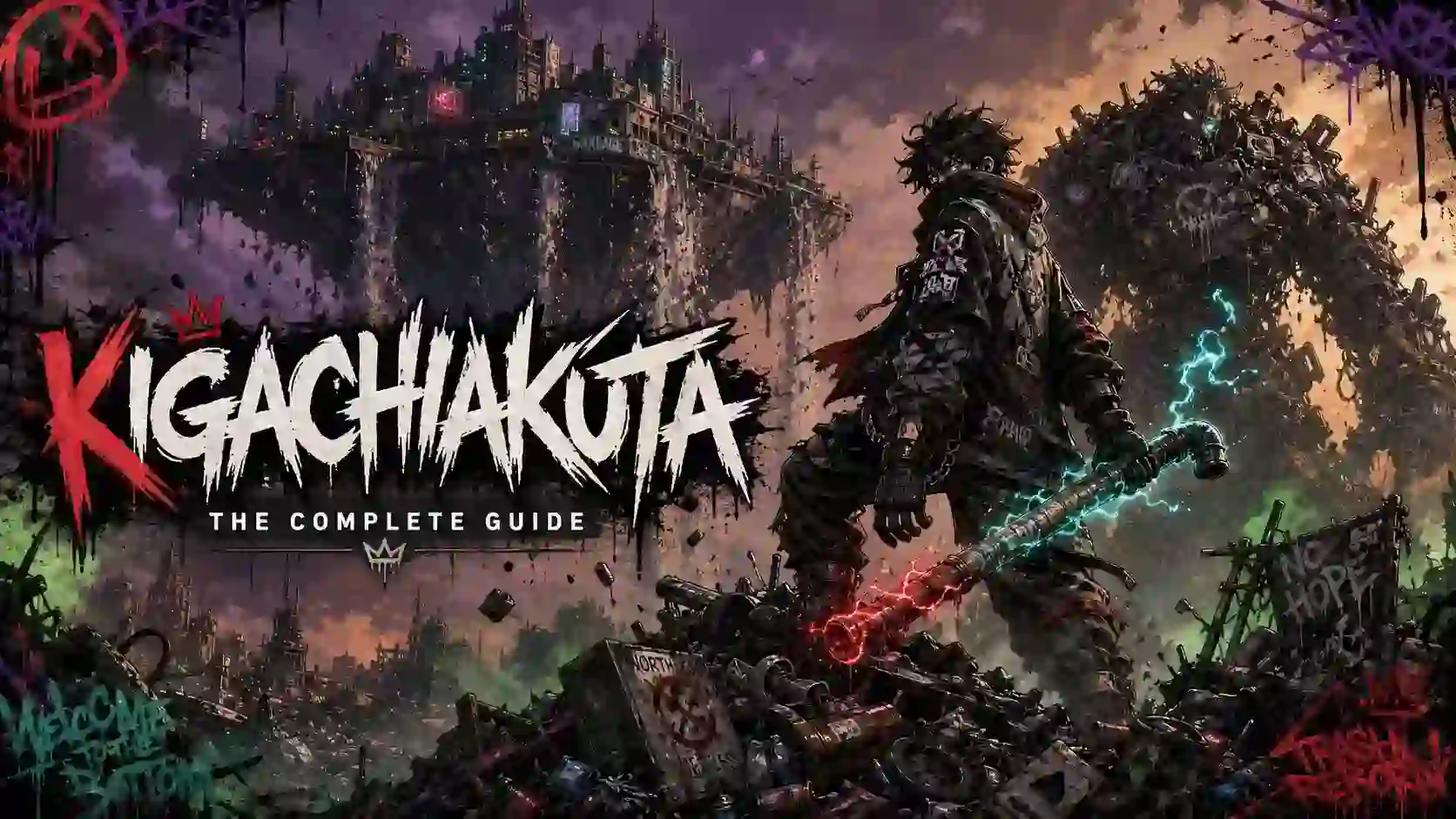
You heard friends rave about an anime full of trash monsters and graffiti fights, so you typed kigachiakuta into Google. Then you hit old dates, spoilers, and fan rumors that made the series feel harder to start than it should be. This guide fixes that. You get the story, the world rules, the cast, every legal way to watch and read, and the real Season 2 status, all checked against official sources.
What Is Kigachiakuta? The Quick Answer
Kigachiakuta is the spelling many people type when they search for Gachiakuta, the dark fantasy manga by Kei Urana and its hit anime from Bones Film. The story follows Rudo Surebrec, a slum kid framed for murder and thrown into a giant garbage pit below his floating city. Down there, he learns that loved objects carry power, and he learns to fight with them.
The manga launched in Kodansha’s Weekly Shōnen Magazine on February 16, 2022. The anime aired 24 episodes from July to December 2025, and a second season is in production.
Here is the short version for busy readers:
- Format: Manga (ongoing, 19 volumes in Japan) and TV anime (24 episodes so far)
- Genre: Dark fantasy, action, dystopian
- Core hook: Trash becomes treasure, and treasure becomes a weapon
- Perfect for: Fans of Fire Force, Soul Eater, Chainsaw Man, and Dorohedoro
Why Do People Search “Kigachiakuta” Instead of “Gachiakuta”?
The official title is ガチアクタ, written in English as Gachiakuta. The kigachiakuta spelling pops up from fast phone typing, voice assistants mishearing the name, or fans blending words together. Google reads the intent behind both spellings and points them to the same series.
The real name carries a clever meaning. “Gachi” is Japanese slang for “for real” or “serious,” and “akuta” (芥) means rubbish or dust. Together, the title reads roughly as “legit trash.”
That title works as a mission statement. Society treats Rudo like garbage, and he spends the story proving that thrown-away people and things hold real value.
Kigachiakuta at a Glance: Key Facts Table
Bookmark this table. It answers the questions fans ask most, in one place.
| Detail | Information |
|---|---|
| Official title | Gachiakuta (ガチアクタ) |
| Common search spelling | Kigachiakuta |
| Title meaning | Roughly “Legit Trash” |
| Story and art | Kei Urana |
| Graffiti designs | Hideyoshi Andou |
| Japanese publisher | Kodansha |
| English publisher | Kodansha USA |
| Magazine | Weekly Shōnen Magazine |
| Serialization start | February 16, 2022 |
| Japanese volumes | 19 (Volume 19 released July 16, 2026) |
| English volumes | Volume 12 released September 22, 2026; Volume 13 due November 24, 2026 |
| Manga status | On hiatus since August 2026, return date not yet announced |
| Anime studio | Bones Film |
| Director | Fumihiko Suganuma |
| Series composition | Hiroshi Seko |
| Character design | Satoshi Ishino |
| Music | Taku Iwasaki |
| Season 1 broadcast | July 6 to December 22, 2025 (24 episodes, two straight cours) |
| Streaming | Crunchyroll (most regions), Ani-One Asia (Southeast Asia) |
| US TV broadcast | English dub on Adult Swim’s Toonami starting October 2026 |
| Season 2 | Confirmed, premiere date not yet announced |
| Video game | Gachiakuta: Breakout (PS5, Xbox Series X and S, PC), planned for 2027 |
| Top awards | 50th Kodansha Manga Award (Shōnen, 2026); Best New Series at the 2026 Crunchyroll Anime Awards |
Who Created Gachiakuta? Meet Kei Urana and Hideyoshi Andou
Kei Urana writes and draws the manga. Before her solo debut, she worked as an assistant to Atsushi Ohkubo, the creator of Soul Eater and Fire Force, and Ohkubo has publicly recommended her series. You can spot that lineage in the bold linework, the street-punk fashion, and the explosive fight pages.
Urana has shared two childhood memories that shaped the story. As a kid, she snapped a pen she loved and felt as if the pen was pleading with her. She also noticed the plain hangers that came back with her grandmother’s dry cleaning, ordinary objects with a quiet usefulness that nobody thought about.
Those moments grew into the big idea behind the series: objects soak up the feelings of the people who care for them. Every power system rule in the story flows from that single, very human memory.
Hideyoshi Andou designs the graffiti that covers walls, clothes, and battle scenes. His work is not background decoration. Graffiti marks territory, tells stories, and even powers spells in certain towns, so his art carries real story weight.
What Is Gachiakuta About? A Spoiler-Light Plot Summary
Rudo Surebrec lives in the slums on the edge of the Sphere, a floating city split by class. His foster father, Regto, raised him after Rudo’s birth father was executed as a killer. Rudo spends his days digging through dumps and rescuing perfectly good items the rich toss away.
One evening, Rudo comes home to find Regto attacked by a masked stranger. The authorities arrest Rudo on the spot because of his tribesfolk background. The crowd jeers as guards throw him into the Pit, a punishment everyone treats as certain death.
Rudo survives the fall. He wakes in an endless sea of garbage, monsters made of trash attack him, and a relaxed fighter with an umbrella named Enjin saves his life. Enjin awakens Rudo’s hidden power and recruits him into the Cleaners, a group that hunts these trash monsters.
Rudo agrees, but only because joining brings him closer to revenge on the people who framed him. From there, the story grows from a revenge tale into a mystery about the border between two worlds, the giant Watchman who guards it, and why society throws away people and things so easily.
How Does the World of Gachiakuta Work?
The setting has its own vocabulary. Learn these terms once, and every episode becomes far easier to follow.
- The Sphere (Tenkai): A floating, country-sized city. The wealthy live in the center, while the poor tribesfolk live behind a guarded wall on the outskirts.
- Tribesfolk: Descendants of criminals. The upper class treats them with open contempt.
- The Pit: The name Sphere residents give the land below. They dump trash and convicted criminals there.
- The Ground (Gekai): The name locals use for that same land. Whole towns and cultures live there, polluted but very much alive.
- Trash Beasts (Han-jū): Monsters born from garbage and built-up emotional energy. They regenerate, so normal weapons fail against them.
- Anima (Shinen): The energy of thoughts and feelings that collects inside objects.
- The Watchman: A huge, mysterious being that patrols the border between the Sphere and the Ground.
The central irony hits hard. The Sphere sees the Ground as a dead dump, yet the Ground holds most of the story’s warmth, loyalty, and courage. The “trash” turns out to be where real life happens.
What Are Vital Instruments and Givers?
A Giver is a person who can pour Anima into an object they love and turn it into a weapon called a Vital Instrument (Jinki). Only Vital Instruments can destroy Trash Beasts. That makes Givers the front line of defense on the Ground.
The rules are simple and smart:
- The object must matter to its owner. Love and care unlock the power.
- The longer someone treasures an item, the stronger it grows.
- The weapon reflects its owner’s personality and life story.
- Everyday items work best: umbrellas, scissors, gloves, glasses, and even a pacifier.
The rarest tier belongs to the Watchman Series, a set of exceptionally strong instruments linked to the Watchman. Users usually need to have lost something deeply important to wield one without breaking mentally.
Rudo carries one of these. His gloves, called 3R, were a gift from Regto, and they let him turn discarded junk into weapons on the fly. It fits perfectly for a boy who always believed thrown-away things deserved a second chance.
This system is what makes the series feel fresh. In most battle shōnen, power comes from bloodlines or training arcs. Here, it comes from affection for objects, so every fight doubles as a small character study.
Who Are the Main Characters in Kigachiakuta?
The cast is loud, strange, and lovable. Here are the key players you meet in Season 1, with their weapons and voice actors.
| Character | Role | Vital Instrument | Japanese Voice | English Voice |
|---|---|---|---|---|
| Rudo Surebrec | Framed hero and rookie Cleaner | 3R gloves (Watchman Series) | Aoi Ichikawa | Bryson Baugus |
| Enjin | Rudo’s mentor and Team Akuta leader | Umbreaker (umbrella) | Katsuyuki Konishi | Christopher Wehkamp |
| Zanka Nijiku | Proud, highly skilled Cleaner | Lovely Assistaff (staff) | Yoshitsugu Matsuoka | Corey Wilder |
| Riyo Reaper | Cheerful fighter with a shadowy past | The Ripper (scissors) | Yumiri Hanamori | Katie Caruso |
| Amo Empool | The Lady of Penta | Watchman boots | Kana Hanazawa | Celeste Perez |
| Arkha Corvus | Boss of the Cleaners | Foresight-type instrument | Rikiya Koyama | Gabe Kunda |
| Semiu Grier | Cleaners receptionist | Eyes (glasses) | Mie Sonozaki | Kenneisha Thompson |
| Delmon Gates | Loud, big-hearted Team Eager member | Thirst Quencher | Masami Iwasaki | Brent Mukai |
| Tamsy Caines | Calm senior of Team Eager | Tokushin (distaff) | Mitsuki Saiga | Adam Gibbs |
| Guita Hebby Fantasia | Wild member of Team Child | Kaiju onesie | Maria Naganawa | Lara Woodhull |
Rudo starts angry and stays angry for a while, and that honesty makes him easy to root for. His growth comes from learning who deserves his rage and who deserves his trust.
Enjin plays the cool mentor, but the story slowly peels back his own painful history. Zanka begins as Rudo’s rival and becomes one of his best partners, which gives the series its most satisfying friendship.
Riyo brings comic energy and terrifying speed in equal measure. Amo enters as one of the most unsettling characters in Season 1, and her arc lands with real emotional force.
How Good Is the Gachiakuta Anime by Bones Film?
The staff list reads like an all-star roster. Hiroshi Seko, who handled series composition for Chainsaw Man and the first season of Jujutsu Kaisen, shaped the scripts. Taku Iwasaki, the composer behind the Soul Eater soundtrack, delivered a heavy, hip-hop-flavored score.
Satoshi Ishino designed the characters and served as chief animation director. Fumihiko Suganuma directed the series for Bones Film.
Season 1 ran 24 episodes with no mid-season break, from July 6 to December 22, 2025. Before the TV debut, a world premiere screening in Shinjuku on July 4, 2025, kicked off “Gachiakuta: World Takeover” screenings across more than 15 countries.
The visual style stands out instantly. Thick, ink-like outlines, painted graffiti overlays, and grimy backgrounds keep the manga’s street-art energy alive in motion. That background work earned Best Background Art at the 2026 Crunchyroll Anime Awards.
The music deserves its own spotlight:
- Opening 1: “HUGs” by Paledusk
- Ending 1: “Tomoshibi” by DUSTCELL
- Opening 2: “Let’s Just Crash” by Mori Calliope
- Ending 2: “Ban” by Karanoah
Episode 24, titled “Field Trip,” matches chapter 85 of the manga, which closes Volume 10. That detail matters if you plan to keep reading, and the section below covers it.
Where Can You Watch and Read Kigachiakuta Legally?
Official platforms give you the best translation, the best video quality, and direct support for the people who make the show. Additionally, they provide unambiguous signs of demand that aid in the production of upcoming seasons.
Where to watch the anime:
- Crunchyroll: The main global streaming home, with subtitles and multiple dubs.
- Ani-One Asia: Medialink’s official YouTube channel for viewers in Southeast Asia.
- Adult Swim’s Toonami (United States): The English dub joins the block in mid-October 2026.
Where to read the manga:
- Kodansha USA: Official English print and digital volumes, sold through major bookstores and licensed ebook stores.
- Weekly Shōnen Magazine: Kodansha’s original Japanese chapters.
Availability changes by country, so check the Crunchyroll catalog in your region before you start. For accurate translations of the slang-heavy conversation, readers outside of Japan should stay with the Kodansha USA versions.
Where Should You Start the Manga After the Anime?
Go to Chapter 86 of Volume 11, “Contact.” Volume 11 begins exactly where the screen story ends, since chapter 85 is adapted in the anime’s final episode.
Kodansha USA released the English edition of Volume 11 on July 21, 2026, and Volume 12 followed on September 22, 2026. Japanese readers can go much further, since Volume 19 arrived on July 16, 2026.
A quick tip from the reading side: Volume 1 still rewards anime fans. The manga includes small details, author notes, and graffiti panels that the show trims for pacing.
Here is a simple reading plan:
- Finished the anime and want more now? Start at Volume 11.
- Want a refresher first? Reread the last half of Volume 10.
- Want the full creator experience? Start at Volume 1 and enjoy the extras.
Is Gachiakuta Season 2 Coming? The Latest Status
Yes. The production team confirmed a second season right after the Season 1 finale in December 2025. Crunchyroll then held an exclusive first look at Anime Expo on July 3, 2026, and confirmed the new season will stream on its platform.
As of October 11, 2026, no official premiere date exists. Any exact date you see on social media without an official announcement behind it is a guess, not news.
Story-wise, Season 2 continues from the manga’s Volume 11 material. The official Gachiakuta anime website and Crunchyroll’s news channels remain the fastest places to catch the real date when it drops.
Why Is the Gachiakuta Manga on Hiatus?
Weekly Shōnen Magazine published the most recent chapter in its combined issue 36 and 37, which shipped on August 5, 2026. Since then, the magazine has listed the series as on break so Kei Urana can carry out research for the story.
On September 8, 2026, Kodansha’s official Weekly Shōnen Magazine account confirmed the hiatus continues and stated it will announce the return once a date is decided. The series has not been cancelled.
Weekly manga schedules are brutal, and research breaks often protect story quality. For new fans, this pause is the perfect window to catch up on all 19 volumes before fresh chapters arrive.
What Awards Has Gachiakuta Won?
The series has piled up honors on both the manga and anime side. These wins show that critics, industry judges, and everyday readers all connect with it.
- 50th Kodansha Manga Award (2026): Winner in the Shōnen category, after nominations in 2023 and 2024.
- 10th Crunchyroll Anime Awards (2026): Best New Series, Best Background Art, and Best Character Design for Satoshi Ishino.
- Japan Expo Awards: Daruma for Best Anime and Daruma for Best Action Anime.
- 21st AnimaniA Awards: Best TV Series: Online.
- The New York Times: Volume 1 appeared on the Graphic Books and Manga monthly bestseller list from February to July 2026.
- Circana BookScan: Gachiakuta reached No. 1 on the US adult graphic novel list for January 2026.
- 2022 Next Manga Award: 13th place in print manga, and the top choice among English-speaking voters before any official English release existed.
That last point says a lot. Readers around the world championed this series before a single official English page hit shelves.
Beyond the Anime: Video Game, Stage Play, and More
The franchise is growing well past manga and TV. Two big projects stand out.
- Com2uS Group’s role-playing game Gachiakuta: Breakout was revealed in December 2025 for the PlayStation 5, Xbox Series X and S, and PC via Steam. The current target is 2027.
- The stage play: A live adaptation ran at Stellar Ball in Tokyo in May 2026 and at Rohm Theater Kyoto in June 2026. Go Ueki directed, and rapper KEN THE 390 led the music direction, a natural fit for a story soaked in hip-hop culture.
Expect merchandise, art books, and collaboration events to keep expanding as Season 2 approaches. Follow the official channels so you can tell genuine releases from knockoffs.
What Themes Make Gachiakuta Stand Out?
Plenty of action series look great. Few say as much as this one does about the world we live in.
- Waste and consumerism: The Sphere throws away new, working items without a second thought. The narrative challenges readers to examine their own routines.
- Class and prejudice: Rudo gets convicted for his background, not for evidence. The series shows how labels turn into punishment.
- Grief and attachment: Love and loss are the sources of vital instruments. Every weapon is a memory someone refused to let go.
- Found family: The Cleaners are misfits who choose each other. Their bond gives the dark world its warmth.
- Graffiti is a kind of art as resistance, allowing the weak to make their imprint. It turns walls into voices.
These themes give the series staying power. You finish an episode thinking about the fight, and then you find yourself thinking about the old jacket in your closet you could never throw out.
Is Kigachiakuta Right for You?
This series suits teens and adults. It includes graphic violence, death, abuse themes, and harsh language, so younger kids should skip it.
You will likely love it if you enjoy:
- Street-art style visuals with heavy ink and bold color
- Underdog heroes with real anger and real growth
- Creative power systems instead of plain strength contests
- Mysteries that unfold slowly across arcs
- Hip-hop and rock soundtracks
If those boxes check out, these related titles make great companions:
- Fire Force: From Urana’s former mentor, Atsushi Ohkubo, with a similar firefighting-team setup.
- Soul Eater: Also by Ohkubo, with weapon partners and gothic style.
- Chainsaw Man: Raw, punk energy and an outsider hero, with Hiroshi Seko on the anime scripts.
- Dorohedoro: Grimy, weird, funny, and violent in a similar spirit.
- Jujutsu Kaisen: Team-based monster hunting with high emotional stakes.
Beginner’s Roadmap: Start Kigachiakuta in 5 Easy Steps
New fans often freeze at the starting line. Follow this path and you will go from curious to caught up without spoilers.
- Watch episodes 1 to 3 on Crunchyroll. The fall into the Pit and the first Cleaner fights show you exactly what the series offers.
- Keep this guide’s world terms handy. Sphere, Ground, Givers, and Vital Instruments click fast once you know them.
- Finish all 24 episodes. The second half, with Amo’s arc and the Raiders, raises the stakes sharply.
- Switch to the manga at Volume 11. Pick up chapter 86 and keep going.
- Follow official channels for Season 2. Check the official anime website, Crunchyroll, and Kodansha for verified news.
Frequently Asked Questions About Kigachiakuta
What is kigachiakuta?
Kigachiakuta is a common search spelling for Gachiakuta, Kei Urana’s dark fantasy manga and its Bones Film anime. The story follows Rudo, a framed boy thrown into a trash-filled pit who learns to fight with loved objects.
How many episodes does Gachiakuta Season 1 have?
Season 1 has 24 episodes. It aired without a break from July 6 to December 22, 2025, and streams on Crunchyroll.
Is Gachiakuta Season 2 confirmed?
Yes, Season 2 is confirmed, but it has no premiere date yet. Crunchyroll showed a first look at Anime Expo on July 3, 2026, and will stream the new season.
Is the Gachiakuta manga finished?
No, the manga is still ongoing. It has 19 Japanese volumes and has been on a research hiatus since August 2026, with Kodansha promising to announce its return.
Which manga volume continues the anime?
Start with Volume 11, chapter 86. The anime’s last episode adapts chapter 85, which ends Volume 10.
Is kigachiakuta suitable for kids?
No, it fits teens and adults better. The series shows graphic violence, death, and abuse themes that younger viewers may find disturbing.
Your Next Step: Jump Into the Pit
Kigachiakuta is far more than a typo that leads to a cool anime. It is a story about seeing worth where others see garbage, told with brilliant art, a fierce soundtrack, and characters you will not forget.
So take the leap. Stream episode 1 tonight, grab Volume 11 when the finale leaves you hungry, and save this guide for the moment the Season 2 date drops.
Now tell us in the comments: if you were a Giver, which everyday object would become your Vital Instrument, and why?