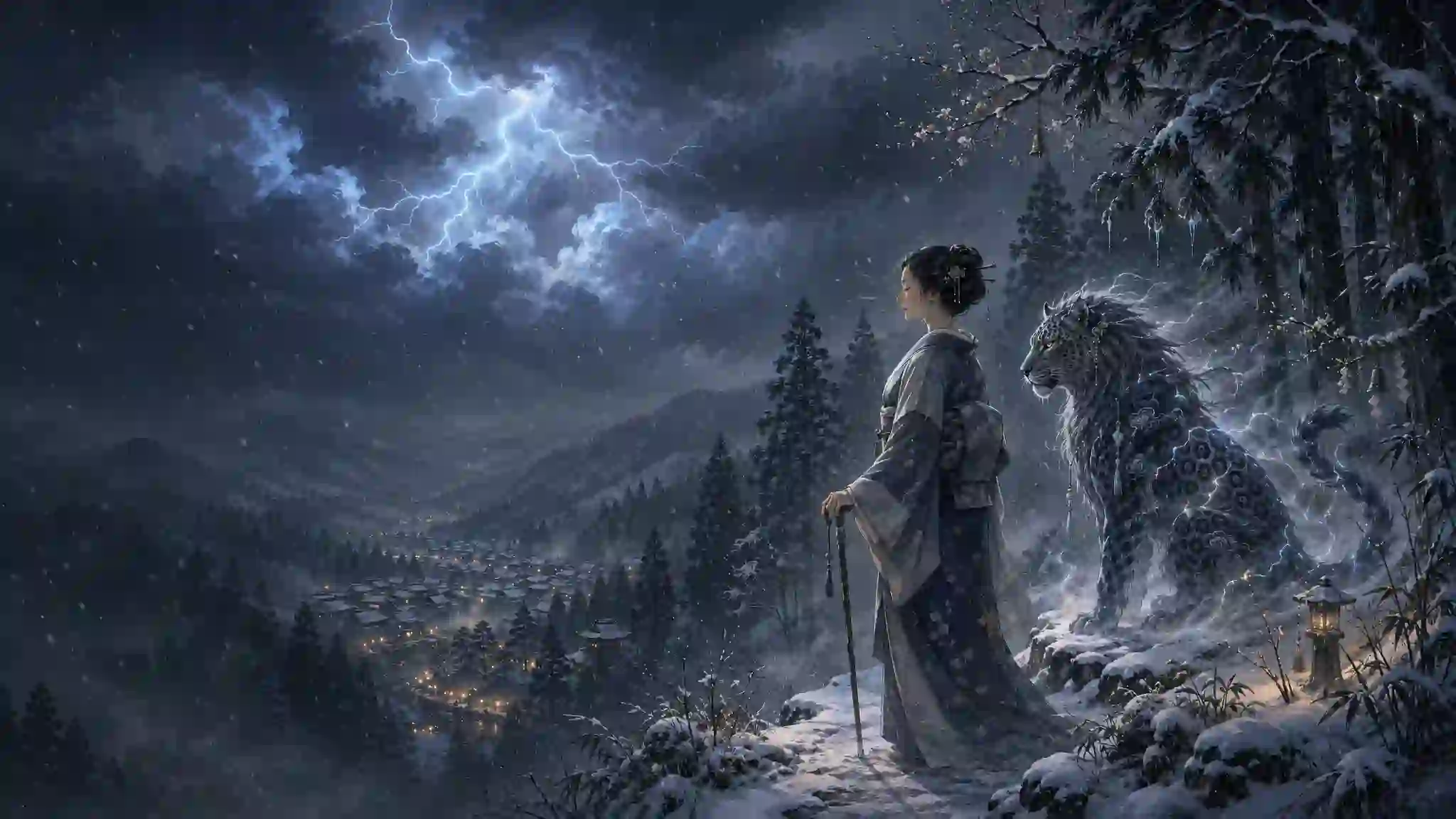
Searching for Raimei to Zansetsu can lead to mixed title spellings, fan summaries, and vague warnings that hide what readers actually need to know. That matters because this is a self-contained R18 manga, not an all-ages snow-and-thunder fairy tale, and its relationship plot touches on marriage, disability, and adult material. This guide separates verified publisher details from interpretation, so adult readers can decide whether the story, content, and available edition suit them.
Content notice: This guide discusses an adults-only manga in non-graphic terms. The official listing flags explicit interspecies sexual material, other-partner and group-sex themes, sexualized insect imagery, and blood during battle scenes. Do not treat the work as suitable for readers under 18.
Raimei to Zansetsu at a glance
Quick answer: Raimei to Zansetsu is the Japanese title of a 2023 digital manga released by the circle NegiManju and credited to JINMEN Shijimi. Its English title is Thunder and Snow. The publisher describes a supernatural leopard-like being called Shao and a blind woman named Yukino, whose clashes lead to an unexpected attachment. The work is rated R18, so the title is best approached as adult fantasy romance with significant content advisories, not as a gentle folklore story. [1][2]
| Detail | Verified information |
|---|---|
| Japanese title | 雷鳴と残雪 |
| Romanized title | Raimei to Zansetsu |
| English title | Thunder and Snow |
| Creator credited by the listing | JINMEN Shijimi (人面シジミ) |
| Circle / creator brand | NegiManju (ネギ饅頭) |
| Original release | July 12, 2023 |
| English edition | Listed as released July 26, 2023 |
| Format | Digital manga; PNG images with a PDF included in the original listing |
| Length | 97 main pages plus 3 additional pages; 100 pages total |
| Age label | R18 / adults only |
| Official catalog tags | Male protagonist, interspecies sexual content, and group-sex themes |
| Main characters | Shao, a supernatural leopard-like being; Yukino, a blind woman with unusual powers |
| Official distribution information | DLsite lists the original and separate language editions; check the current product page for regional access and terms |
The table keeps catalogue facts separate from interpretation. “Pure love,” for instance, appears in the product description, but it does not cancel the adult labels or complicated relationship circumstances also disclosed by the publisher. A reader deciding whether the manga suits them should use both parts of that information rather than relying on its romance tag alone. [1][2] For anyone searching for Raimei to Zansetsu by title alone, the creator, circle, English title, and age label are the fastest checks for confirming the right listing.
What does the title mean?
The Japanese title combines 雷鳴, meaning thunder or a thunderclap, with 残雪, meaning lingering or remaining snow. DLsite presents the English edition as Thunder and Snow, a concise translation that preserves the two central images without spelling out every shade of the Japanese wording. In search results, readers may meet the Romanized title, the kanji title, or the English title; all three point to the same work when paired with NegiManju and JINMEN Shijimi. A reader who finds Raimei to Zansetsu under one name and Thunder and Snow under another is seeing the Japanese and English titles for the same manga, not two separate series.
Those images also invite a useful reading, though it is interpretation rather than a confirmed statement of authorial intent. Thunder suggests sudden force, noise, and an arrival that cannot be ignored. Snow that remains after a season changes suggests a person who seems out of step with the world around her. The official synopsis itself uses the image of snow that has not melted in the shade to describe Yukino, then puts her beside a being who arrives with thunder. The title therefore acts as a compact contrast between the two leads: storm and stillness, intrusion and endurance.
For topical clarity, mention the English title once near the beginning of a page, then use the original title in key places where readers are likely to search it. Readers who type “Thunder and Snow manga” may be looking for the same edition as people searching the romanized Japanese name, but the terms should not be forced into every paragraph. Alternate spellings and the original kanji are useful identification details, not invitations to repeat the keyword unnaturally.
What kind of manga is it?
Raimei to Zansetsu is a standalone digital manga of 100 pages, with 97 pages identified as the main story in the official English listing. Its catalog placement combines adult romance and supernatural fantasy with explicit interspecies themes. The listing also classifies the work as R18 and places it in an otome-oriented section, while its story synopsis features a male supernatural lead and a blind, married heroine. These catalogue labels describe different aspects of the product; none should be used alone as a complete promise about tone.
That distinction helps set expectations. A reader searching for a Japanese supernatural romance may expect folklore, an impossible attraction, and a clash between human and nonhuman characters. Those ingredients are present in the official summary. But the age rating and content warnings make clear that the book also belongs to adult manga. It is not a general-audience fantasy romance, and a romance label should not be mistaken for a guarantee of soft or conventional relationship dynamics. For Raimei to Zansetsu, the adult rating is part of the basic genre description, not a footnote to add only after a reader has started.
The safest short description is therefore specific: an R18 supernatural romance manga featuring a leopard-like raiju, a blind woman, a married heroine, conflict, and explicit fantasy content. It is more informative than calling the work simply “a romance,” and it helps readers decide whether to inspect the official samples and warnings before purchasing.
Spoiler-light story guide
Shao is introduced as a supernatural being who dislikes humans and appears with thunder while attacking a village. During one such encounter, he meets Yukino, a woman with mysterious abilities. She defeats him quickly, reversing the expected power dynamic: the creature who appears to dominate the scene is not the strongest person in it. The defeat motivates Shao to try again, but his repeated efforts to get the better of her end in further losses.
The plot shifts when the two become lost together. Away from the familiar conflict between a village and its attacker, Shao sees Yukino in a different light and develops feelings for her. The complication arrives with the knowledge that she is already married. The official summary frames the premise as a love story, but it also establishes a triangle, a supernatural-human divide, and a heroine whose life does not revolve solely around the new admirer. In that sense, Raimei to Zansetsu moves from a battle premise toward a relationship story without removing the conflict that made the leads notice each other.
That is enough to understand the central hook without giving away the full reading experience. The story moves from confrontation to proximity, then makes attraction difficult rather than straightforward. Anyone looking for the exact sequence of later adult scenes should rely on the publisher’s samples and content notice rather than an unsourced plot recap. This guide keeps the synopsis non-graphic and avoids presenting interpretation as a scene-by-scene account.
Who is Shao?
Shao is the story’s male lead and the source of its thunder imagery. The official character note describes him as a supernatural leopard-like being and identifies his true nature as a raiju, glossed in the English edition as a “thunder beast.” The listing gives his age as 19 to 25. That is useful context for readers who want to distinguish the character from a young human protagonist or from a generic talking animal: he is presented as an adult, myth-inspired supernatural figure. [1][2]
His first description is deliberately abrasive. He hates people and attacks a village, so the story does not introduce him as a harmless stranger or an uncomplicated romantic hero. His repeated defeats by Yukino then unsettle his self-image. Rather than controlling every encounter, he has to face a woman who can resist him and whose unusual abilities make his assumptions unreliable.
A character arc can be read in the gap between Shao’s initial hostility and his later attraction. That gap raises questions about what makes him change: shared vulnerability, curiosity, admiration, desire, or the isolation of being lost together. The publisher’s short synopsis confirms the change of heart but does not explain every emotional step. Readers can therefore discuss whether the transition feels earned after reading the manga, while an SEO overview should not pretend to know the author’s inner intent.
Who is Yukino?
Yukino is a blind woman in her thirties, according to the official character profile. The product description also says she has strange or unusual powers, and the plot summary shows her defeating Shao. Those facts make her more than a passive figure in the central conflict: she has agency in the action, a life of her own, and a marriage that complicates the romantic premise. [1][2]
The publisher’s short description gives less detail about her history than it gives about the hook of the relationship. It does not, by itself, explain how Yukino experiences daily life, what her powers mean to her, or how much space the manga gives her perspective. A careful guide should not fill those gaps with assumptions. It can say that blindness is part of her character profile and ask readers to evaluate the actual pages for the depth of that portrayal.
The same care applies to her marriage. It is not a throwaway detail: it directly changes what Shao’s attraction means and informs the publisher’s content warning that both leads have sexual encounters with other people during the first half. The official synopsis does not name her husband in its short summary, so there is no reason to invent a name or claim that he plays a larger role than the source confirms.
What makes their relationship complicated?
The romance depends on contrast, but it is not a standard “opposites attract” setup. One lead is a supernatural being who has attacked humans; the other is a blind married woman with the power to fight back. Their age difference, species difference, unequal knowledge, and the heroine’s existing marriage create a dense set of questions around trust and boundaries. Those details can be more compelling than a simple forbidden-love label, but they also mean the story needs to be approached with open eyes.
The publisher calls the premise a pure-love story. That is a marketing description, not a substitute for reading the content notice or analyzing the relationship. A reader can acknowledge the title’s romantic framing while still asking whether each character’s choices feel understandable, whether power shifts over time, and how the manga handles desire and responsibility. Those questions help keep discussion precise instead of flattening the story into either “wholesome” or “bad.”
Because the work contains adult material, it is also useful to separate fictional fantasy from real-world standards. A supernatural romance may use heightened conflict, impossible anatomy, or ethically messy situations as part of its genre. That does not make such situations a guide to healthy relationships. Readers who are sensitive to power imbalance or ambiguous consent should review the official warnings and available samples first, then decide whether the premise is comfortable for them.
Major themes readers can examine
Outsiderhood and human society
Shao begins from hostility toward humanity, while Yukino is human yet difficult for him to understand or defeat. The conflict invites questions about who is treated as a monster, who gets to define danger, and what happens when an encounter disrupts the categories characters rely on. The story’s supernatural frame lets it exaggerate those boundaries, but the theme remains recognizable: fear can make people turn difference into a reason for violence.
That does not mean the manga presents a neat lesson about tolerance. The official synopsis establishes a human-hating attacker, repeated battles, and a relationship that develops after they are isolated together. It does not claim that one conversation ends the conflict or that either lead becomes a model of morality. Readers can use the outsider theme to describe what the plot sets up while staying cautious about claiming a tidy moral resolution.
Attraction, marriage, and fidelity
Yukino’s marriage gives the romance its most direct social obstacle. Shao’s feelings do not arise in an empty world: Yukino already has a spouse, and the official content note says that both characters have sexual encounters with other people in the first half. That turns the story away from a simple courtship and toward desire, fidelity, and the friction between what someone wants and the life they already have.
A strong review can ask how the manga treats each person affected by that arrangement, not only the two central leads. Does the narrative give Yukino room to define her own wishes? Does it make Shao’s heartbreak understandable without treating it as entitlement? Does the husband exist as a character or mainly as a plot condition? Those are evaluation questions, not facts that the product listing answers, and they provide a more useful framework than repeating a generic “love conquers all” claim.
Vulnerability and power
The repeated battles create a shift in control. Shao’s first position is that of an attacker, but Yukino defeats him; later, being lost together changes the conditions of their interaction. This sequence makes power a moving part of the premise rather than a fixed feature of one character. A reader can track who initiates, who resists, who has knowledge, and whether either person can change the terms of an encounter.
Power in fiction is not only physical strength. It can also come from social status, information, ability to leave, emotional leverage, and the other person’s expectations. The supernatural framework magnifies those differences, while the adult category asks readers to be especially attentive to how intimate choices are depicted. Discussing these layers gives the article depth without narrating explicit scenes.
Isolation and forced proximity
The moment when the leads become lost together is the hinge of the short synopsis. It creates forced proximity: two characters who meet through conflict have to spend time in the same uncertain situation. In romance and adventure stories, isolation often removes ordinary witnesses and routines, making private reactions more visible. Here it also interrupts the pattern of Shao attacking and Yukino defeating him.
Forced proximity can be a useful story device, but it does not automatically create trust. Readers may notice whether the change in setting allows conversation, mutual recognition, or merely accelerates attraction. That distinction matters in a compact digital manga, where a limited page count leaves less room for gradual relationship development than a long series might have. The device is therefore both the hook and a good point for close reading.
Thunder, snow, and seasonal imagery
The title’s weather images give the story a visual and emotional contrast. Thunder is abrupt, loud, and associated with Shao’s arrival; lingering snow suggests an element that persists after the season should have changed. The official synopsis uses this snow image for Yukino, so the symbolism is not invented solely by readers. Even without attributing a definitive meaning to the creator, the contrast helps explain why the title is memorable and why it reflects the two leads. [1]
Snow can imply stillness, coldness, beauty, or endurance, depending on context. The phrase about snow remaining in a shaded place also hints at a person who is not easily moved by the warmth or expectations surrounding her. Thunder, by contrast, implies an event that breaks into a quiet landscape. Read together, the images create a relationship shape: Shao arrives with force, while Yukino persists on her own terms.
These are interpretive possibilities, not a coded answer key. A close reader might find that the visual motifs carry through the panels, or might see them mainly as part of the opening line and title. The guide should leave room for that difference. The value of naming a motif is not to announce one correct meaning; it is to give readers language for noticing how title, character, and setting speak to one another.
Blindness and character representation
Yukino’s blindness is one of the clearest search-relevant details about the manga, so it deserves more than a passing mention. The official listing identifies her as blind and also says she has unusual powers. Those facts establish a disability-related representation topic, but they do not prove whether the manga handles blindness with nuance, stereotype, or a mix of both. A sales synopsis is not enough evidence to rate the portrayal.
Readers assessing representation can look for several concrete things: whether Yukino makes decisions that affect the plot; whether the story gives her traits, relationships, and goals beyond disability; whether blindness is treated as a lived condition instead of shorthand for helplessness or mystical insight; and whether other characters speak over her or listen to her. They can also observe how her unusual abilities relate to blindness. Does the story keep the two distinct, or imply that disability must be compensated for by a supernatural gift? The answers require reading the actual manga, not guessing from a catalogue line.
This balanced approach protects both accuracy and reader trust. It avoids praising the work for representation the guide has not verified, but it also avoids dismissing the character based on a single phrase. For blind and low-vision readers, page design and accessibility may matter as much as plot: confirm the available format, sample pages, device zoom, and reading tools before buying. For reviewers, explain what evidence supports an evaluation and separate personal reaction from factual description.
The supernatural premise and the raiju label
The official character profile identifies Shao as a raiju and translates the term as “thunder beast.” The product also describes him as a leopard-like supernatural being. That is a confirmed part of the manga’s own framing. It is safer to describe the work as using a raiju-inspired character than to present it as an authoritative account of Japanese folklore; the listing offers a fantasy character note, not a guide to religious or historical tradition. [1][2]
This distinction matters for topical authority. Articles about Japanese supernatural creatures often mix different spellings, regional traditions, and modern fictional adaptations. A work-specific guide should identify the character using the publisher’s wording, then separate the fictional treatment from any broad cultural explanation. If a future version of the article adds a folklore section, it should consult a reliable specialist source and explain that the manga adapts rather than documents a tradition. This version stays with what the product materials confirm.
The fantasy element also broadens the audience query beyond romance. Readers may arrive searching for a leopard monster, a thunder spirit, a beast-human pairing, or supernatural manga with adult content. Mentioning those topic connections helps readers understand the premise while keeping the page focused on the actual title. It also prevents a misleading impression that the work is a general myth anthology or a conventional creature encyclopedia.
How to read or buy it responsibly
Use the official retailer and verify the listing title, creator circle, age rating, and language before paying. DLsite identifies the original under the Japanese title and lists separate translation editions; its page also marks the original as a DLsite exclusive. This is more reliable than a file-hosting page or an unattributed scan, which can be incomplete, mislabeled, or unauthorized. The official product listing is the best place to confirm current file formats, regional access, pricing, and content notices. [1][2][3]
Because the work is R18, follow the age restrictions and local rules that apply where you live. Do not share adult pages with minors or repost paid scans. If you are reviewing the manga, you can discuss its premise, themes, and content notices without reproducing panels or giving away the whole work. That supports the creator and makes the article useful to people who are deciding whether to purchase.
Before buying, use a simple checklist:
- Confirm that the listing is for Raimei to Zansetsu or Thunder and Snow by NegiManju / JINMEN Shijimi.
- Confirm the selected edition’s language; do not rely only on a browser’s translated storefront interface.
- Read the R18 designation and official content warnings.
- Check whether the file format works on your preferred device.
- Review the sample pages, if offered, for art presentation and reading comfort.
- Check current regional availability and terms directly with the official retailer.
Who may enjoy it—and who may want to skip it?
The title may suit adults who enjoy supernatural romance, fantasy creatures, short complete manga, complicated attraction, and stories that mix conflict with intimate drama. Readers interested in raiju-inspired characters or in how an author builds a romance between human and nonhuman leads may also find the premise distinctive. The blind heroine and the question of how the manga represents her can be a point of interest for readers who approach with curiosity and a critical eye.
It may not suit readers who want all-ages fantasy, a low-conflict romance, a simple monster-of-the-week plot, or a story with no explicit sexual content. People who avoid interspecies erotica, group-sex themes, insect imagery, or battle blood should take the official warnings as a reason to pause. Readers concerned about marriage or other-partner dynamics may prefer to check a preview before deciding.
This distinction is not a verdict on the work’s quality. It is a reader-service decision: genre labels describe what is on the shelf, while content notes help people choose. Strong recommendation copy names both the appeal and the limits. Saying “a supernatural adult romance with a difficult relationship premise” is more useful than saying “a must-read for every manga fan.”
How to write about the manga without overclaiming
A trustworthy article about Raimei to Zansetsu separates three layers: verified product facts, plot points provided by the publisher, and the writer’s reading of the story. Facts include title variants, creator credit, release dates, age label, format, page count, language editions, and the stated content warnings. The plot synopsis can summarize the official setup. Claims about pacing, art quality, emotional realism, or disability representation require the writer to read the work and explain the evidence behind the judgment.
This matters because search pages reward clarity, not invented authority. Do not say “I read every page” or “fans universally agree” unless those statements are true and supported. If the article is based on publisher materials, say so. If an editor has personally read the title, add a byline and a brief disclosure describing that experience. If an expert in disability representation reviews the piece, state their real role and obtain their permission; never create a credential to make the page look authoritative.
A helpful author box can include the writer’s real name, manga-review experience, a short bio, and a way to contact the publisher. A trust note can say when the article was last checked and what sources it uses. This supports E-E-A-T more effectively than promising a score, claiming human authorship without proof, or repeating an SEO phrase a fixed number of times. Readers can see what the article knows and what it cannot verify.
Related search topics and entity connections
The main topic connects to a small, coherent cluster of related entities. Use this map to plan supporting pages or internal links on your own site; this article itself contains no hyperlinks.
| Entity or topic | Relationship to this manga | Useful reader question |
|---|---|---|
| Thunder and Snow | Official English title | Is it the same work as the Japanese title? |
| JINMEN Shijimi | Creator credited in the listing | Who created the manga? |
| NegiManju | Circle / creator brand that released it | Which publisher or doujin circle is associated with it? |
| Shao | Supernatural leopard-like male lead, identified as a raiju | What kind of being is Shao? |
| Yukino | Blind heroine in her thirties with unusual powers | Who is Yukino, and what role does she play? |
| Raiju / thunder beast | Myth-inspired fantasy label used for Shao | Is the creature a folklore figure or a fictional adaptation? |
| Supernatural romance manga | Broad genre connection | What is the story about? |
| R18 adult manga | Age and content classification | Is it appropriate for all readers? |
| Disability representation in manga | Critical lens for discussing Yukino | How does the work handle a blind character? |
| Official language editions | Japanese original and separate translated product pages | Is an English edition available? |
The map keeps the page focused while making clear what supporting content could answer. A creator profile can cover JINMEN Shijimi and other works; an explainer can discuss what “raiju” means in fantasy fiction; a separate accessibility review can examine the PDF and image formats; and a content guide can explain R18 tags. Each page should have its own purpose instead of paraphrasing the same synopsis. That is how a topical cluster builds real authority: it answers different questions accurately and points readers toward the right level of detail.
Frequently asked questions
What is Raimei to Zansetsu about?
It follows Shao, a supernatural leopard-like being who clashes with Yukino, a blind woman with unusual powers. Their repeated confrontations lead to an unexpected attraction, complicated by Yukino’s marriage. The manga is adults-only and includes explicit fantasy content.
Is Thunder and Snow the same manga?
Yes. Thunder and Snow is the official English title used for the English-language edition of Raimei to Zansetsu. The Japanese title is 雷鳴と残雪.
Who created the manga?
The official product listing credits JINMEN Shijimi (人面シジミ), with NegiManju (ネギ饅頭) as the circle or creator brand. The English edition credits Translators Unite, with birdsong translations listed for the translation.
Is it appropriate for teenagers?
No. The official listing marks the work R18. It contains explicit adult material and additional warnings for other-partner or group-sex themes, insect imagery, and battle blood. It is intended for adults.
Is there an official English edition?
Yes. DLsite lists a separate English edition of Thunder and Snow. Check the language label on the exact product page before purchasing, because the translated edition is a separate listing from the Japanese original.
How long is the manga, and what formats does it use?
The official listing gives 100 pages total: 97 main pages plus three additional pages. It identifies PNG images and a PDF file; check the current listing for file details and regional availability.
Final thoughts
Raimei to Zansetsu stands out through its collision of storm imagery, a raiju-inspired lead, a capable blind heroine, and a romance complicated by marriage and adult themes. Its appeal depends on whether those ingredients match a reader’s interests and boundaries. Check the official rating, warnings, language, and sample before choosing an edition; then bring your own perspective to the story. If you have read it, share a spoiler-marked note about what worked for you—and what future readers should know.
Editorial scope and update note: This is a spoiler-light, metadata-led guide checked against official product materials on October 13, 2026. It does not claim a firsthand scene-by-scene review or judge the full execution of the manga’s disability representation. Interpretation is identified as interpretation; product details should be rechecked against the live official listing before publication.