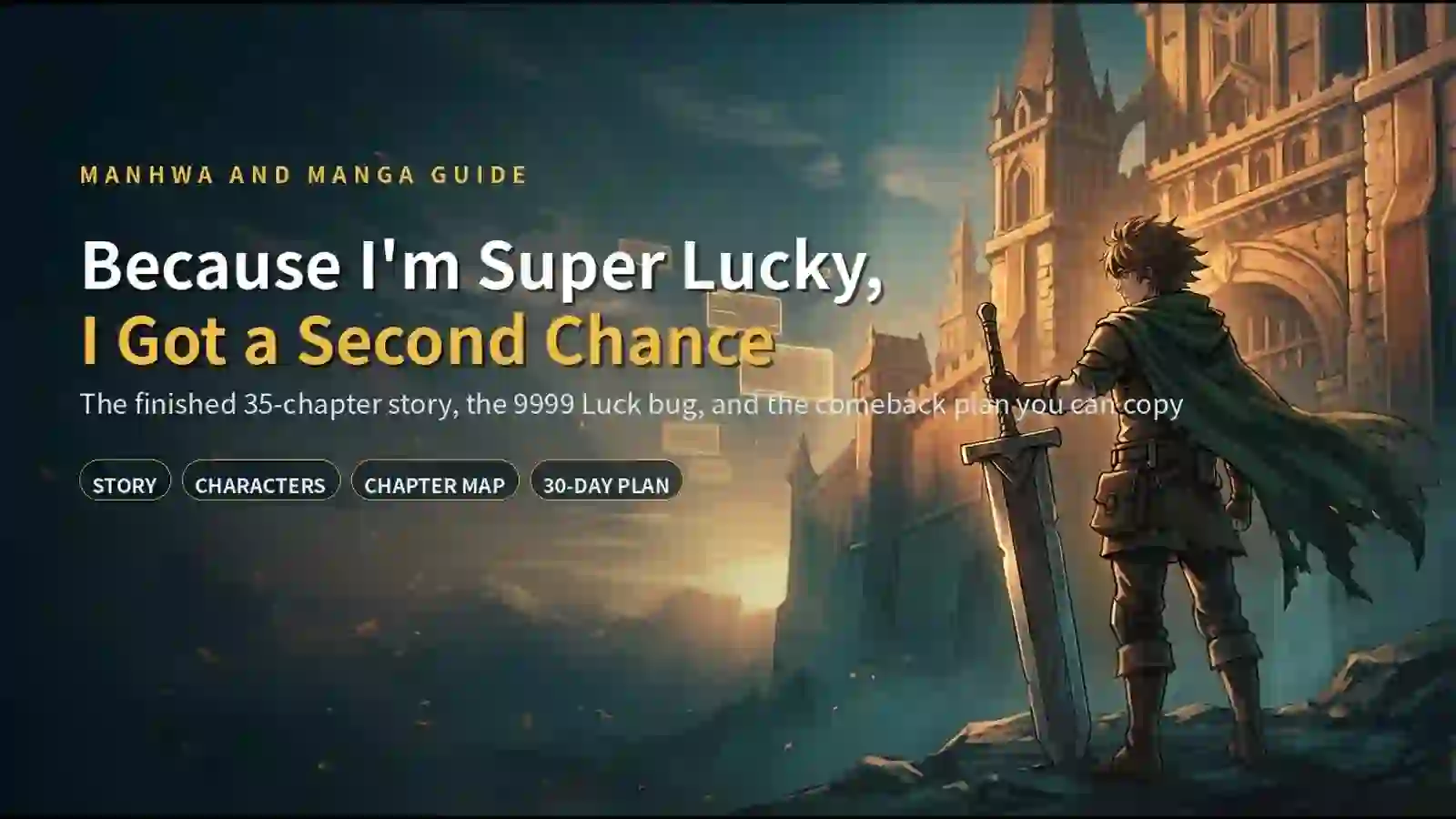
Most people lose their second chance before they notice it arrived. You burn out, get rejected, and watch a decade of work vanish. Yukito Takahashi knew that ending from the inside: a mocked G-rank adventurer whose stats never climbed. Then he died a failure.
Because I’m super lucky I got a second chance stopped being a comic line the moment the system offered him a rollback. Here is the story, the verified facts, and the plan you can copy.
Quick Answer Box: What This Series Is
This guide covers the full picture. You get the story, the cast, the 35-chapter map, the genre it belongs to, the real psychology behind luck, and a practical plan you can run this month. Nothing here is scraped. Every fact about the series is checked against official publisher listings, and every life lesson is explained in plain language.
“Because I’m Super Lucky, I Got a Second Chance at Life” is a completed 35-chapter Japanese fantasy manga, drawn in full colour for vertical scrolling, about a failed adventurer who dies broke and useless, then gets rolled back to age fifteen with his Luck stat locked at 9999. The story is written by Hozumi Susumu, designed and produced by Creative House Pocket, and published under the HykeComic and HxSTOON labels.
That answer matters because half the internet still gets it wrong. Plenty of English listings show the series as ongoing with 30 chapters. The official storefront records say otherwise, and we will get into that below.
What Is “Because I’m Super Lucky, I Got a Second Chance at Life” About?
Yukito Takahashi spends his whole adult life as a G-rank adventurer, the lowest rank in a guild system that measures human worth with numbers. He levels up for decades and his stats never move. Other adventurers laugh at him. He grows old, keeps swinging, and dies on a job without ever becoming stronger.
Then the system speaks. A message appears and admits that the entire world has been running a broken status engine. A critical bug gets found, a correction patch gets applied, and his life gets rolled back. The patch also releases a hidden parameter and hands him a status bonus of +9999.
He wakes up at fifteen, on the exact day he first registered as an adventurer. He checks his status sheet and his heart drops. Nothing changed. Same weak body, same low numbers. Then he notices a new line he never had before: Luck: 9999. Maxed on the first day.
That single line rewrites every rule he lived under:
- Monsters now drop rare items on nearly every kill, because his drop rate has nowhere left to climb.
- Skills and gear upgrades that fail by chance now succeed, because failure itself became statistically unlikely.
- Weapons that used to miss simply do not miss anymore.
- Every gamble he takes lands, which turns a weak fighter into the most dangerous person in the room.
He still carries a greatsword he can barely afford to swing, and he still cannot wear proper armour because his build does not support it. The story keeps him physically fragile on purpose. His edge lives in outcomes, not muscles.
Why One Maxed-Out Luck Stat Beats Ten Levels of Strength
Most power fantasies hand the hero raw strength. This one hands him a probability advantage, and that choice makes the story smarter than its cover suggests.
Power adds. Luck multiplies. Strength raises one number. A maxed luck stat raises the result of every action he takes, forever, across every system in the world. He does not need to be the strongest when the world keeps handing him the best possible version of each moment.
The story also builds its own tension around this. He wins fights, but he does not win by dominating them. He wins by reading the situation faster than everyone else and letting probability do the heavy lifting. Chapter 8, titled Adapt and Overcome, and chapter 11, A Warrior’s Instinct, both lean on judgement rather than brute force.
Then the rollback reveal adds a second layer. His knowledge of the first timeline becomes a cheat code of its own, separate from luck. He remembers the monsters, the markets, the scams, and the tragedies. He knows which shortcuts are traps and which strangers become allies.
Put those two advantages together and you get the series’ real engine: foresight plus favourable odds plus a man who refuses to waste either one.
Series Fact Sheet: What the Official Listings Confirm
Chapter counts and credits get mangled constantly in fan listings, so here is the verified record, pulled from the publisher’s own retail pages.
| Field | Verified Detail |
|---|---|
| English title | Because I’m Super Lucky, I Got a Second Chance at Life |
| Japanese title | 幸運値MAXの俺だけ人生回帰【タテヨミ】, also listed as 超幸運の俺だけ人生回帰 |
| Romanised Japanese | Chou Koun no Oredake Jinsei Kaiki (Kouunchi MAX no Ore Dake Jinsei Kaiki) |
| Author | Hozumi Susumu (穂積潜), original story and script |
| Character design and production | Creative House Pocket (クリエイティブハウスポケット) |
| Storyboards | Kon Suzu and Wada Miyu |
| Publisher and label | HykeComic, released under the HxSTOON label |
| Rights holder | HykeComic and StraightEdge inc. |
| Status | Completed, 35 chapters |
| Format | Tateyomi, meaning Japanese vertical-scroll manga, full colour |
| Demographic | Shounen |
| Genres | Action, adventure, drama, fantasy, time travel, magic, special abilities |
| Protagonist | Yukito Takahashi, a G-rank adventurer returned to age fifteen |
| Core premise | A status-system bug rolls his life back and unlocks Luck at 9999 |
| Free sample | The opening chapters read free on the official Japanese storefronts |
Two details in that table matter more than the rest. First, the run is finished at 35 chapters, which means you can commit to it without waiting years for an ending. Second, the platform is a Japanese vertical-scroll app, not a Korean studio pipeline, so calling it a manhwa is a habit rather than a fact. The style travels well and the pacing feels like a webtoon, but the label belongs to Japan.
The Characters and Entities That Drive the Story
The cast stays small, which lets the family thread carry real weight. These are the names and forces worth tracking as you read.
| Character or Entity | Role in the Story | Why It Matters |
|---|---|---|
| Yukito Takahashi | G-rank adventurer sent back to his fifteen-year-old self | Carries both the luck cheat and the memory of a wasted life |
| Yukito’s mother | Lives with an incurable illness in the first timeline | Turns the do-over from a power trip into a rescue mission |
| Yukito’s sister | Keeps parts of her life hidden from him in timeline one | Her secret becomes the pivot of the story’s darkest turn |
| The Hero | Enters the narrative in the mid-teens of the chapter run | Represents institutional power that decides who deserves saving |
| The System | The broken engine behind the rollback and the hidden parameter | Acts as judge, plot device, and metaphor at the same time |
| The Adventurers’ Guild | Sets rank, pay, and social worth | Shows how a rigid system buries capable people |
| The Drop Economy | Monsters, rare loot, enhancement attempts | Makes “luck” visible through objects and money |
| HykeComic and HxSTOON | Publisher and label | Confirms the run length and the official credits |
| Creative House Pocket | Production studio behind the art | Explains the full-colour, high-frequency release schedule |
Notice the pattern. Yukito’s advantage is loud, but his motivation stays quiet and domestic. He does not want to rule a kingdom. He wants his mother alive, his sister safe, and his name respected. That is the emotional spine, and every strong chapter hangs off it.
The 35-Chapter Map: What Each Arc Does and What You Can Steal From It
Chapter titles below come from the official storefront listings, so the text is translated here rather than invented. Where the listings do not publish a title, the row describes the stretch instead of guessing.
| Chapter Range | Official Title (Translated) | What the Arc Does | The Life Lesson Inside It |
|---|---|---|---|
| 1 | The Incompetent Yukito | Shows decades of failure, then the death and the rollback message | Rock bottom is data, not identity |
| 2 | Luck | He checks his stats, feels crushed, then finds the 9999 | Your advantage hides in a column you were not watching |
| 3 to 6 | Opening chapters, untitled in listings | Meets his family again, tests the drop system, buys his first gear | The first thing he fixes is not his power, it is his proximity |
| 7 | Monster Panic | A city-scale threat forces him into a real fight | Chaos rewards preparation more than muscle |
| 8 | Adapt and Overcome | He changes tactics mid-crisis | Rigid plans break. Flexible ones survive |
| 9 to 10 | Run continues | Guild attention grows as his results stop looking normal | Visible results create invitations |
| 11 | A Warrior’s Instinct | Instinct and judgement carry a fight | Trained instinct is compressed experience |
| 12 | The Schemer Drowns in His Own Scheme | A manipulator turns on himself | Clever people fail when they over-model other people |
| 13 | The Hidden Room | A sealed space opens for him | Opportunity often sits behind a door nobody bothered to try |
| 14 | Yukito of Luck | His reputation becomes a title | Names matter in every guild, office, and industry |
| 15 | Tragedy Always Strikes Without Warning | The story’s darkest turn lands | Luck cannot buy time you already wasted |
| 16 | The Two Who Start Over | A second character gets a second chance | Redemption is contagious when somebody watches you do it |
| 17 to 26 | Mid-run chapters, titles not listed | Reputation, allies, escalating world-level threat | Scale changes the game. Values should not |
| 27 to 34 | Late-run chapters, titles not listed | The first timeline’s consequences close in | Avoidance rarely works. Confrontation usually does |
| 35 | Beyond Luck | Finale | The advantage gets you there. The choice keeps you |
Read that last column again, because the series argues something useful: luck decides the size of the door, but it never decides whether you walk through it. Yukito spends 35 chapters answering the same question in different costumes. Now that nothing can stop me, what do I actually want?
What the Story Is Really Arguing About Luck, Regret, and Family
Strip away the status windows and the monster loot and you find three arguments running at once.
First, regret is a map, not a punishment. Yukito remembers every mistake he made, and he uses those memories the way a trader uses charts. He avoids the scammers, the dead-end quests, the people who wasted his years. Regret becomes a navigation tool the moment he stops using it to hurt himself.
Second, the person you ignored is usually the point. He spent his first life grinding levels and losing his family in the background. His mother’s illness runs its course, and his sister’s hidden life becomes central to the story’s tragedy. The do-over forces him to look sideways instead of forward.
Third, competence beats charisma. He wins allies by delivering results, not speeches. The guild notices him because monsters keep dropping rare materials nobody else can farm. In fiction and in real life, results are the only reputation that survives scrutiny.
The series never says because I’m super lucky I got a second chance out loud, yet every chapter argues it. One more thing worth naming: the story never pretends luck is a personality. Yukito trains, plans, and takes risks. He treats 9999 Luck as a starting position, not a finished life. That is exactly the posture the rest of this guide will hand you.
Where It Sits in the Second-Chance Genre
Every second-chance story answers the same question with a different mechanism. Knowing the mechanism helps you find more of what you liked.
| Title | Second-Chance Mechanic | What It Does Differently |
|---|---|---|
| Because I’m Super Lucky | A status-system rollback plus a hidden Luck parameter | The do-over comes from a bug, so the universe owes him a correction |
| Erased | Involuntary time jumps before a tragedy | Returns 18 years, not to a game world but to a real childhood |
| Tokyo Revengers | A 12-year time leap to middle school | Saves a person first and a future second |
| Re:Zero | Return by Death, restarting at a save point | Harms the hero every time instead of rewarding him |
| Mushoku Tensei | Reincarnation with memories intact | Builds an entire life from infancy instead of fixing an old one |
| A Returner’s Magic Should Be Special | A 13-year regression as a magic student | Fixes a catastrophe by fixing a friend group |
| Omniscient Reader’s Viewpoint | Knowledge of a story that becomes real | Turns spoilers into a survival strategy |
| Solo Leveling | A System with daily quests and a status window | Upgrades the weakest body in the world on a schedule |
Stacked together, these titles show you the genre’s real vocabulary: regression, time leap, reincarnation, save points, hidden parameters, status windows, LitRPG mechanics, cheat characters, and the underdog-to-legend arc. That vocabulary is the reason this niche has such loyal readers. It sells hope with rules attached.
Next to those titles, because I’m super lucky I got a second chance lands as the version where the universe apologises first. The do-over arrives as a repair, not a wish, and that single change of mechanism separates it from every save point and reincarnation on the list.
Is It Luck or a System Bug? The Metaphor That Applies to Your Life
Here is where this series stops being entertainment and starts being useful. Yukito’s entire advantage arrives through a bug report, an apology from the engine, and a patch note. His fortunes change because somebody finally admitted the rules were broken.
Real second chances rarely arrive that way. Nobody sends the message. You have to notice the bug yourself.
Behavioural research has spent decades mapping what people call luck. Richard Wiseman’s work in The Luck Factor found that lucky people share habits rather than destinies: they notice more opportunities, act on hunches, expect good outcomes, and convert bad luck into something usable. K. Anders Ericsson’s research on deliberate practice explains how ordinary ability compounds when feedback is fast and specific. Carol Dweck’s growth mindset work shows why people who treat ability as trainable recover faster from failure. BJ Fogg’s tiny habits model shows why small, anchored actions beat heroic intentions. Peter Gollwitzer’s findings on symbolic self-completion explain why announcing a goal can drain the motivation to pursue it.
None of that requires a status window. All of it maps onto the series:
- Yukito’s 9999 Luck is opportunity awareness that is too high to miss.
- His first-life knowledge is deliberate practice with 30 years of feedback.
- His refusal to waste the do-over is growth mindset in motion.
- His habit of stacking small wins is tiny habits at scale.
- His decision to stop talking and start moving is goal silence that protects the work.
So, is luck real? Yes, and it is mostly behavioural. Yukito never had to file the bug report himself, which is the single real difference between his version of because I’m super lucky I got a second chance and yours. You cannot patch the world’s status engine. You can absolutely raise your own hidden parameters.
How Do You Actually Build a Second Chance? Seven Steps
Yukito runs because I’m super lucky I got a second chance as a seven-step sequence, and you can copy the order without copying his powers. He starts with honesty and ends with proof, which is why the sequence works. The series hands you the path if you look closely.
1. Audit the mess honestly. He starts by reading his own status sheet, including the numbers he hates. Write down where you actually stand: money, health, skills, relationships. Facts calm panic.
2. Find your hidden parameter. His advantage sat in a column he never checked. Yours might be a skill people keep asking you for, a network you forgot you built, or a niche you understand better than most.
3. Go straight to the person you neglected. He returns to his family before he returns to the guild. Call the person you ghosted. Repair comes before promotion.
4. Get a big, simple weapon. He carries a greatsword and nothing else. Pick one skill and go deep instead of collecting ten shallow ones. Depth is what people pay for.
5. Take the fight you can survive. He fights monsters, not armies. Choose challenges that stretch you and stay winnable. Recovery speed beats peak effort.
6. Let results speak. He never explains his power. The loot does the talking. Publish the work, ship the project, show the number. Proof travels faster than promises.
7. Protect the timeline you are rebuilding. He guards his family, his plans, and his information. Cut the leak, the drama, and the person who keeps borrowing your energy.
Run those seven steps badly for a year and you will still beat the version of you who planned them perfectly and never started.
Your First 30 Days: A Practical Plan
Motivation fades by Wednesday. Structure does not. The grid below turns because I’m super lucky I got a second chance into four weeks of concrete work. Use one row per week.
| Week | Focus | Three Actions | How You Know It Worked |
|---|---|---|---|
| Week 1 | Audit | Write a one-page status sheet, list every income source and drain, name the one problem you keep avoiding | You can state your real position without flinching |
| Week 2 | Skill | Choose one skill, block 45 minutes daily, finish one small deliverable you can show someone | You produced something visible, not a plan |
| Week 3 | People | Send three repair messages, make one ask, join one room where your skill matters | Two conversations went somewhere |
| Week 4 | Proof | Publish your result, ask for one piece of harsh feedback, set a 90-day target | A stranger or a client reacts to your work |
Track one number all month. Completion rate beats everything else. If you finish 70 percent of your planned sessions, you are ahead of most people who started with you.
Where Can You Read It Legitimately, and What About Sites Like MangaGeko?
When readers type because I’m super lucky I got a second chance into a search bar, they land on two very different kinds of page. Start with the official route. The Japanese run sits on HykeComic’s own app, with the opening chapters free, and on licensed storefronts including BookWalker and Mechacomic. Those pages give you the real chapter count, the credits, and the correct title in both languages.
Now the honest part. Search engines push a lot of readers toward aggregator pages, and the term mangageko shows up in those searches because aggregator domains compete hard for manga keywords. Sites like that look convenient, load fast, and ask for nothing. The trade is real though:
- They repost scans without permission, which pulls money away from the studio that makes the chapters.
- They carry aggressive redirect ads and pop-unders that lead to malware and card-skimming pages.
- Their metadata rots fast, which is exactly why so many of them still list this series as ongoing with 30 chapters.
- Their titles, credits, and translations drift, so you end up reading something the author never approved.
If a listing cannot tell you the chapter count that the publisher already published, treat everything else on that page as unverified too. Read the free official chapters first, then decide whether you want to pay for the rest. That habit keeps the people who made this story employed, and it keeps your device clean.
One practical rule: check the copyright line. Official pages credit the rights holders directly, in this case HykeComic and StraightEdge inc. A page that hides its credits is telling you something.
How to Spot Scraped or Spammy Second-Chance Content Before It Wastes Your Time
Bad content about good stories is its own genre now. These signals separate real coverage from recycled filler.
- Correct chapter count. A trustworthy page knows the run finished at 35 chapters. A scraped page repeats outdated numbers for years.
- Named credits. The story comes from Hozumi Susumu, with design and production by Creative House Pocket. If a page credits nobody, it researched nothing.
- Publisher verification. Real coverage points to HykeComic, HxSTOON, BookWalker, or Mechacomic. Filler points to other aggregators.
- Specific chapter detail. Mentioning chapter 13’s The Hidden Room or chapter 35’s Beyond Luck proves someone read the text.
- No fake dates. A page claiming daily chapter updates for a finished series is bait.
- Readable prose. Rewritten summaries stutter, repeat, and switch tenses. Humans vary sentence length and admit uncertainty.
Apply the same test to anything you publish. Google’s helpful content systems reward pages written for people first, and they punish pages built to farm a keyword. That standard is not scary once you write from real material.
Six Mistakes That Quietly Kill a Second Chance
Every mistake below breaks one of the moves Yukito made on his way to because I’m super lucky I got a second chance, and each one is easy to spot in hindsight and hard to spot in real time.
Waiting for the apology. Yukito only moves after the system admits its bug, and fiction can afford that. Real life rarely confesses. Start before anyone validates you.
Confusing luck with a plan. Good odds multiply whatever you bring to them. Bring nothing and the multiplier has nothing to work with.
Returning to the same room. Healing rarely survives the environment that caused the damage. Change the room, change the people, change the inputs.
Announcing the comeback too early. Tell five people your plan and your brain records the applause as progress. Save the reveal for the results.
Grinding the wrong stat. He needed his mother alive, not a higher rank. He chased both, but the order was the point. Know which number actually buys your life back.
Refusing to forgive the earlier you. Shame burns fuel fast and leaves nothing behind. Treat the old version of yourself as the person who gathered the data you now use.
Frequently Asked Questions
Is Because I’m Super Lucky, I Got a Second Chance at Life finished?
Yes. The official storefront listings show a completed run of 35 chapters, closed out with chapter 35, translated as Beyond Luck. Many English aggregator pages still label it ongoing with 30 chapters, and those pages are simply out of date.
Who wrote and drew Because I’m Super Lucky, I Got a Second Chance at Life?
Hozumi Susumu wrote the original story and script. Creative House Pocket handled character design and production, with storyboards by Kon Suzu and Wada Miyu. HykeComic published it under the HxSTOON label, and HykeComic and StraightEdge inc. hold the rights.
Is Because I’m Super Lucky, I Got a Second Chance at Life a manhwa, a manga, or a webtoon?
It is a Japanese tateyomi manga, meaning a full-colour vertical-scroll comic built for phone reading. The Korean-style webtoon pacing gets it labelled a manhwa across fan sites, but the publisher, the credits, and the original language are Japanese.
Is Yukito actually overpowered from chapter one?
Only in one column. His physical stats stay exactly where they were, and his Luck stat sits at 9999 from the moment he returns to age fifteen. He cannot even wear proper armour because his build will not carry it. The luck handles outcomes, so he still has to handle judgement.
So why does a maxed Luck stat matter so much in this second chance story?
Because luck compounds across every system at once. Monsters drop rare items, enhancement attempts that should fail succeed, and weapons that should miss always land. A single hidden parameter quietly raises the value of every action he takes. Chapter 2, titled Luck, is where he discovers it.
Does the story ever move past the gimmick?
It does, and the pivot arrives in chapters 15 and 16, Tragedy Always Strikes Without Warning and The Two Who Start Over. The do-over stops being a power fantasy and becomes a rescue mission about family, timing, and a second character who also deserves another shot.
Your Second Chance Is Already in Your Hands
Yukito got his do-over from a bug in a fictional machine. You get yours from noticing what is already broken and fixing the part you control. That is the entire difference, and it is smaller than it sounds.
Pick your hidden parameter today. Write the status sheet tonight. Message the person you owe an apology. Start the skill, ship the small thing, and let the results make the argument for you. No system will ever send you a message saying your life has been rolled back. The rollback is a decision.
You are permitted to be the fortunate one.. Act like it, and you will be.
If this guide helped, do two things before you go. Save it, because you will want the 30-day plan when motivation dips. Then send it to one person who is standing exactly where Yukito stood before chapter one. Because I’m super lucky I got a second chance is not just a title you read. It is a sentence you can live.