Tokyo Ghoul Manga vs. Anime Disparities: A Comprehensive Analysis
Tokyo Ghoul Manga vs. Anime Disparities: A Comprehensive Analysis
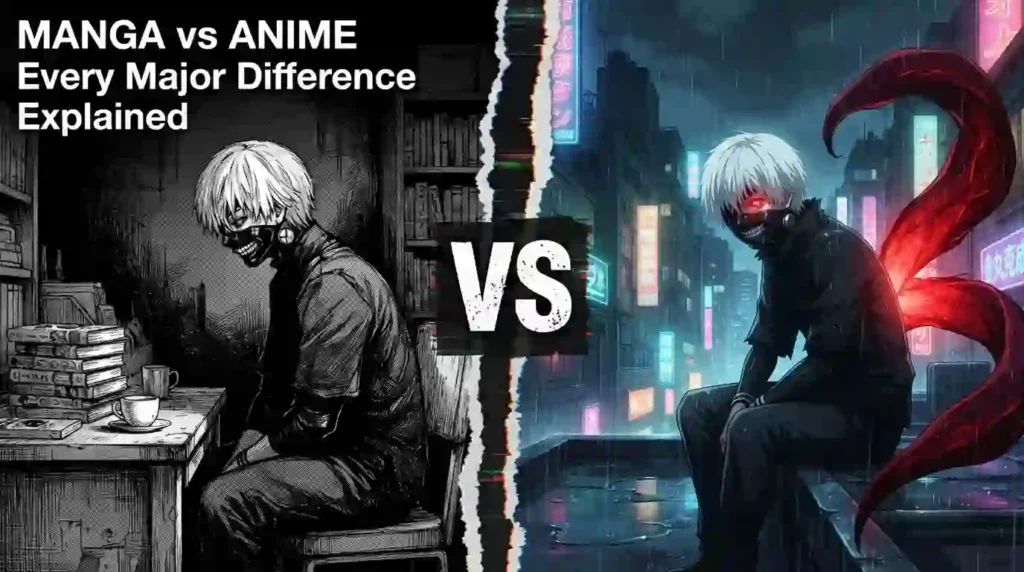
You finished the Tokyo Ghoul anime and felt something was missing. Scenes jumped without explanation, characters vanished mid-story, and the ending left you completely confused. You are not alone. The tokyo ghoul manga vs anime differences run deep, and they reshape the entire narrative. This guide breaks down every major change so you finally understand what Sui Ishida originally wrote for Weekly Young Jump.
Why Do Tokyo Ghoul Manga vs Anime Differences Matter to Fans?
The tokyo ghoul manga vs anime differences matter because the two versions tell fundamentally different stories after the first twelve episodes. Sui Ishida crafted a dark, layered narrative about identity, hunger, and survival in his original manga published by Shueisha. Studio Pierrot adapted that material faithfully at first, then veered off course entirely.
Fans who only watched the anime missed critical character development, entire battle sequences, and plot threads that set up Tokyo Ghoul:re. Understanding the tokyo ghoul manga vs anime differences gives you the full picture Ishida intended. It also explains why the manga community and the anime community often argue about which version is superior.
How Did Studio Pierrot Change the Original Story?
Studio Pierrot produced the Tokyo Ghoul anime in 2014 and covered the first sixty chapters of the manga with reasonable accuracy. The pacing felt rushed even then, compressing roughly fourteen volumes into twelve episodes. Character moments that spanned multiple chapters in the manga got reduced to single scenes or cut altogether.
The real problems started with season two, branded as Tokyo Ghoul √A. Instead of adapting the manga’s Aogiri Tree invasion arc, the studio created an original storyline with Sui Ishida’s partial involvement. This decision is the single biggest source of tokyo ghoul manga vs anime differences and the reason season two feels disconnected from everything that follows.
What Story Arcs Did the Anime Cut Entirely?
The anime skipped or severely condensed several arcs that carry enormous weight in the manga. The Aogiri Tree infiltration arc, where Kaneki joins the ghoul organization to grow stronger, never happened on screen the way Ishida wrote it. In the manga, Kaneki deliberately chooses to enter Aogiri after his torture by Jason, marking a pivotal shift in his psychology.
The Owl Suppression Operation also suffered heavy cuts. The manga dedicates multiple chapters to the CCG’s assault on Anteiku, showing individual investigator battles, ghoul casualties, and emotional farewells. The anime compressed this into a single chaotic episode that skipped the V14 underground battle entirely. That battle features Kaneki fighting his way through CCG forces and confronting Kishou Arima, a moment that defines the entire series.
The Anteiku Raid aftermath also plays out differently. In the manga, the fallout from the Owl Suppression Operation directly shapes the events of Tokyo Ghoul:re. The tokyo ghoul manga vs anime differences in this section create plot holes that the anime never resolves.
How Does Kaneki’s Character Arc Differ Between Versions?
Kaneki Ken undergoes one of the most dramatic transformations in modern manga, and the tokyo ghoul manga vs anime differences distort that journey significantly. In the manga, Kaneki’s shift from timid college student to ruthless ghoul happens gradually through specific traumatic events. His torture under Yamori (Jason) breaks him psychologically, and his decision to join Aogiri Tree shows calculated intent rather than confusion.
The anime portrays Kaneki as more passive and conflicted throughout √A. He wanders through events without the clear internal motivation the manga provides. His iconic “I am a ghoul” acceptance moment hits harder in the manga because Ishida spends chapters building the psychological foundation for it. The anime rushes past that groundwork, making Kaneki’s later transformation into Haise Sasaki in Tokyo Ghoul:re feel unearned for anime-only viewers.
The Black Reaper phase, where Kaneki becomes cold and merciless, also loses impact on screen. The manga earns that shift through accumulated trauma and loss. The anime simply presents it as a sudden personality swap.
What Happened in Tokyo Ghoul √A That Confused Everyone?
Tokyo Ghoul √A is the epicenter of tokyo ghoul manga vs anime differences. The season opens with Kaneki joining Aogiri Tree, which contradicts the manga where he forms his own independent group. This single change ripples through every subsequent episode and creates a storyline that does not connect to Tokyo Ghoul:re.
Key events in √A, such as Kaneki carrying a wounded Hide through the CCG blockade, never occur in the manga. The manga instead shows Hide’s fate unfolding during the V14 battle in a far more ambiguous and devastating way. The anime’s version of Hide’s injury and Kaneki’s desperate walk through the snow became iconic visually, but it created a continuity problem that Studio Pierrot had to awkwardly retcon in Tokyo Ghoul:re season one.
Fans who transitioned from √A to Tokyo Ghoul:re found themselves lost because the anime essentially rebooted its own continuity to match the manga again. This is the most frustrating of all tokyo ghoul manga vs anime differences for viewers trying to follow the complete story.
How Did the Aogiri Tree Arc Change on Screen?
In the manga, the Aogiri Tree arc establishes the ghoul organization as a complex political force with internal factions, strategic goals, and a mysterious leader known as the One-Eyed Owl. Kaneki infiltrates Aogiri to understand ghoul society and protect his friends at Anteiku from a position of strength. His interactions with Tatara, Ayato, and Eto reveal layers of ghoul politics that the anime ignores.
The anime’s version reduces Aogiri Tree to a generic villain group. Kaneki’s time with the organization feels aimless, and the strategic reasoning behind his choices disappears. The tokyo ghoul manga vs anime differences in this arc strip away the moral complexity that makes Tokyo Ghoul more than a standard action series. Ishida wrote Aogiri as a mirror to the CCG, showing that both sides commit atrocities in the name of survival. The anime flattens that nuance.
What Are the Biggest Fight Scene Differences?
The manga features detailed, brutal fight choreography that Ishida illustrated with stunning double-page spreads. The Owl Suppression Operation alone contains over a dozen individual battles, each with distinct kagune types, quinque weapons, and tactical approaches. The CCG investigators fight with specific strategies based on their ranks and equipment, and the ghoul defenders counter with equal precision.
The anime condenses these battles into quick exchanges that prioritize visual spectacle over tactical depth. Kaneki’s fight against Shinohara and Suzuya in the manga spans multiple chapters and shows Kaneki’s kagune evolving in real time. The anime wraps that confrontation in minutes. The tokyo ghoul manga vs anime differences in combat scenes remove the strategic layer that makes Ishida’s action sequences compelling beyond their gore.
The Arima vs Kaneki showdown, arguably the most important fight in the entire series, also loses weight on screen. The manga builds tension across several chapters before their clash in the V14 tunnels. The anime rushes through it, robbing the moment of its emotional devastation.
How Does Tokyo Ghoul:re Compare to Its Manga Source?
Tokyo Ghoul:re the anime attempted to course-correct after the √A detour, but it created new problems. The first season of :re covered roughly eighty chapters in twelve episodes, an impossible compression ratio. Entire investigation arcs, character introductions, and the complex CCG hierarchy got trimmed to fit the runtime.
The second season of :re accelerated even further, cramming the final eighty chapters into twelve episodes. The Rushima Landing Operation, the Clowns’ reveal, and the Dragon arc all received minimal screen time. The tokyo ghoul manga vs anime differences in :re stem from pure pacing constraints rather than creative divergence, but the result is the same. Anime-only viewers struggle to follow the plot because critical connective tissue is missing.
The manga’s ending, where Kaneki finds peace and builds a family, carries emotional weight because Ishida spent hundreds of chapters developing every relationship. The anime’s ending feels abrupt by comparison, even though it hits the same story beats.
Which Characters Got the Worst Treatment in the Anime?
Several characters suffered the most from the tokyo ghoul manga vs anime differences. Touka Kirishima’s role shrank dramatically after season one. In the manga, Touka remains a central figure throughout the story, managing a coffee shop, supporting Kaneki’s mental health, and fighting alongside him in the final battles. The anime sidelines her for long stretches.
Hideyoshi Nagachika (Hide) lost the most depth. The manga portrays Hide as Kaneki’s emotional anchor and a surprisingly perceptive investigator who understands ghouls better than most CCG officers. His sacrifice during the V14 battle is one of the most heartbreaking moments in the manga. The anime reduces him to a cheerful sidekick whose fate gets muddled across seasons.
Kishou Arima, the CCG’s strongest investigator, also received less development on screen. The manga explores his background, his connection to the Washuu clan, and his secret role in the ghoul world. The anime presents him as an unbeatable fighter without the tragic context that makes his character resonate.
What Did the Anime Change About the Ending?
The ending represents the final and most debated of all tokyo ghoul manga vs anime differences. In the manga, Kaneki defeats the Dragon entity, reconciles with his ghoul and human identities, and marries Touka. The final chapters show a peaceful Tokyo where ghouls and humans coexist, and Kaneki’s daughter Ichika represents the next generation.
The anime’s version of the ending hits the same broad strokes but rushes through the emotional resolution. The Dragon arc, which spans dozens of chapters in the manga, gets compressed into a handful of episodes. Kaneki’s internal struggle to accept both halves of his identity happens off-screen rather than through the gradual healing process Ishida illustrated.
The tokyo ghoul manga vs anime differences in the ending leave anime viewers with a satisfying but shallow conclusion. Manga readers experience a deeply earned resolution that rewards years of investment in the characters.
Is It Better to Watch the Anime or Read the Manga First?
Most fans and critics recommend reading the manga first. Sui Ishida’s original work published through Shueisha’s Weekly Young Jump contains the complete, unaltered story with every character arc, battle, and thematic layer intact. The manga spans fourteen volumes for the original Tokyo Ghoul and sixteen volumes for Tokyo Ghoul:re, totaling roughly 179 chapters of dense storytelling.
The anime works best as a visual companion after you finish the manga. Studio Pierrot’s animation during key moments, particularly the season one finale and the opening of √A, delivers striking imagery that complements Ishida’s art. Watching the anime after reading the manga lets you appreciate those visual highlights without the frustration of missing plot points.
If you only have time for one version, choose the manga. The tokyo ghoul manga vs anime differences are significant enough that the anime alone will leave you with an incomplete understanding of the story.
Detailed Comparison Table: Manga vs Anime at a Glance
| Story Element | Manga Version | Anime Version |
|---|---|---|
| Kaneki joins Aogiri Tree | No, he forms his own group | Yes, season two opens with this |
| V14 Underground Battle | Full multi-chapter arc with Arima fight | Completely skipped |
| Hide’s fate | Ambiguous during V14, revealed later | Shown injured during CCG blockade |
| Owl Suppression Operation | Detailed multi-perspective battle | Compressed into one episode |
| Touka’s role | Central throughout both series | Reduced after season one |
| Arima’s backstory | Full Washuu clan connection explored | Minimal background provided |
| Tokyo Ghoul:re pacing | 179 chapters of detailed storytelling | 24 episodes covering the same material |
| Ending resolution | Gradual emotional closure over final chapters | Rushed conclusion in final episodes |
| Kagune combat detail | Tactical, evolving fight choreography | Fast-paced visual spectacle |
| Aogiri Tree complexity | Political factions and moral ambiguity | Simplified villain organization |
Frequently Asked Questions
What is the biggest Tokyo Ghoul manga vs anime difference?
The biggest difference is Tokyo Ghoul √A’s original storyline, which replaces the manga’s Aogiri Tree infiltration arc with an anime-exclusive plot that does not connect to Tokyo Ghoul:re.
Does the Tokyo Ghoul anime accurately depict the manga?
Season one follows the manga closely with minor pacing cuts. Season two diverges completely, and Tokyo Ghoul:re compresses the source material too heavily to remain faithful.
Should I read the Tokyo Ghoul manga after watching the anime?
Yes. The manga fills in every missing arc, character moment, and battle that the anime skipped or condensed. It provides the complete story Sui Ishida intended.
Why did Studio Pierrot change the Tokyo Ghoul story?
Studio Pierrot chose to create an original second season rather than wait for the manga to progress further. This production decision caused the tokyo ghoul manga vs anime differences that persist through the rest of the series.
Does Tokyo Ghoul:re anime fix the √A problems?
Partially. The :re anime returns to the manga’s storyline but introduces its own pacing problems by compressing too many chapters into too few episodes.
Which version has the better ending?
The manga delivers a more emotionally satisfying ending because it earns the resolution through detailed character development across 179 chapters. The anime reaches the same destination but takes shortcuts to get there.
Take the Next Step in Your Tokyo Ghoul Journey
The tokyo ghoul manga vs anime differences reveal two distinct experiences built from the same foundation. The anime delivers striking visuals and memorable moments that introduced millions of fans to Ishida’s world. The manga delivers the complete, uncompromised story with every layer of character depth, political intrigue, and emotional weight intact.
If you watched the anime and felt something was missing, you were right. Pick up the manga from volume one and experience the story the way Sui Ishida crafted it. The Aogiri Tree arc, the V14 battle, the full Owl Suppression Operation, and the earned ending await you. Share this guide with fellow fans who still wonder why the anime left them confused, and join the conversation about which version you prefer. The debate keeps the Tokyo Ghoul community alive, and your perspective adds to it.