Lustiges Taschenbuch: The Complete Guide to Germany’s Cult Disney Comic
Lustiges Taschenbuch: The Complete Guide to Germany’s Cult Disney Comic
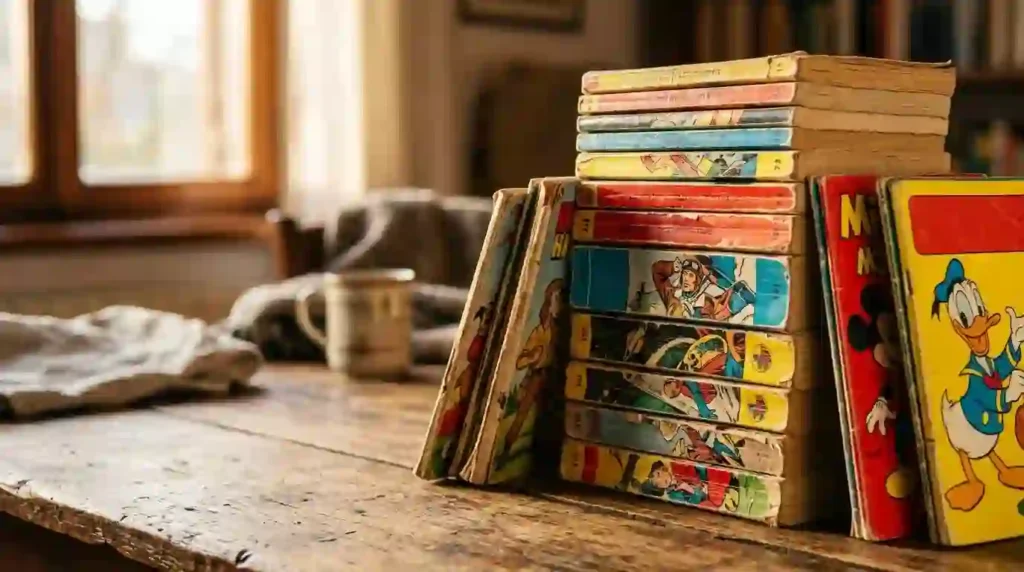
You know Donald Duck from the screen. You have laughed at his tantrums and cheered his clumsy wins. Yet the stories that shaped him for generations of German readers hide inside a small paperback you may never have opened. That book is a publishing phenomenon called Lustiges Taschenbuch. It sells over a hundred thousand copies per issue and has run for nearly sixty years. This guide collects everything worth knowing about it: origins, creators, characters, spinoffs, collector values, and honest buying advice.
What Is Lustiges Taschenbuch?
Lustiges Taschenbuch (pronounced roughly “LOOS-tih-guhs TAH-shen-book”) is Germany’s best-loved Disney comic series. The name translates as “funny pocket book,” and the product fits the label perfectly: a palm-sized paperback of about 256 pages, stuffed with Donald Duck and Micky Maus adventures. The publisher, Berlin-based Egmont Ehapa Media, releases a new volume every four weeks.
Three things make this series special. Every volume of the main line contains German first publications, meaning stories that have never appeared in Germany before. Each book mixes gag-a-day shorts with sweeping adventures. And the illustrated spines line up to form one giant picture across your shelf, a trick that turns casual buyers into devoted collectors.
The format follows a proud European tradition. Italy has Topolino, the Nordic countries have their Jumbobooks, and Germany has its own iconic pocket series. Among the European family, the German edition became the biggest success story of all.
The Key Facts in One Table
| Fact | Detail |
|---|---|
| First volume | Walt Disneys Lustige Taschenbücher No. 1, Der Kolumbusfalter und andere Abenteuer, October 9, 1967 |
| Launch price | 2.50 German marks (about 1.28 euros today) |
| Publisher | Egmont Ehapa Media GmbH, Berlin (formerly Ehapa Verlag) |
| First editor and translator | Dr. Erika Fuchs, a legend of German comic translation |
| Rhythm | Every four weeks; 13 volumes per year since 1995 |
| Issue count | No. 600 reached July 29, 2025; main series at No. 614 by August 2026 |
| Format | About 256 pages, 12.5 × 19 cm, roughly 250 pages of comics |
| Current cover price | 8.99 euros (Germany), 9.50 euros (Austria), 14.90 Swiss francs |
| Sales | Over 100,000 audited paid copies per issue; more than 3.5 million volumes a year across all series |
| Story sources | Disney studios across Europe, mainly Italy and Scandinavia, plus Brazil and elsewhere |
How Did Lustiges Taschenbuch Start?
The story begins in Italy. There, Disney comics in pocket form had sold brilliantly for years, and the German publisher Ehapa wanted the same magic at home. German readers already knew Donald from the weekly Micky Maus magazine, which had run since 1951. But those thin issues could not carry long, ambitious tales.
On October 9, 1967, the first Lustiges Taschenbuch landed on newsstands. It offered four long adventures, led by the story Der Kolumbusfalter. Buyers paid 2.50 marks and received something genuinely new: Disney comics with room to breathe, translated with uncommon wit by Dr. Erika Fuchs.
Fuchs deserves her fame. She gave German Donald Duck a voice full of playful elegance, invented expressive German names and phrases, and turned translation into an art form. Her German names proved so good that other countries adopted them, including the Netherlands, which borrowed her “Dagobert” for Uncle Scrooge. When public broadcaster DW examined the German Disney phenomenon, it noted that these little paperbacks have often outshone the cartoons themselves in German hearts.
The early years ran slowly, with only a handful of volumes per year. The 100th volume arrived in 1984. Around 1987, with volume 119, the series gained a new look, a shorter name, and full color inside. In 1995 the publisher set the steady four-week rhythm that continues today.
Who Creates the Stories Inside?
Egmont Ehapa Media does not draw these comics alone. It commissions them through Disney’s worldwide studio network, so a single volume may mix work from Italy, Denmark, Brazil, and beyond. That pipeline explains the freshness: German first publications keep readers returning because they cannot find these tales anywhere else.
Famous names enrich the pages. The American master Carl Barks, who defined Uncle Scrooge and the Duckburg universe, stars in dedicated reprint series. Modern giants such as the Italian Casty, the veteran Giorgio Cavazzano, and the Danish Flemming Andersen appear regularly. Fans even track every story, creator, and first print through the INDUCKS database, the world’s most complete Disney comics index.
Why Do Germans Love It So Much?
Ask any German about their childhood and the answer often includes a worn paperback in a holiday bag. Lustiges Taschenbuch became a family ritual. Parents read it aloud, children devour it silently, and grandparents keep volumes from the 1970s. The books survive trips, picnics, and bath-time accidents. That emotional glue is hard to copy.
Quality explains the loyalty too. Lustiges Taschenbuch mixes slapstick, mystery, science fiction, and treasure hunts, so every reader finds a favorite genre. The stories end within one volume, which suits short attention spans perfectly. And the spine artwork, which builds one long panorama across a full shelf, turns storage into a game. Germans call the result a Sammel-Spaß, collecting fun.
Meet the Cast: Life in Entenhausen
Almost every story happens in Entenhausen, the German name for Duckburg. Readers follow Donald Duck, the unlucky everyman with the famous temper, plus his nephews Tick, Trick, and Track (Huey, Dewey, and Louie to you). Uncle Scrooge, called Onkel Dagobert, guards his money bin with loving fury. The Beagle Boys, known as Panzerknacker, scheme to empty it.
Micky Maus, Minni, and Goofy patrol the mouse side of town, while Kater Karlo plays the heavy. Witch Gundel Gaukeley (Magica De Spell) chases Scrooge’s lucky dime. At night, Donald sometimes trades his sailor suit for the superhero cape of Phantomias, Germany’s take on Paperinik.
One running joke says everything about the town: almost everyone is an uncle, aunt, nephew, or cousin, and parents are strangely absent. Fans even coined a word for it, Veronkelung, the “uncling” of Duckburg. This cozy, timeless family structure keeps the stories safe for every age.
The Growing Family of Spinoff Series
One monthly book was never enough. Egmont built a whole shelf of sister series around the flagship Lustiges Taschenbuch. Each targets a different mood, age group, or reading habit. Here are the main ones:
- LTB Spezial — themed anthologies that have run past volume 130, with genres like fantasy and adventure.
- LTB Premium — the action corner: Phantomias adventures, Micky X, DuckTales stories, and Darkwing Duck.
- LTB Enten-Edition — a proud home for classic Carl Barks duck stories.
- LTB Maus-Edition — the mouse counterpart for Micky Maus fans.
- LTB Young Comics — modern, faster-paced stories aimed at teens.
- LTB Mystery — a fresh crime and suspense series launched in 2026.
- LTB Fantasy, Crime, History, Weltreise, and Europareise — genre and travel-themed pockets.
- Seasonal volumes — Christmas, Easter, summer, Halloween, and Advent editions that make lovely gifts.
- Collectors Edition — selected volumes with special cover colors, such as the gray Scrooge anniversary edition.
- Nostalgie-Edition — the 2017 reprint of volumes 1–10 with original covers, limited to 5,000 certified sets.
Counting the main Lustiges Taschenbuch line, its spinoffs, and seasonal specials, Egmont ships roughly 70 German-language Disney books per year. That output makes Germany the world’s busiest producer of Disney pocket comics, a fact the publisher proudly repeats.
Milestones on the Way to Number 600
| Year | Milestone |
|---|---|
| 1967 | Volume 1, Der Kolumbusfalter und andere Abenteuer, appears on October 9 |
| 1984 | Volume 100 reaches the shops |
| 1987 | New design around volume 119; full color; the title shortens to Lustiges Taschenbuch |
| 1995 | Steady rhythm of 13 volumes per year begins |
| 2007 | 40th birthday; first variant covers appear (gold and silver editions of volume 369) |
| 2016–2017 | Volume 500 and the 50th anniversary, with fan-voted content and the Nostalgie reprints |
| 2024–2025 | Marvel crossover fun: Donald Duck becomes Wolverine in volume 598, and Minnie turns into Captain Marvel |
| July 2025 | Gilded volume 600 celebrates the series with eleven new stories |
| August 2026 | Volume 614 ships, themed around Formula 1 racing fever |
| 2026 onward | The four-week clock keeps ticking; issue 615 lands in autumn 2026 |
How Much Is an Old Volume Worth?
Most Lustiges Taschenbuch volumes cost pocket money and stay that way. A handful of exceptions make collectors’ hearts beat faster. The crown jewel is a first-edition volume 1 in top condition: German price guides estimate its value around 1,500 euros, and unusual copies have sold for more on auction sites.
What pushes value upward? Early print runs with the original cover and price stamp, anniversary volumes, variant covers, and anything with a misprint. Volume 600’s gold cover already looks destined for the highlight shelf. Ordinary readers should not worry about rarity. A complete spine-picture collection brings joy without needing a safe.
Newcomer tip: buy the volumes you love, store them upright, and keep the spines unbroken. The shelf picture works best when every book stands together.
Where Can You Buy It, Even Abroad?
Inside Germany, Austria, and Switzerland, find new volumes at supermarket checkouts, press shops, kiosks, and bookstores. The publisher’s own online shop, the Egmont Shop, sells current Lustiges Taschenbuch issues, spinoffs, subscriptions, and back catalog titles. Subscription services also deliver each new volume to your door on release day.
International fans face one honest hurdle: the text is German. The drawings carry the story, but the jokes live in the language. That has not stopped collectors worldwide. Marketplaces such as eBay and Amazon list new and vintage volumes, many sellers ship internationally, and comic importers bundle mixed lots. Prices abroad simply add shipping.
Language learners get a bonus: short episodes, recurring characters, and everyday dialogue make these books excellent reading practice. Some fans even hunt regional editions, including a Swabian dialect volume that turns Donald’s tantrums into pure comedy gold.
Why Parents and Teachers Approve
Not every comic wins over parents. This one did, generation after generation. Comics were once dismissed in Germany as cheap entertainment, yet this paperback earned a seat at the family table because it rewards reading without feeling like homework.
Educators point to real benefits. Captions and speech bubbles build vocabulary in small, digestible steps. Story arcs last exactly one volume, giving young readers a satisfying finish. Jokes that work on several levels keep adults laughing too, which turns reading time into shared time. Screens glow everywhere today, yet a pocket book that travels anywhere still feels like magic.
Lustiges Taschenbuch: Six Questions Fans Ask
1. What does Lustiges Taschenbuch mean in English?
Lustiges Taschenbuch translates as “funny pocket book.” The series ran for its first twenty years as Walt Disneys Lustige Taschenbücher (“Walt Disney’s Funny Pocket Books”) before the shorter, snappier name won in 1987.
2. When did the first volume appear?
October 9, 1967. Volume 1, Der Kolumbusfalter und andere Abenteuer, cost 2.50 marks and sold through the regular press trade. Dr. Erika Fuchs served as its editor and translator, setting a standard the series still follows.
3. Is the series still running in 2026?
Absolutely. The main line keeps its four-week rhythm, roughly 13 books per year. After the golden volume 600 in July 2025, number 614 followed in August 2026, with volume 615 due in autumn. Egmont shows no intention of stopping.
4. Which artists draw the stories?
Most tales come from European Disney studios, led by Italy and Scandinavia, with Brazil and others in the mix. Reprint lines celebrate Carl Barks, while modern favorites like Casty, Giorgio Cavazzano, and Flemming Andersen contribute new adventures. INDUCKS tracks every creator by issue.
5. Are old volumes valuable?
A flawless first edition of volume 1 can command around 1,500 euros. Beyond that rarity, anniversary and variant covers hold value, and complete spine collections please the eye daily. The safest investment rule: collect what you love to read.
6. Can international readers buy it?
Yes. Online shops, marketplaces, and importers ship worldwide, though the stories remain German. New volumes cost about 9 euros at home, plus shipping abroad. Non-German speakers still enjoy the art, and learners gain a charming study tool.
What Comes Next for the Series?
The numbers tell the story: 614 main volumes, 600th birthday behind it, and a publisher that still fills every issue with fresh German first publications. Marvel crossovers brought superhero energy in 2025, new mystery spinoffs launched in 2026, and anniversary editions keep arriving for Scrooge, Donald, and Phantomias.
Digital reading grows, but the paperback refuses to fade. There is something honest about a book with no battery, no updates, and no ads. Nearly sixty years in, Lustiges Taschenbuch still does one thing better than any app: it makes people laugh on page one.
Your Next Move: Start Your Own Collection
You now hold the full picture. Lustiges Taschenbuch is not just a comic series; it is a sixty-year conversation between a publisher, brilliant artists, and millions of laughing readers. The best way to understand that magic is to feel the paper in your hands.
Grab the newest volume at a German press shop or order it online. Pick up a secondhand stack and watch the shelf picture grow. Share this guide with a Disney fan who has never heard of Duckburg’s paperback empire, and tell us in the comments which volume started your journey. Every collection begins with a single book. Why not this week?