Milk Teeth in Adulthood: Why Baby Teeth Stay and How to Fix Them
Milk Teeth in Adulthood: Why Baby Teeth Stay and How to Fix Them
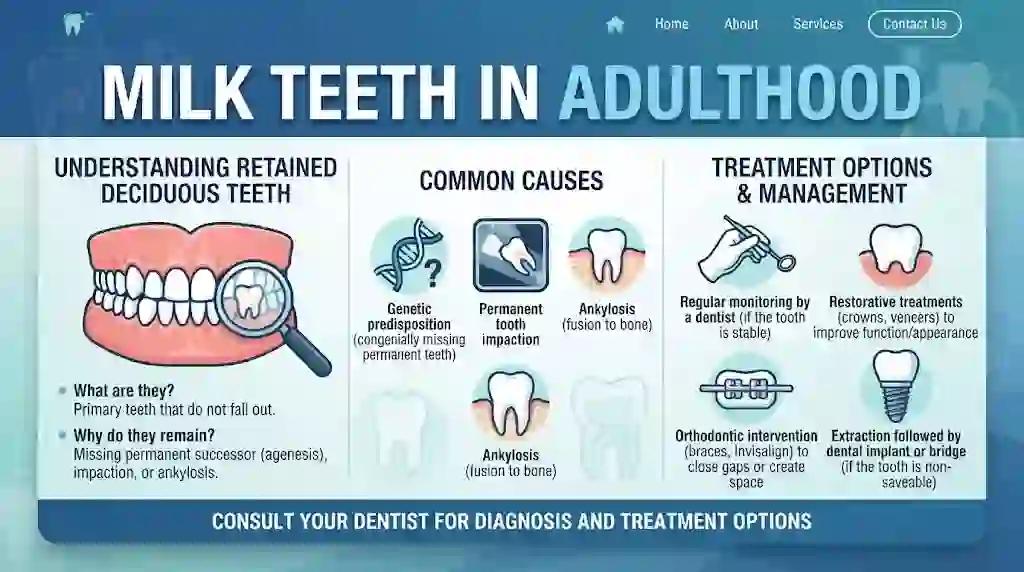
Quick answer: Milk teeth in adulthood happen when a baby tooth never falls out. The usual reason is simple: the adult tooth underneath never formed, never lined up, or fused to the jawbone. A healthy, well-placed baby tooth can serve you for decades, so you keep it and protect it. A loose, submerged, or decayed one gets replaced after an X-ray and a plan from your dentist.
What Milk Teeth in Adulthood Actually Are
Dentists call these retained deciduous teeth or retained primary teeth. They are the same 20 teeth that filled a child’s mouth, still sitting in an adult arch.
Every baby tooth has an expiry date built into its root. As the adult tooth rises, cells called odontoclasts eat the root away until nothing holds the baby tooth in place. Then it wobbles and drops out.
Most children finish that swap between ages 6 and 12, according to the StatPearls anatomy reference on primary dentition. When a tooth is still there at 18, 30, or 45, something interrupted the handover.
That interruption is not a disease. It is a clue. Your job, and your dentist’s job, is to find out which clue you are holding.
How Common Are Milk Teeth in Adulthood?
Common enough that no dentist raises an eyebrow. Rare enough that most people never hear the term until their own X-ray shows one.
Here is what the imaging studies report:
- Primary molars were still present in 15.2% of adults screened on panoramic X-rays at Umm Al-Qura University in Makkah.
- Retention rates in other radiographic surveys sit between 0.5% and 1.02% of all patients examined, with 274 retained teeth found across 13,516 patients in a Japanese hospital cohort.
- Among people who are born missing adult teeth, a retained baby tooth was the most common associated finding at 23.4% in a 2025 PLOS One review of 494 patients.
- Hypodontia, the medical term for missing adult teeth, affects 2% to 8% of the general population.
Two teeth show up most often: the lower second baby molar and the upper canine. If a dentist mentions a retained tooth, those are the usual suspects.
Why a Baby Tooth Refuses to Leave
Four causes explain almost every case of milk teeth in adulthood.
No adult tooth was ever made. The baby tooth keeps its place because nothing pushes on its root. The second premolars and the upper side front teeth are the most frequently missing teeth in the mouth, so those are the sites that hold longest.
The adult tooth took a wrong turn. An ectopic eruption path means the successor heads sideways instead of straight up. Without upward pressure, the root of the baby tooth stays intact.
The adult tooth is blocked. Extra teeth, dense bone, cysts, or simple crowding stop the climb. The baby tooth stays because the exit plan got cancelled.
The tooth fused to the bone. Ankylosis occurs when the periodontal ligament, the tiny shock absorber around a root, is replaced by bone. The tooth joins the jaw. It cannot loosen and cannot be moved with braces.
Less common drivers include a badly decayed baby tooth whose roots scarred down, trauma to a permanent tooth bud during childhood, and inherited conditions such as ectodermal dysplasia or cleidocranial dysplasia. A soft modern diet also gets blamed: less chewing force in childhood means weaker stimulus for root resorption.
Signs You Still Have One of Milk Teeth in Adulthood
You can often spot a retained baby tooth in a mirror before any X-ray. Look for these tells:
- One tooth in the row is noticeably shorter and flatter than its neighbours.
- The crown looks paler, more opaque, or chalkier white than adult enamel.
- The back teeth on one side look wider than the matching side, because baby molars flare out at the contact points.
- A small gap or a slight overlap sits next to that shorter tooth.
- The tooth has been exactly the same size and position since you were in school.
- It feels a bit springy, or a bit solid, in a way the neighbours do not.
- Chewing on that side feels slightly low, like the tooth does not meet properly.
Submerged teeth tell a second story. As your jaw keeps growing upward, an ankylosed tooth stays behind, so it appears to sink. Gums creep over the edge of the crown and food starts packing there.
Baby Tooth vs Adult Tooth: The Side-by-Side Facts
| Feature | Retained baby (milk) tooth | Adult permanent tooth |
|---|---|---|
| Typical shed age | 6 to 12 years | Never sheds naturally |
| Enamel thickness | Thin, about half of adult enamel | Thick and durable |
| Pulp (nerve space) | Large relative to tooth size | Smaller, more recessed |
| Root shape | Short, thin, flared, resorbs over time | Long, thick, three-dimensional grip |
| Crown colour | Opaque, chalky white | Slightly yellow, more translucent |
| Crown size | Narrow neck, wide contact bulge | Squarer, taller profile |
| Replacement tooth | Second premolar or incisor | None |
| Cavity speed | Reaches the nerve in months | Years, if hygiene is fair |
| Longevity when healthy | 10 to 30+ years with care | Lifetime with care |
| Response to braces | Moves only if not fused | Moves predictably |
That enamel difference drives everything else. Thin enamel plus a big pulp means a cavity in a retained baby tooth becomes an aching nerve far faster than it would in an adult molar.
Four Retention Patterns, Four Different Playbooks
| Pattern | What the X-ray shows | Usable lifespan | Standard move |
|---|---|---|---|
| Missing adult successor | Empty socket space under an intact root | Often decades | Save it, reshape it, monitor it |
| Ectopic successor | Adult tooth angled off course | Years, then risk rises | Guided eruption or exposure and bonding |
| Blocked successor | Adult tooth stacked in bone, sometimes an extra tooth | Short, unpredictable | Remove the blockage, then decide |
| Ankylosed (fused) tooth | Lost ligament space, tooth sitting below the ridge | Poor, worsens over time | Monitor in youth, remove and rebuild in adults |
Ask your dentist to say which of these four you have. The label changes the whole plan, and it changes what your tooth is likely to look like at age 40.
What Happens If You Ignore Milk Teeth in Adulthood
Nothing dramatic happens in the first few years, which is exactly why people postpone. Then the slow costs start stacking.
Neighbouring teeth lean into the space and rotate. The opposing tooth in the other jaw drops down because it has nothing to bite against. The bite shifts, and a small cosmetic oddity turns into a joint and muscle problem.
A submerging ankylosed tooth drags the gum line with it. The bone under that tooth stays flat while the bone beside it grows, so the ridge sinks. Years later, that vertical defect makes an implant harder to place and more expensive to build.
Decay is the quiet one. Retained baby teeth carry a higher cavity rate because their enamel is thin and their wide contact points trap plaque. In the Makkah study, the most common problems found alongside retained molars were tipping of adjacent teeth, root resorption, cavities, and old fillings that had failed.
None of this argues for panic. It argues for an X-ray now rather than a reconstruction later.
Save It or Pull It: The Real Decision
Save the tooth when most of these are true:
- The root still has length and the bone around it is stable.
- The tooth sits at the right height and angle in the arch.
- Your gums bleed nowhere near it and it does not ache when you chew.
- There is no adult tooth waiting underneath that needs the space.
- You can clean it properly with floss or an interdental brush.
- Your bite loads it evenly instead of hammering it.
Extract the tooth when you see these instead:
- It has become loose, painful, or swollen.
- It sits visibly below the level of its neighbours.
- A cavity has reached the pulp or the root has resorbed to a stub.
- Chronic food packing keeps the gum inflamed.
- Orthodontics needs the space to align the arch.
- An adult tooth is stuck in bone and needs a clear path.
Saving a baby tooth sounds sentimental, but it is a real clinical option. In the Nagasaki University cohort, retained deciduous teeth survived 62% at 10 years and 53% at 20 years, and teeth with no successor performed best. A research review in BMC Oral Health found 83% to 93% survival at 5 to 15 years for retained primary teeth with no adult replacement. A healthy baby tooth is often a better first choice than an implant in someone still growing.
Treatment Options for Milk Teeth in Adulthood, Matched to Your Situation
Watch and protect. For a stable tooth with no successor, this is the whole plan. Cleanings every six months, a bitewing X-ray each year, and reshaping of any ledge where food collects.
Reshape and camouflage. Composite bonding builds out the narrow neck of a baby tooth so it fills the gap and matches its neighbours. A veneer or a crown does the same job with more durability. Dentists also flatten heavy contacts so the tooth stops taking trauma.
Root treatment when needed. Because the pulp is large, a cavity in a retained baby tooth often reaches the nerve. A root canal plus a crown can buy years, though the thin remaining walls still need gentle loading.
Extraction plus space closure. Braces or aligners pull the arch together and simply delete the gap. Many adults with missing premolars choose this route and never need an implant.
Extraction plus replacement. The usual menu: a dental implant, a resin-bonded (Maryland) bridge, or a conventional bridge. Implants wait until jaw growth finishes, commonly around 18 to 21 years of age, otherwise the implant ends up looking submerged next to living teeth.
Expose and guide. For a buried adult tooth, the oral surgeon uncovers the crown and bonds a small chain to it. Orthodontics then drags it into the arch over 6 to 18 months, and the baby tooth comes out at the same time.
Autotransplantation. In selected cases, a wisdom tooth moves surgically into the empty site and keeps its own blood supply. When it works, it behaves like a natural tooth and even maintains the bone ridge.
Decoronation. For a severely submerged ankylosed tooth in a younger patient, removing the crown and leaving the root preserves bone height until implants become realistic.
How to Care for a Milk Tooth You Keep
Your aim is simple: keep plaque off a thin-enamed tooth and keep heavy bite forces off a short root.
- Brush twice daily with a fluoride toothpaste, angled at the gum line for 30 seconds per area.
- Clean between teeth once a day. An interdental brush usually beats floss around a wide baby molar.
- Ask about a prescription-strength fluoride paste or varnish if the surface looks chalky.
- Wear a night guard if you grind. A baby root cannot absorb the punishment an adult root can.
- Skip ice, hard candy, pen caps, and nail-biting. Vertical fracture is the most common way these teeth die.
- Report any change quickly. Soreness on biting, a pimple on the gum, or a new bad taste means the nerve or the gum has a problem.
- Book a review every six months and say out loud that the tooth is a baby tooth, so the chart tracks it.
Small habits decide the lifespan here more than any clever restoration.
Milk Teeth in Adulthood, Braces, and Implants
If you want orthodontics, the baby tooth is a fork in the road. Move it, and the gum and bone move with it, which often gives a better result than replacing it. Extract it early and leave the space open for an implant, and the ridge narrows while you wait.
Tell your orthodontist before treatment starts. That single sentence changes the plan.
A few specifics worth knowing:
- An ankylosed tooth will not move at all. The clinician needs to luxate it or remove it.
- Baby incisors in a crowded upper arch are commonly extracted for alignment; baby molars in a spare-mouthed patient are commonly preserved.
- Space maintainers matter more for a child than any cosmetic fix for an adult.
- Keep a baby tooth as long as it is healthy, even if you plan an implant at 25. It preserves the bone you would otherwise have to rebuild with grafts.
- Ask your clinician to compare three numbers: how long the tooth is likely to last, the cost of replacing it at that point, and the cost of closing the space with braces instead.
A Practical Plan for This Week
Take these steps in order and you will know where you stand within a month.
- Call a dentist and ask for a panoramic X-ray, mentioning the retained tooth by name.
- Ask which of the four patterns you have, and ask them to write it in your notes.
- Ask whether an adult successor exists, and where it sits.
- Book a hygiene visit and ask for cleaning instructions specific to that tooth.
- If it is a front tooth, ask about composite bonding before you consider any extraction.
- If it hurts, is loose, or looks sunken, request a referral to an orthodontist or oral surgeon now.
- Photograph it today, in the same lighting, and repeat every year. Change is easier to see in a photo than in a memory.
Your Questions About Milk Teeth in Adulthood, Answered
Is it normal to still have milk teeth in adulthood?
It is not typical, but it is common and rarely urgent. Most adults who discover a retained baby tooth have had it since their teens and have no pain. What is not normal is leaving it undiagnosed, because the X-ray decides whether you keep or replace it.
Can milk teeth in adulthood fall out on their own?
Yes. A retained baby tooth whose root finally resorbs, or one that develops a cavity into the pulp, can loosen and drop out, sometimes with no warning while you eat. If that happens and no adult tooth is underneath, the space will not close by itself, so call your dentist within a few weeks.
Are baby teeth weaker than permanent teeth?
Yes, in one important way. Their enamel is roughly half as thick and their nerve chamber is larger, so decay travels to the pulp faster. Their roots are also shorter and flared, so they tolerate heavy bite forces poorly. Shape and size differ too, which is why one often looks small and blocky next to its neighbours.
Will a retained baby tooth stop my implant?
It usually protects you first and complicates you later. Keeping a healthy baby tooth preserves ridge height while you grow. Once it is removed, bone narrows, and a graft may be needed. That is why many clinicians delay implant placement until the early twenties and keep the tooth in place meanwhile.
What does removal of milk teeth in adulthood involve?
A local anaesthetic, a few minutes of rocking the tooth out, and socket cleaning. An ankylosed tooth is different: it has no ligament, so the surgeon removes a small window of bone and lifts the tooth out, with stitches and about a week of soft food. Replacement options are discussed afterwards, not on the day.
Can I whiten a retained baby tooth to match the others?
Partly, and carefully. Whitening gel lightens the adult teeth around it and can make the baby tooth look mismatched at first. Composite bonding or a veneer usually matches better than bleaching. Ask your dentist to shade-map before committing to any whitening course.
Take the Two-Minute Step That Saves Years
You now know more about milk teeth in adulthood than most people ever learn, and knowledge without an X-ray changes nothing. So do the smallest useful thing: book a dental appointment, say the words “I think I have a retained baby tooth,” and ask for a panoramic image.
Then send us your story. Did a dentist keep your baby molar at 30 and it is still going strong? Did a sunken canine turn into the best bonding work you have ever seen? Tell us in the comments, or share this page with the friend who has always wondered about that one small tooth in their smile. Your question could save someone else a decade of guessing.