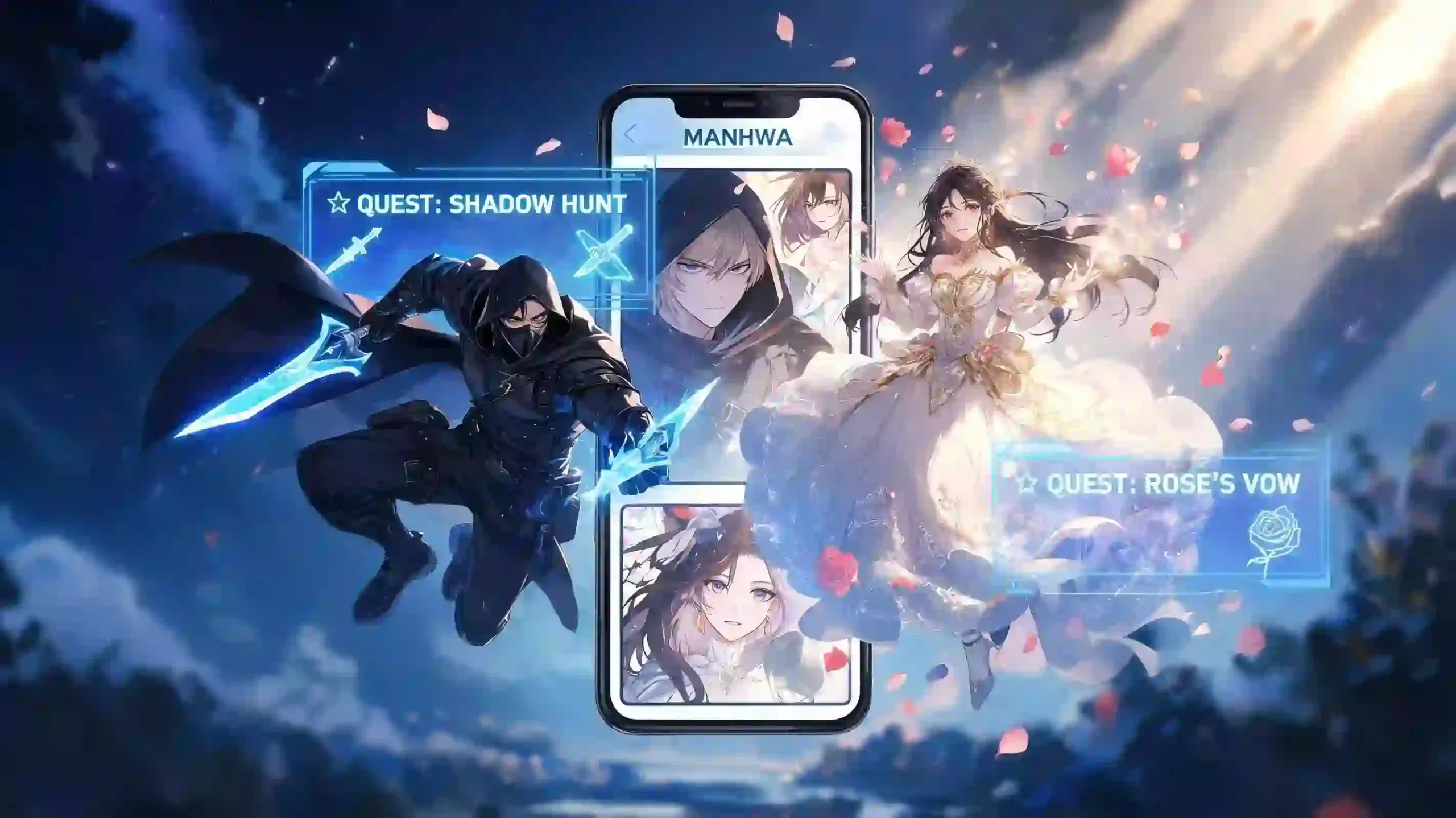
Straining your eyes over tiny, cluttered comic panels on your smartphone ruins the magic of visual storytelling. Pinched scans, awkward sideways zooms, and clunky monochrome pages drain your patience during dramatic narrative peaks. Enter webtoon manhwa. This full-color, seamless vertical format redefines mobile reading with cinematic pacing and breathtaking art. This definitive guide unpacks the entire phenomenon.
What Exactly Is Webtoon Manhwa? Origins, Format, and Meaning
The word “manhwa” simply means comic or print cartoon in Korean. It shares linguistic roots with Japanese manga and Chinese manhua, dating back to early twentieth-century woodblock prints and satirical newspaper cartoons. For decades, South Koreans consumed manhwa through neighborhood comic rental shops called manhwabang. Readers gathered in these community hubs to rent paperback volumes of martial arts epics and melodramas.
Understanding the core identity of webtoon manhwa requires separating historical roots from digital delivery. A webtoon represents a distinct technological leap that transformed traditional manhwa into an internet-native medium. Creators abandon the multi-panel grid of print books in favor of a continuous vertical strip. This infinite canvas optimizes the reading experience entirely for touchscreens.
Vertical scrolling changes how artists direct the eye of the reader. Instead of turning physical pages, you scroll downward continuously using your thumb. Korean creators use the empty space between panels, known as gutters, to control narrative pacing and dramatic tension. A long, empty gutter stretches time, building suspense before a shocking plot twist drops onto your screen.
Every chapter of a modern webtoon arrives in vivid, saturated full color. Traditional print comics often rely on black-and-white ink drawings with screentone patterns to save printing costs. Digital publication eliminates paper overhead, allowing illustrators to apply cinematic lighting, digital gradients, and dynamic visual effects across every panel.
How Did Korean Digital Comics Evolve into a Global Cultural Force?
The late 1990s brought severe economic turmoil to South Korea during the Asian financial crisis. Traditional print publishers collapsed overnight, and thousands of neighborhood manhwabang closed their doors permanently. At the same time, the South Korean government invested heavily in national high-speed broadband infrastructure. Displaced cartoonists moved to early personal homepages, community message boards, and internet cafes to share their work.
Search portal operators recognized the immense traffic potential of free digital comics. Daum launched its dedicated platform, Daum Webtoon, in 2003 with pioneering serials like Kang Full’s Love Story. Naver countered in 2004 under the guidance of program founder Junkoo Kim, launching Naver Webtoon. These web portals paid creators steady monthly salaries and hosted open-submission challenge leagues to discover fresh artistic talent.
South Korea’s Ministry of Culture, Sports and Tourism, alongside the Korea Creative Content Agency (KOCCA), recognized digital comics as a strategic cultural export. Public funding supported localization initiatives, translation grants, and creator training programs. This institutional support aligned manhwa directly with the broader Korean Wave, known globally as Hallyu.
International smartphone adoption in the early 2010s accelerated global expansion. Naver launched Line Webtoon internationally in 2014, translating premier Korean series into English, Spanish, Thai, and Indonesian. Mobile readers worldwide embraced the intuitive interface and accessible storytelling. Today, South Korean platforms generate billions in annual revenue and maintain hundreds of millions of active monthly readers worldwide.
What Is the Difference Between Manhwa, Manga, and Manhua?
Asian comic industries share historical kinship, yet each has evolved a unique visual syntax and commercial distribution model. Comparing Japanese manga with webtoon manhwa highlights contrasting artistic traditions and commercial philosophies. Manga remains deeply rooted in physical print culture, publishing through serialized magazines like Weekly Shonen Jump before collecting chapters into tankobon volumes.
Japanese manga reads from right to left, adhering to traditional Japanese text orientation. Black-and-white linework dominates manga, using screen tones, crosshatching, and panel density to evoke mood. In contrast, Korean webtoons flow exclusively from top to bottom, reading left to right whenever text spans across panels. Full-color digital rendering serves as the baseline requirement rather than an occasional luxury.
Chinese manhua blends elements of both mediums while carrying its own unique identity. Published across mainland China, Hong Kong, and Taiwan, modern manhua frequently adopts the digital vertical scroll format popularized by Korean platforms. Manhua art often showcases painterly digital brushwork inspired by traditional Chinese watercolor techniques. The thematic focus leans heavily toward historical cultivation fantasies and mythological folk adventures.
Western digital comics, often called webcomics, historically relied on horizontal strip formats similar to Sunday newspaper funnies. American and European creators typically operate as independent auteurs without unified corporate publishing portals. While Western creators increasingly adopt vertical scrolling on platforms like Tapas, Korean studios lead the industry in standardized production speed and serial narrative consistency.
| Feature | Webtoon Manhwa | Japanese Manga | Chinese Manhua | Western Webcomics |
|---|---|---|---|---|
| Primary Format | Vertical digital scroll | Multi-panel print page | Digital scroll & print | Variable (Strips & pages) |
| Reading Direction | Top to bottom | Right to left | Top to bottom (digital) | Left to right |
| Color Treatment | 100% Full digital color | Black & white with ink | Full color / painterly | Mixed (Color or B&W) |
| Primary Platforms | Naver, Kakao, Lezhin | Shueisha, Kodansha | Kuaikan, Bilibili | Tapas, independent sites |
| Release Schedule | Weekly continuous | Weekly / Monthly | Multi-weekly or weekly | Irregular or weekly |
| Core Themes | Regression, RoFan, Gates | Shonen, Seinen, Isekai | Cultivation, Wuxia | Slice-of-life, superhero |
| Asset Pipeline | 3D SketchUp backgrounds | Hand-drawn backgrounds | 3D assets & digital brush | Traditional / Hand-drawn |
Vertical scrolling transforms how your brain processes sequential art. Because you never see two facing pages simultaneously, surprises stay hidden until your finger moves the screen. The format mimics cinema camera techniques, using downward pans and upward tilts to convey scale and vertical motion.
What Are the Most Popular Genres in the Webtoon Manhwa Ecosystem?
The diverse landscape of webtoon manhwa genres offers something tailored for every demographic. While Western comic markets often remain dominated by superhero narratives, Korean platforms thrive on narrative variety. Distinct tropes and genre conventions have emerged, establishing reliable frameworks for gripping serial drama.
The fantasy sector thrives on the “Three R’s”: Regression, Reincarnation, and Transmigration. Regression stories (hoe-gwi) feature protagonists who die after living a tragic life, only to wake up ten years in the past with their future memories intact. Reincarnation tales (hwan-saeng) transport characters into fantasy realms as infants, while transmigration stories (bing-ui) drop ordinary modern people directly into the bodies of novel characters.
Romance Fantasy, widely abbreviated as “RoFan,” represents one of the largest commercial segments in the market. These stories typically feature female protagonists who wake up inside the world of a Victorian romance novel or historical otome game. The heroine often finds herself trapped in the body of the villainess destined for execution. Survival requires outsmarting corrupt aristocrats, forging contractual marriages with cold northern dukes, and building independent financial empires.
Contemporary action series frequently utilize the “System” or “Dungeon Gate” trope. Modern cities face sudden cataclysms when dimensional portals open, unleashing monstrous beasts upon civilization. Select humans undergo an awakening, gaining magical abilities managed by blue floating user interface screens. These narratives blend gaming elements like experience points and inventory slots with gritty urban survival.
The Murim genre transports readers into the legendary world of ancient Chinese and Korean martial arts. These epic sagas explore internal energy cultivation, meridian training, and blood feuds between the Orthodox factions, Unorthodox alliances, and the demonic cult. Protagonists rise from crippled outcasts to legendary sect masters through relentless discipline, sword mastery, and ancient secret manuals.
Modern school action stories capture urban adolescent anxieties through visceral, hyper-stylized combat. These series follow bullied outcasts who master boxing, wrestling, or street fighting to dismantle entrenched campus syndicates and juvenile crime cartels. Dynamic paneling, crunching sound design, and sharp street fashion make this genre a perennial hit among younger readers.
Which Masterpiece Titles Define the Webtoon Manhwa Industry?
Webtoon manhwa gained widespread reputation worldwide thanks to a number of groundbreaking titles. These flagship works showcased the artistic and narrative capabilities of the vertical scroll format to millions of international fans. Each series represents a milestone in visual execution, pacing, and cultural impact.
The worldwide poster child of contemporary action manhwa is Solo Leveling, which was authored by Chugong and illustrated by the late artist DUBU (Sung-rak Jang) of Redice Studio. The story tracks Sung Jinwoo, the weakest hunter in the world, who survives a brutal double dungeon massacre. He awakens with a mysterious player interface that allows him to level up without limits. The series set the gold standard for electric action choreography, dynamic lighting, and breathtaking shadow-soldier splash panels.
Tower of God, created by mastermind artist SIU, delivers an expansive fantasy universe on par with the world-building of classic literature. The narrative follows Twenty-Fifth Bam, an innocent boy who enters a colossal, mysterious tower to pursue his childhood companion, Rachel. Each floor presents lethal, mind-bending tests overseen by eccentric administrators and ruthless high rankers. The complex moral alignments, multi-layered politics, and deep lore keep readers theorizing for years.
Omniscient Reader’s Viewpoint, adapted from the acclaimed web novel by Sing Shong and illustrated by Sleepy-C, deconstructs modern fantasy tropes with brilliant meta-commentary. Dokja Kim is the sole reader who completed an obscure, three-thousand-chapter apocalypse novel. When the fictional disaster suddenly becomes reality, Dokja uses his exclusive knowledge of the plot to keep his allies alive. The series blends emotional depth, philosophical dilemmas, and thrilling strategic battles.
True Beauty, created by creator Yaongyi, shattered digital readership records worldwide in the romance and slice-of-life categories. Jugyeong Lim transforms her life by mastering cosmetics after suffering intense bullying over her appearance. Caught in a heartfelt love triangle between two striking young men, Jugyeong navigates high school romance, college pressures, and career ambitions. The series tackles real-world societal expectations surrounding physical beauty with humor and empathy.
Sweet Home, written by Kim Carnby and illustrated by Hwang Young-chan, offers a masterclass in psychological horror and tension. Cha Hyun-soo, a reclusive high school student grieving the loss of his family, barricades himself inside a dilapidated apartment complex when humans transform into grotesque monsters reflecting their deepest inner desires. The creators utilize tight paneling and suffocating darkness to craft relentless suspense and explore human resilience.
The Boxer, written and illustrated by JH, transcends standard sports comics through profound existential philosophy. An abusive childhood leaves Yu emotionally hollow, possessing superhuman reflexes and terrifying boxing instincts. As his ruthless coach guides him through the world boxing rankings, each opponent receives a rich, empathetic backstory explaining their reasons to fight. The comic presents boxing not merely as athletics, but as a search for light within overwhelming human suffering.
How Are Modern Webtoon Manhwa Produced? Inside the Studio Pipeline
Behind every high-ranking webtoon manhwa stands an intricate production pipeline built for speed and precision. In the early 2000s, independent cartoonists handled every stage of production alone, from drafting scripts to laying ink and applying colors. Today, weekly publishing quotas require sixty to eighty fully rendered panels every seven days. This punishing schedule spurred the industrialization of comic creation across South Korea.
Powerhouse creative studios like Redice Studio, Ylab, and Kenaz revolutionized the medium by implementing specialized assembly-line production. A typical production team divides labor among multiple skilled professionals working in parallel. A script adapter first converts chapters of an existing web novel into comic script format. A storyboard director, known as the conty artist, then sketches the rough panel layout, camera angles, and speech bubble placement.
Once the lead artist approves the storyboard, line artists produce clean digital line work using pressure-sensitive drawing tablets. The project files then pass to dedicated flat colorists who lay down base tones. Lighting and post-processing specialists add cinematic depth, dynamic glows, lens flares, and atmospheric smoke effects. Finally, typesetters and letterers place localized dialogue, narrative captions, and stylized onomatopoeic sound effects.
Digital assets play an indispensable role in maintaining weekly release schedules. Artists rarely draw complex cityscapes, castle interiors, or ornate carriages by hand from scratch. Instead, studios purchase 3D architectural assets created in software like SketchUp and Clip Studio Paint. Background artists rotate, light, and render these 3D models to match panel perspectives, applying digital filters and line extraction to blend models seamlessly with hand-drawn characters.
Studio producers manage the entire workflow to guarantee quality control and prevent missed deadlines. These project directors balance artist health, creative pacing, and reader feedback metrics in real time. This collaborative studio model enables publishers to maintain astonishing visual fidelity across multi-year publishing runs.
Where Can You Read Authentic Webtoon Manhwa Legally Online?
Finding where to read authentic webtoon manhwa legally ensures direct financial support for hardworking creators and translation teams. Pirate aggregator sites strip creator metadata, degrade image quality through compression, and inject dangerous malware into your browser. Fortunately, multiple official platforms provide pristine reading experiences on web browsers and mobile apps.
Naver’s global service, known simply as WEBTOON, operates as the largest and most accessible platform worldwide. The service offers an extensive catalog of completely free titles supported by non-intrusive advertisements. Readers can enjoy the latest weekly updates without spending money, or purchase digital tokens called Coins to unlock advance Fast Pass chapters weeks before standard release.
Kakao Entertainment operates KakaoPage domestically and services international audiences through platforms like Tapas. Kakao introduced the revolutionary “Wait-Until-Free” monetization mechanic. Readers can unlock a premium chapter for free every twenty-four or seventy-two hours, rewarding patient fans while monetizing enthusiastic binge-readers through digital currency purchases. Tapas hosts a vast collection of official romance fantasy and action localizations alongside thriving indie creator communities.
Lezhin Comics caters to mature readers, offering premium titles spanning psychological horror, gritty crime drama, and uncensored romance. Lezhin operates primarily on a coin-purchase model, prioritizing high compensation rates for independent creators who retain artistic control over their work. The platform earned a loyal global following by championing distinct artistic voices and unfiltered storytelling.
Tappytoon and Pocket Comics provide curated selections of licensed hits from major Korean publishers. Both platforms employ professional translation teams to ensure natural dialogue, accurate cultural references, and polished typesetting. Their subscription options and token bundles offer flexible avenues to follow popular serializations as soon as Korean chapters debut.
How Did Webtoon Manhwa Reshape Television, Cinema, and Streaming?
The surge of live-action streaming series transformed webtoon manhwa into a premier intellectual property goldmine. Major international streaming platforms, led by Netflix and Disney+, actively compete against South Korean entertainment giants like CJ ENM and Studio Dragon for exclusive adaptation rights. Global audiences now consume stories born on vertical mobile screens through high-budget cinematic productions.
Entertainment executives value webtoons because they function as pre-tested narrative blueprints. A serialized webtoon with hundreds of millions of views provides verifiable proof of concept before production companies spend millions filming. Directors utilize the comic’s vertical panels as dynamic, ready-made storyboards, shortening pre-production planning and visual development phases.
Netflix’s adaptation of Sweet Home demonstrated the global viability of Korean comic adaptations, dominating international streaming charts with cutting-edge practical creature effects and computer-generated visual spectacles. All of Us Are Dead, adapted from Joo Dong-geun’s zombie thriller Now at Our School, achieved historic global viewership records. The claustrophobic school setting and intense emotional character arcs translated seamlessly to television.
Romantic comedies and workplace dramas achieve phenomenal commercial success on television screens. A Business Proposal, Marry My Husband, What’s Wrong with Secretary Kim, and Itaewon Class began as serialized digital comics before becoming worldwide broadcast sensations. These series drive immense traffic back to the original source material, creating a lucrative feedback loop that boosts digital comic subscriptions and merchandise sales.
Japanese animation studios now actively license Korean properties for high-profile anime productions. Crunchyroll partnered with Webtoon to produce acclaimed anime adaptations of Tower of God, The God of High School, and Noblesse. The historic anime debut of Solo Leveling, produced by renowned Japanese studio A-1 Pictures, confirmed that Korean digital comics command the same international prestige as traditional Japanese manga properties.
How Do Creators Monetize and Build Sustainable Careers?
Economic sustainability within the webtoon manhwa industry relies on varied revenue channels. Unlike mid-century cartoonists who depended strictly on print royalties and flat page rates, modern digital artists build multi-layered income streams. The base foundation begins with guaranteed minimum guarantees provided by hosting platforms.
Preview monetization models represent the primary driver of digital income. When fans refuse to wait a week for the next plot resolution, they spend digital currency to read ahead three to ten chapters. Top-tier creators earn substantial revenue shares from these micropayments, with popular authors earning tens of thousands of dollars each month from preview sales alone.
Physical book publishing offers lucrative secondary income. Publishers like Yen Press (through its dedicated imprint, Ize Press) and Webtoon Unrolled reformat vertical scrolling strips into deluxe print graphic novels. These hardcovers and full-color paperbacks fill mainstream bookstore shelves worldwide, appealing to collectors who cherish physical media.
Crowdfunding platforms like Kickstarter and Korea’s Tumblbug enable creators to bypass traditional retail distribution. Dedicated fan bases raise hundreds of thousands of dollars for luxury box sets, acrylic character standees, metal pins, and art books. Authors also license their intellectual properties for video game spin-offs, character merchandise, audio dramas, and apparel lines.
Serialization demands intense physical and emotional stamina. Producing full-color digital art every week causes chronic repetitive strain injuries, carpal tunnel syndrome, and severe mental burnout. Industry associations and leading platforms now implement mandatory seasonal hiatuses, allowing creators to rest and recharge between story arcs to preserve long-term health.
What Technical Innovations Are Shaping the Future of Webtoon Manhwa?
Technological innovation continues to elevate webtoon manhwa beyond static panels. Modern mobile devices enable sensory features that turn digital reading into an immersive multimedia journey. Creators no longer treat the mobile screen as mere digital paper; they treat it as an interactive, responsive canvas.
Auditory integration transforms dramatic story beats through embedded original soundtracks and ambient audio effects. Platforms like Line Webtoon incorporate custom background scores composed by professional musicians. As your finger scrolls past a specific panel coordinate, the app triggers orchestral swells, rain sounds, or sudden battle themes tailored to the emotional beat of that scene.
Cinematic scrolling innovations incorporate dynamic motion graphics and optical illusions. Programmers embed animated GIF panels that loop subtle character breathing, flickering flames, or drifting cherry blossom petals. Parallax scrolling splits background and foreground assets onto separate digital layers, moving them at different speeds as you scroll downward to generate convincing three-dimensional depth.
Haptic smartphone feedback introduces physical sensation to digital reading. High-tension horror stories and explosive action sequences trigger synchronized vibration motors in your mobile device when a monster lunges or a punch lands. These sensory flourishes blur the traditional boundary separating comics, cinema, and interactive video games.
Artificial intelligence tools spark heated debate across the digital comic community. While some studios experiment with automated color rendering and background generation to ease production strain, readers and creators voice legitimate concerns regarding copyright infringement and artistic soul. The industry increasingly seeks balanced ethical guidelines that protect human craftsmanship while leveraging modern software for tedious post-production tasks.
How Can Beginners Start Reading Webtoon Manhwa Today?
Starting your journey with webtoon manhwa requires only a mobile device and a curious appetite. The barrier to entry remains delightfully low compared to traditional comics, which often demand decades of complex superhero continuity knowledge. Webtoon stories are completely self-contained, linear, and formatted specifically for intuitive reading on the go.
Download official apps like WEBTOON, Tapas, or Tappytoon from your device’s application store. Create a free user account to track your reading history, save favorite series to your digital library, and receive automated notifications whenever new chapters drop. Take advantage of free initial chapters to sample different art styles and pacing before committing to a long-running series.
Match your device settings to the visual demands of the format. A smartphone screen between six and seven inches offers the standard handheld experience intended by most creators. However, reading on an eight-to-eleven-inch tablet in portrait mode reveals breathtaking background textures and microscopic artistic details that smaller screens obscure.
Select your introductory series based on your favorite entertainment genres:
- For Adrenaline and High Stakes: Begin with Solo Leveling for peerless action visuals, or The Northern Blade for masterful, grounded martial arts choreography.
- For Mystery, Suspense, and Horror: Read Bastard for an intimate psychological battle against a serial killer parent, or Sweet Home for creature survival terror.
- For Wit, Drama, and Romance: Dive into A Business Proposal for hilarious romantic comedy, or Remarried Empress for lavish court intrigue and satisfying vindication.
- For Mind-Bending Fantasy Concepts: Immerse yourself in Omniscient Reader’s Viewpoint or Tower of God to experience expansive worlds with rich lore.
Set personal reading boundaries to avoid late-night binge burnout. Many platforms offer daily pass systems that unlock one free chapter every twenty-four hours. Utilizing this system lets you savor multiple diverse stories simultaneously without spending a dime.
Frequently Asked Questions About Webtoon Manhwa
What distinguishes a webtoon manhwa from traditional Japanese manga?
A webtoon manhwa is a full-color, vertically scrolling digital comic created primarily in South Korea and read from top to bottom on mobile devices. Traditional Japanese manga is published in black-and-white, formatted for physical multi-panel pages, and read from right to left.
Are webtoon manhwa read from right to left or left to right?
Webtoon manhwa reads from top to bottom along a single vertical strip. When dialogue text spans across a single panel, you read speech bubbles from left to right, matching modern Western and Korean reading conventions.
Why are almost all webtoon manhwa published in full color?
Digital webtoon manhwa bypasses the expensive printing, paper, and physical ink distribution costs associated with traditional paper publishing. Because readers view episodes on luminous high-resolution smartphone screens, creators use full digital color, dramatic lighting, and gradient effects to maximize visual appeal.
How often do webtoon manhwa creators publish new chapters?
The industry standard across official platforms requires publishing one complete chapter every seven days. A typical weekly chapter contains between sixty and eighty fully rendered color panels, often produced by collaborative studios using digital 3D assets to meet tight production deadlines.
Can you read webtoon manhwa legally for free?
Yes, official platforms like Naver WEBTOON and Tapas offer thousands of chapters completely free to read, monetized through advertisements. Readers only need to spend money if they choose to purchase premium tokens to unlock advance Fast Pass chapters ahead of the free weekly schedule.
Why are so many modern K-dramas based on webtoon manhwa?
Television studios adapt webtoon manhwa because they feature pre-tested storylines, dedicated global fan bases, and established visual concepts. The episodic, cliffhanger-rich structure of weekly digital comics translates seamlessly into the seasonal pacing of streaming television shows.
Step Into the Boundless Universe of Korean Digital Comics
Embracing the dynamic art of webtoon manhwa opens up a vibrant realm of storytelling crafted for the smartphone era. The seamless vertical scroll, rich full-color palettes, and fearless genre experimentation offer a refreshing visual feast unlike any traditional medium. Whether you seek heart-pounding dungeon battles, intricate royal court schemes, or heartwarming slice-of-life romance, a captivating story awaits your thumb.
Pick an official platform, download your first series from our recommended list, and experience the modern evolution of graphic storytelling today. Join online reader communities, share your favorite panel screenshots with fellow enthusiasts, and support the brilliant artists shaping the future of global digital entertainment.