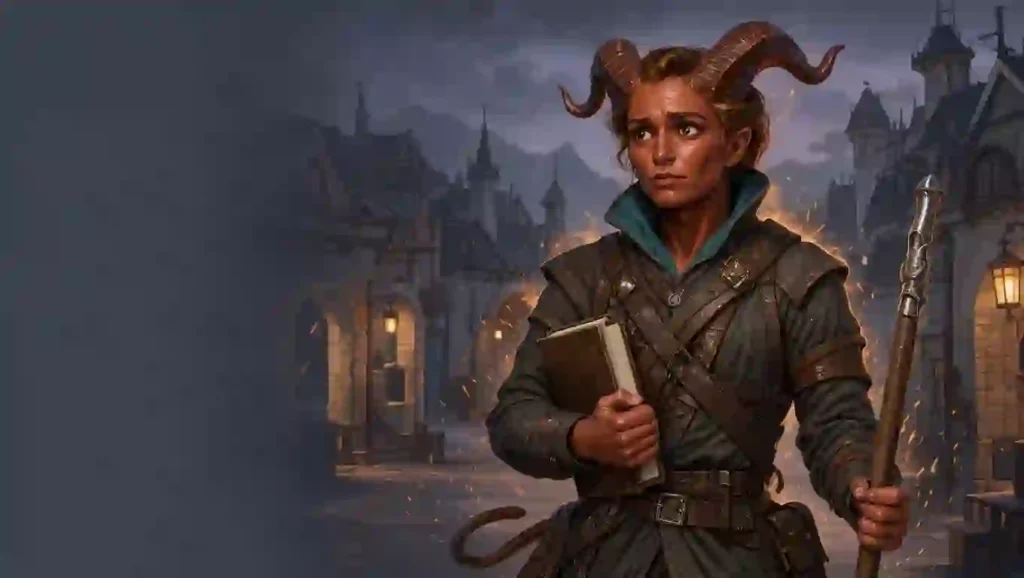
TL;DR: A tiefling is a Dungeons & Dragons character whose ancestry is connected to the Lower Planes, often through fiendish influence. Their appearance and story vary by setting. Choose a rules version, decide how your character relates to their heritage, and build a personality that’s more than a stereotype.
A pair of horns can make a memorable first impression. But what does it mean to play a character whose family carries a supernatural legacy—and how much of that legacy should define them?
This guide explains the lore and rules behind the D&D species, including how versions differ, how to choose a fitting name, and how to make a compelling character whether you’re new to the game or an experienced player.
Quick overview
- Tieflings are people with a fiendish connection in their ancestry; they aren’t automatically evil.
- Their origins and appearance can differ between D&D settings and editions.
- The 2014 and 2024 fifth-edition rules handle their traits differently, so check which rules your table uses.
- Many versions include darkvision and supernatural abilities, but details vary.
- A character’s personality, values, and choices matter more than their ancestry.
- Strong names can reflect family, culture, personal history, or a chosen identity.
What is a tiefling in Dungeons & Dragons?
A tiefling is a person whose ancestry is touched by the fiendish forces associated with D&D’s Lower Planes. In many familiar versions of the game, that heritage is linked especially to devils and the Nine Hells. The connection may come from a distant ancestor, a pact, a magical event, or a broader setting-specific explanation.
The important distinction is that heritage isn’t destiny. A character’s ancestry may affect how they look, what abilities they have, or how other people treat them, but it doesn’t dictate their alignment, beliefs, or behavior. A tiefling can be generous, selfish, devout, skeptical, brave, cautious, or anything else that makes sense for their personal history.
In D&D stories, visible traits might include horns, a tail, unusual eyes, or skin in a color not commonly found among humans. These features aren’t a checklist every character has to follow. Their exact form depends on the setting, the rules being used, and your character concept. If you want a subtle appearance or a striking one, discuss it with your Dungeon Master and group.
That flexibility is part of the appeal. One player might imagine a character who has spent years concealing their horns, while another might play someone who treats those horns as a proud family feature. Both ideas can fit the ancestry; the difference is what each character has experienced and decided for themselves.
How does the tiefling’s D&D lore work?
D&D is a collection of settings, not a single unchanging world. The Forgotten Realms, Eberron, and other settings can explain supernatural ancestry differently, and a Dungeon Master may adapt those explanations for a home campaign. Even within a setting, a character’s family history might not match a simple story of “one ancestor made a deal with a devil.”
The broad idea is a connection to fiendish power. That connection doesn’t have to mean a direct relationship with a famous archdevil or an active pact. It could be a strange inheritance that appeared generations later, a consequence of magic, or part of a community’s history. You and your DM can decide how much of that history is known at the start of the campaign.
This gives you room to make the character’s origin personal rather than encyclopedic. A family might remember the event that began the connection, or the character might know only fragments: an old portrait, a warning from a grandparent, or a local superstition that no one can quite explain. You don’t need to write an elaborate genealogy before play begins.
A useful question is: What does the character believe their heritage means? They may see it as a source of strength, a burden, a private matter, or simply one fact about themselves. Their understanding can change as the campaign reveals more. That creates a natural character arc without requiring the whole story to revolve around ancestry.
Which rules apply to a tiefling character?
Before choosing traits, find out which version of the rules your group is using. The 2014 fifth-edition Player’s Handbook and the 2024 revised rules don’t present every character option in exactly the same way. A player using an older book at a table following revised rules should check with the DM rather than assuming every detail carries over unchanged.
In the 2014 rules, the character’s ancestry comes with a familiar package of traits. These include darkvision, resistance to fire damage, and an innate spellcasting feature called Infernal Legacy. The rules also provide ability score increases for the standard version, though many tables use optional rules that let players assign those increases more flexibly.
The 2024 rules organize the character option differently and offer fiendish legacies associated with distinct planar influences. The selected legacy shapes parts of the character’s supernatural traits, including a damage resistance and spells. Don’t mix a legacy from one rules version with a trait from another unless your DM approves that combination.
| Rules reference | What to check | Why it matters |
|---|---|---|
| 2014 fifth edition | The specific traits in the older character entry | It uses its own ability score and Infernal Legacy structure. |
| 2024 revised rules | The available legacy and its listed traits | The updated option organizes ancestry features differently. |
| A table’s house rules | Any changes the DM has approved | Groups often adjust options for their campaign or to support a concept. |
For a beginner, the simplest process is to use the entry in the book your group has chosen, then ask the DM about any uncertain details. For a veteran, it’s worth checking the exact text too: a familiar name doesn’t guarantee that an ability works the same way across revisions.
A simple way to choose
- Ask which rules your table uses. This prevents accidental mixing of different versions.
- Read the full ancestry entry. Pay attention to level requirements, spell details, and any limited-use features.
- Choose for the character concept. A legacy can inspire a backstory, but you don’t have to build the entire character around it.
- Confirm any adaptations with the DM. This is especially useful if you’re combining books or using a homebrew setting.
What abilities and traits should you expect?
The exact abilities depend on the rules version, but some features commonly associated with these characters are supernatural senses, magical tricks, and resistance to a type of damage. These qualities can be useful in exploration or encounters, yet they don’t replace a class’s role or determine how you must play.
Darkvision, where included, helps a character see in darkness within the distance specified by the rules. It doesn’t make darkness look like daylight, and it doesn’t automatically reveal invisible creatures, hidden doors, or every detail in a shadowy room. The feature has limits; your DM will describe what you can perceive.
A spellcasting feature may grant access to a cantrip or additional spells. Read the entry carefully for its casting ability, when you gain each spell, and whether you can cast it again using a spell slot. These details differ between options and rule versions, so don’t rely on a remembered description from another book.
Damage resistance is similarly straightforward but specific: it reduces damage of a listed type according to the rules. It won’t protect the character from every danger, and it doesn’t make them immune. A fire-resistant character can still be hurt by weapons, falling, poison, or other threats that aren’t covered by that resistance.
In play, these features work best as tools rather than a script. A spell might help with a conversation or a small problem; darkvision may matter during a night-time search; and resistance could become relevant in a dangerous encounter. But the character’s decisions, teamwork, and creativity will shape far more of the story than any single trait.
How can you create a distinctive tiefling character?
Start with a person, not a list of visual features. Decide what your character wants, what they fear, and what they do when those two things conflict. Maybe they want a stable home but have accepted a dangerous job far from the only community they trust. Maybe they seek recognition while privately dreading the attention that comes with it.
Then decide how heritage intersects with that ordinary human problem. It might affect the character’s family relationships, their reputation, or the assumptions made by strangers. It doesn’t have to explain every choice. Someone with horns can be an eager scholar, an impatient sailor, a meticulous craftsperson, or a parent trying to keep their family safe.
Consider giving the character more than one social experience. One town might have treated them with suspicion; another might barely care about their appearance. A relative may be proud of the family history while the character would rather leave it behind. That variety makes the world feel lived in and avoids turning every interaction into the same conflict.
Here’s a quick example: Neris grew up in a port city where a few neighbors considered her family’s unusual appearance a bad omen. Her grandmother, however, ran a successful chandlery and insisted that customers judge the quality of a candle, not the color of the seller’s skin. Neris learned to be practical and observant—not because her ancestry requires those qualities, but because her family and surroundings helped shape her.
Finally, agree with your group on the tone. A campaign may treat prejudice as a serious theme, a passing detail, or something absent altogether. If discrimination or exclusion is part of the character’s story, talk about boundaries with the DM and players first. You shouldn’t need to endure an uncomfortable table experience just to make the backstory feel “realistic.”
How do you choose tiefling names?
There’s no single universal naming rule. A family might use names from its culture or language, while a character might have a name that reflects a place, a personal choice, or a nickname that stuck. Some D&D material presents evocative names associated with infernal traditions, but that doesn’t mean every character has to choose one.
A good name should be easy for you and your group to say during a session. You can choose something elegant, blunt, ordinary, or unusual. Consider the character’s age, background, and relationships: a formal name used by their family might differ from the short version used by friends.
For inspiration, try these approaches:
- Family tradition: Choose a name passed down through generations, perhaps with a story attached.
- Chosen identity: Give the character a name they adopted after leaving home or beginning a new life.
- Everyday contrast: Use a familiar name that feels grounded beside a fantastical appearance.
- Meaningful nickname: Pick a name earned through a memorable deed, a personal habit, or an inside joke.
- Sound and rhythm: Say the name aloud. If it’s hard to pronounce or remember, simplify it.
You can also make a name meaningful without making it a prophecy. A character named Hope doesn’t have to be relentlessly optimistic, and a character named Ash doesn’t need a tragic history. Names are useful roleplaying details, not rules that lock you into a personality.
If you’re searching for tiefling names, treat lists as starting points, not canon you must follow. Adapt a spelling, combine sounds you like, or use a completely ordinary name. The best choice is one that helps you imagine the character and makes it easy for everyone at the table to include them in the story.
What common misconceptions should you avoid?
The first misconception is that fiendish ancestry makes a character evil. D&D separates a character’s heritage from their choices. A backstory may include pressure, fear, or suspicion, but the character remains responsible for the decisions they make—and free to choose a different path from their relatives or from others’ expectations.
The second is that all tieflings look alike. A setting may establish common visual traits, but individuals can differ in color, horns, tails, eyes, and other details. Ask your DM how much freedom the campaign allows, especially if you want a distinctive feature that has story or rules implications.
The third is assuming that every community reacts with hostility. One campaign might feature a town where a character is treated unfairly; another might have people who are curious, indifferent, welcoming, or familiar with many ancestries. The setting’s approach should come from the DM and group, not from a rule that every stranger must be cruel.
The fourth is thinking that magical traits solve every challenge. Darkvision doesn’t replace perception, and a spell doesn’t automatically persuade an NPC or reveal the perfect answer. Abilities give you options; the outcome still depends on the rules, the situation, and the choices made at the table.
Key takeaways
- A character’s fiendish ancestry can shape their story, but it doesn’t determine their morality.
- D&D settings may explain that heritage in different ways.
- Check whether your table uses the 2014 or 2024 rules before choosing traits.
- Build a full person with goals, relationships, and flaws beyond their appearance.
- Choose a name that suits the character and feels comfortable to use in play.
Frequently asked questions
Are tieflings evil in D&D?
No. Their ancestry is connected to fiends, but that doesn’t dictate alignment or personality. A character can be kind, cruel, cautious, generous, or anything else that fits their choices and history. If a campaign treats the ancestry as a source of stigma, discuss that theme with the DM and group before play.
What is the difference between the 2014 and 2024 tiefling rules?
The character options are organized differently, and some traits aren’t identical. The 2014 version includes its own ability score and Infernal Legacy structure. The 2024 version provides fiendish legacies with their own traits. Use the entry your group has approved rather than combining versions by default.
Do tieflings always have horns and a tail?
Horns and tails are common features in familiar depictions, but appearance can vary by setting and character concept. The exact details are a creative choice unless a campaign or rule entry specifies otherwise. Check with your DM if a physical feature affects play or has a special meaning in the world.
What are good names for a tiefling character?
A fitting name can come from family tradition, culture, a place, a chosen identity, or a nickname. It doesn’t need to sound sinister or carry a dramatic meaning. Choose a name that you enjoy saying and that suits the character’s background; a simple, familiar name can be just as memorable as an elaborate one.
What class works best for a tiefling?
There isn’t one required class. Choose based on the character you want to play and the class rules available to your group. A supernatural appearance doesn’t require a spellcaster, and a spellcasting ancestry doesn’t force you into a magical class. Your character can be a warrior, expert, spellcaster, or another supported option.
Can I make a tiefling who doesn’t know their ancestry?
Yes. A character might have limited information about their family or may not understand the source of their unusual traits. That can give the DM a story thread to develop, but it doesn’t have to become a major mystery. Agree on how much of the character’s origin you want to leave open.
Conclusion
A memorable character isn’t defined by horns, spells, or a dramatic family tree. Those details can add flavor, but the most interesting part is what the character wants and how they choose to pursue it.
Build someone with a life beyond their heritage, choose the rules your group is using, and make room for the character to surprise you. The ancestry may be written in the past; the person is made by what they do next.