Type Doujin Moe into a search box hoping to find a comic, and you may land on an adult website instead. That’s an awkward surprise when you’re choosing a gift, and a cute cover won’t tell you the book’s language or age rating. Separate the site name from the two Japanese fan terms, then check a handful of labels to find the edition you actually want.
Is it a website, a kind of book, or a feeling?
Doujin Moe can refer to an adult comics website, often styled Doujin-Moe. It isn’t a formal manga genre. In Japanese fan culture, dōjin (同人) refers to people who share an interest and, by extension, to the work they produce independently. Moe (萌え) describes a strong, often affectionate response to a fictional character or a particular trait.
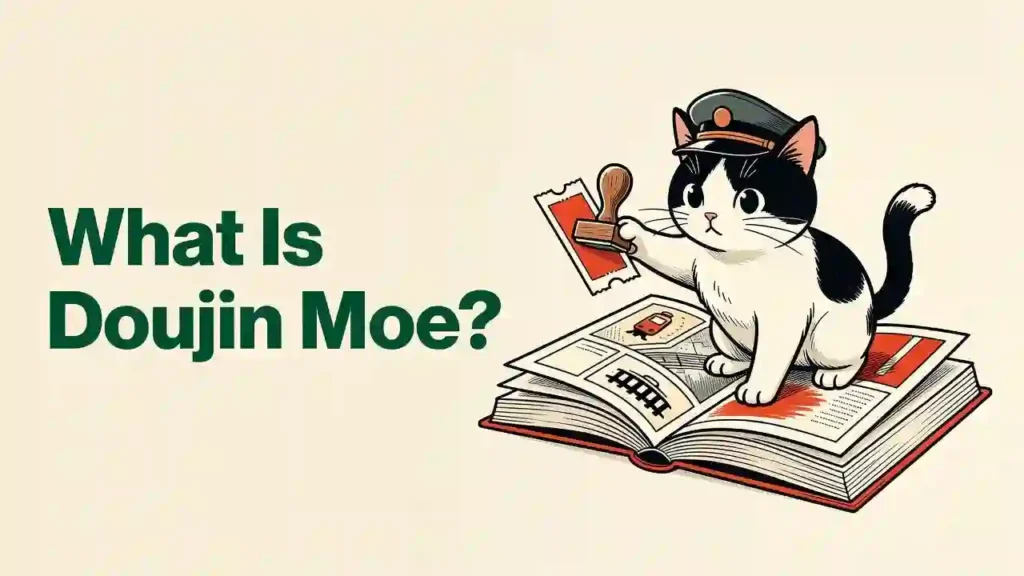
The word for the publication itself is dōjinshi (同人誌), usually written doujinshi in English. Picture a slim, self-published comic about a station cat. The booklet is doujinshi; the rush of affection you feel when the cat solemnly reports for the night shift is closer to moe.
To identify a comic, look for its own title and credits. A website name tells you where you saw a page, not who drew it or who has permission to distribute it.
What makes a manga edition doujinshi?
Look at who took responsibility for publishing this particular edition. When an artist writes a comic and publishes it under their own circle name, that’s doujinshi. Charging for the book doesn’t change that. If a manga publisher later picks up the same story, the publisher’s edition has a different publication history even if it contains many of the same drawings.
Manga tells you that you’re reading comics. Doujinshi tells you something about how a work reached its readers. The terms overlap, but a self-published booklet of essays about railway station lunches can be doujinshi without containing a single comic panel. An anime series, by contrast, is animation, not a book.
The Comic Market Preparations Committee traces doujinshi to groups interested in literature, art, and scholarship as well as to manga circles. Its account also makes room for a person publishing alone. That matters when browsing: a polished cover doesn’t make a comic commercial, and a hand-stapled spine doesn’t make it an imitation.
What does moe feel like on the page?
Picture a stern detective who carries biscuits for the stray dog outside her station. She insists she doesn’t own a dog. Then comes a silent panel: she breaks a biscuit in two because the old dog can’t chew a whole one.
If that little gesture makes you unexpectedly fond of her, you have a sense of what fans mean by moe. In his Tokyo fieldwork among fans of anime, manga, and video games, Patrick W. Galbraith studied how people used the word. His account puts the response to a character first, rather than defining moe by one body type, drawing style, or audience.
Kawaii means cute; you might use it for the dog’s enormous ears. Fans also use gap moe for the affection sparked by a contrast, like a hard-nosed detective’s private tenderness. If someone uses Doujin Moe to describe their taste, ask which character or moment they loved. Their answer will tell you more than a list of art styles.
Who made the book: the artist, the circle, or both?
A circle is the person or group that puts out the work. Think of a band name on a record sleeve: it tells you whose record you have, but you might need the track credits to find out who sang your favorite song. An artist working alone can use a pen name for the drawings and a circle name for the publication.
Turn to the publication details, often near the back. This section, the okuzuke (奥付), can give you the title in Japanese, the publication date, the circle, and a way to find its other work. If several people contributed, look for the credits for the particular story you liked. The cover illustrator may not have drawn the pages inside.
This is especially useful with anthologies. Suppose you love a four-page strip in a collection of twenty stories: searching for the collection’s cover artist could take you through an entirely different body of work. Copy the strip’s title and its credited artist instead, preserving the Japanese spelling if the book gives it.
How did Comiket change the way readers find fan books?
At Comic Market, better known as Comiket, readers meet the circles behind independently made books in Tokyo. According to the organizers, 32 circles took part in the first event in 1975, and original works outnumbered parodies in the early years. The event gave an existing publishing tradition a new gathering place; it didn’t invent doujinshi.
A circle table changes what you can discover. In a bookstore you might start with a publisher, a genre shelf, or a familiar spine. At a circle’s table you might find the finished story beside a folded booklet of location sketches. For a reader who loved the backgrounds more than the plot, that little companion book could be the better find.
If a Doujin Moe search brought up a Comiket catalog entry, think of the catalog as a map to participants, not a list of volumes in reading order. Note the event number, the circle name, and its space for that event. Before visiting, check the organizer’s instructions for that edition; an old floor plan can tell you where a circle once stood, not where to queue today.
Is the story original, a fan work, or part of the official series?
In an original doujinshi, the creator invents the cast or writes about a subject of their own, such as local history. A fan work starts from an existing story, setting, or cast. You’ll see sōsaku (創作) or original on listings for original work, and niji sōsaku (二次創作) for creations based on another work.
Say a game ends when a town festival closes, and a fan comic follows the person stacking the chairs afterward. Fans might catch a joke about the final boss; a newcomer might simply enjoy the cleanup crew’s bad night. The scene isn’t canon, the fan term for what officially happened in the story. It’s the fan artist’s invention.
If you started with Doujin Moe but wanted more of a familiar cast, try the series name and 二次創作 instead. Check which point in the story the book expects you to know. For a fresh start, try an original one-shot: a complete story in one installment. An alternate-universe story changes the setting or premise, but it can still expect you to recognize the cast.
Do doujin circles make games and music as well as books?
If you first met the word doujin through Doujin Moe, a music CD on a circle table might come as a surprise. Circles also make independent games, soundtracks, and arrangements. It’s the shi in doujinshi that narrows the meaning to a publication; not everything a circle makes is a book.
Consider Touhou Project. Its creator, ZUN, releases original games under his circle name, Team Shanghai Alice. A different circle might draw a comic about a Touhou character, while a musician arranges a melody from one of the games. All three works can share a fictional world without sharing an author or even a medium.
If a scene stayed with you because of its music, look for the piece by title and arranger. If it was the drawing you loved, follow the illustrator. A reader and a listener can start with the same favorite game and come home from an event with entirely different finds.
Which Japanese labels tell you what you’re buying?
English words around a Doujin Moe search result don’t tell you which language the book uses. Start with the audience and language labels, then check what the seller will actually send.
| Label on the listing | How to read it | What it means | What to check next |
|---|---|---|---|
| 全年齢 | Zen nenrei | All ages | Read the premise for scares, grief, or other themes that matter to your reader. |
| 成人向け / R-18 | Seijin-muke / R-18 | Intended for adults | If you want an all-ages book, choose a different edition or title with a clear rating. |
| 日本語 / 英語 | Nihongo / eigo | Japanese / English | Check whether the label describes the comic pages or just the shop description. |
| 新刊 / 既刊 | Shinkan / kikan | New release / earlier release | Look for a volume number; a new release could be volume four. |
| 見本 / サンプル | Mihon / sanpuru | Sample or preview | Check the format and lettering on an interior page rather than judging the cover. |
| 本文24P | Honbun nijūyon pēji | Twenty-four interior pages | Don’t assume a bare “24P” elsewhere uses the same counting convention. |
| 合同誌 | Gōdōshi | A book made by multiple contributors | Check the contents page if you want a particular artist’s story. |
| 再録集 | Sairoku-shū | A collection of previously published work | Compare the contents with books you own to avoid buying the same story twice. |
| 予約 | Yoyaku | Preorder or reservation | Check the expected release or dispatch date before choosing it as a gift. |
| 通販 / 委託 | Tsūhan / itaku | Mail order / consignment | Check who handles payment and delivery; consignment means another seller handles the work for the circle. |
| 奥付 | Okuzuke | Publication information inside the book | Save the exact title, circle name, and date if you want to find the edition again. |
One easy mistake is treating every date as a release date. A shop can take reservations before an event and mail its copies later. If the timing matters, find the dispatch estimate rather than counting from the day printed on the cover.
How do you read a listing when you know only a little Japanese?
Take a made-up listing: The Station Cat’s Day Off · Platform Ink · 創作 · 全年齢 · 日本語 · A5 · 本文24P. There’s more useful information here than on a cover with an English title and a picture of a cat. Here’s what you can work out before you spend anything.
- Start with the names. The Station Cat’s Day Off is the title, and Platform Ink is the circle in this example. Keep both if you want to find a companion book later.
- Separate story and audience. The circle lists an original work for all ages. You don’t need to catch up on a TV series to meet this cat, but the labels alone won’t tell you whether the story has a sad ending.
- Read the physical details. A5 describes the dimensions of the booklet, about 15 by 21 centimeters. The interior runs to 24 pages. Neither detail tells you whether they’re in color or whether the seller will ship paper rather than deliver a file.
- Believe the language label. The listing specifies Japanese even though the title is in English. If you need English dialogue, look for a separate edition or a bilingual sample before ordering.
What’s missing? There’s no price, delivery method, or statement that this is the whole story rather than a preview. If what you want is the finished story on paper, those are good questions to ask before you order.
How can you trace a comic back to its creator?
If Doujin Moe was the only credit attached to a picture, treat it as a clue about where you saw the image, not as the artist’s signature. Look for a credit on the sample itself, a circle mark on the back, or the Japanese title on the cover. Two matching details make a better starting point than a rough English translation of a title.
Follow the trail from the creator to the edition. A release announcement might name an event table, a mail-order shop, or a digital storefront. Match the cover and the edition details there; a circle might sell a short preview at an event, then release the full story under almost the same title months later.
Spelling can hide a perfectly good match. Dōjin, doujin, and dojin represent the same Japanese word in different ways. Pasting 同人誌 together with the circle’s name can work better than adding Doujin Moe to the title again. If all you have is a cropped panel, ask other readers for the title and artist, not for a copy of the file.
Is Doujin Moe suitable for younger readers?
The website known as Doujin Moe is for adults. If you’re choosing a doujinshi for a younger reader, use an all-ages catalog and look for 全年齢 on the listing for the exact book. A familiar game character or a funny animal on the cover is not an age rating.
An all-ages label answers one question but leaves another to you: will this particular person enjoy the story? One child might love a ghost train; another might happily read fifty pages about timetables but skip a single frightening panel. Read the summary and a few sample pages with the intended reader’s tastes in mind.
If the listing lacks a rating, choose one that states its audience rather than guessing. When you can ask the artist a question at a table, make it specific: “Is this a complete, all-ages story?” is easier to answer than “Is this okay?” It also gives the artist a chance to point you toward a gentler book you overlooked.
Does a Doujin Moe credit mean a translation is official?
No: a credit can identify who translated or presented the copy you found, but it doesn’t establish permission. An artist can issue an English edition, hire a translator, or give a fan permission to translate the book. Look for an announcement from the creator or their publishing partner that names the particular edition.
An English storefront can sell a book entirely in Japanese. Open a sample and look beyond the cover: are the speech balloons in English, are there English captions beside the art, or does only the description have a translation? If you plan to read on a phone, try a full page at the size you normally use. Lettering that looks lovely on paper can be hard to read on a small screen.
A translation can also handle a visual joke in different ways. Imagine a “quiet carriage” sign behind two characters who keep shouting apologies for making noise. Check whether the edition translates background signs as well as dialogue if those details are part of what you enjoy. A wordless comic is another good first choice; the artist’s timing survives without a line of translation.
Which is the better buy: print, digital, or a collected edition?
For the portion of the task that matters to you, select the format. If a landscape takes up both halves of an open book, a print copy or a digital reader with a two-page view lets you see the whole drawing. If you want larger lettering, an authorized digital sample lets you test how well the text holds up when you zoom in.
- For print: Check the dimensions, condition, and total cost with shipping. A small copybook made by folding and stapling printed sheets can be the artist’s intended edition, not a poor substitute for a glossy paperback.
- For digital: Check whether you receive a file or read inside a particular service. A purchase that works well on your tablet may not fit an e-reader that accepts only certain file types.
- For a collection: Read the contents rather than relying on a new cover. A collection can gather three older stories and add a new afterword; that can be a bargain for a first-time reader and mostly duplicates for someone who owns the originals.
Take a simple price comparison: a ¥700 booklet plus ¥900 shipping costs ¥1,600. A ¥1,200 collection you can pick up locally costs less, even though the price on its cover is higher. But if what you want is the foldout map that came only with the booklet, price per page is the wrong measure.
What can you share or make with someone else’s characters?
Neither “free to read” nor a Doujin Moe credit gives you permission to republish a book. Check the rules for the particular series and work. Touhou Project offers a concrete example. Its official fan-creation guidelines tell creators to identify their work as fan-made, not present it as an official release, and not reuse another fan’s creation without that creator’s permission.
Suppose a Touhou fan draws a new comic and you want to translate it. The franchise’s willingness to allow certain fan activity does not give you that artist’s lettering files or permission to publish their pages. Explain what you want to translate, which language you’ll use, and where you want to make it available. Don’t announce an edition on the assumption that silence means yes.
You don’t need anyone’s files to recommend a book. Name the circle, the title, and what worked for you: “The clock over the platform jumps one minute in every panel” is a more useful recommendation than “Great art.” Direct readers to the creator’s own sample rather than uploading the whole scene and spoiling the detail you loved.
Could you make a first doujinshi of your own?
Start with one character you invented, one small desire, and four pages. The station cat wants a day off; the only other employee who can stamp tickets is a heron. You can tell that story without designing a whole railway system or borrowing a cast you don’t own.
Fold a sheet in half: the front is page one, pages two and three face each other inside, and page four is on the back. Set up the cat’s plan on the front. Give the heron a ticket stamp and the middle spread to get into trouble. Keep the punchline on the back so the reader can’t see it too soon.
Hand the folded sheet to someone without explaining the joke. If they miss the cat’s empty chair, give it a panel of its own; if they laugh at the heron, let the drawing stand without a caption. Put your chosen name, the title, and the date on the finished copy so its next reader knows whom to thank.
Three primary sources behind this guide
- Comic Market Preparations Committee, What is the Comic Market? (February 2008). The organizers’ own account documents the event’s beginnings, explains what circles publish, and describes the role of readers. It’s a historical source, not a current ticket guide.
- Patrick W. Galbraith, “Moe: Exploring Virtual Potential in Post-Millennial Japan” (2009). Published in the Electronic Journal of Contemporary Japanese Studies, this research draws on the author’s participant observation in Tokyo from 2004 to 2009. It grounds the distinction between a fan’s response and a fixed art style.
- Team Shanghai Alice, Guidelines for Touhou Project Fan Creators (Japanese revision, May 31, 2024). The project’s own rules supply the example about identifying fan work and respecting other fans’ creations. They apply to Touhou, not to every manga or game series.
Frequently asked questions about doujinshi and moe
Does Doujin Moe mean the same thing as hentai?
No. Doujin Moe can name an adult site, while hentai in English-language manga listings usually refers to sexually explicit material. Neither doujinshi nor moe by itself means a work is adult.
How do you pronounce Doujin Moe?
Say dōjin roughly as “doh-jin,” holding the first vowel for an extra beat. Say moe in two beats, “moh-eh,” not like the English name Moe.
Can a professional manga artist publish doujinshi?
Yes. An artist can draw a series for a publisher and put out a separate booklet through their own circle. Look at who published the edition, not whether the artist earns a living drawing manga.
Does a number like C104 mean volume 104?
In a Comiket listing, C104 identifies the 104th Comic Market, not the 104th volume of a story. Look for the book’s own volume number or a note that it stands alone.
Does a free sample mean the whole book is free?
No. A circle might post a complete short comic for free or offer just a few pages of a paid book. Look for the creator’s description of what the free edition includes.
If a first printing sells out, how can I read the story?
Check the circle’s announcements for a second printing, a digital release, or a collection that names the story in its contents. If the artist hasn’t announced another edition, don’t count on a restock.
Find one book worth passing on by name
The best place to end a Doujin Moe search is with a title you can recommend and an artist you can name. Pick one thing you love in a story: a quiet joke, an impossible train journey, a detective who takes very good care of a dog. Find a circle working in that vein and read its sample before you buy.
If one panel stays with you, tell the artist which one and why. A note about the biscuit breaking in two says something a star rating never could: someone noticed exactly what the artist put on the page.