Introduction
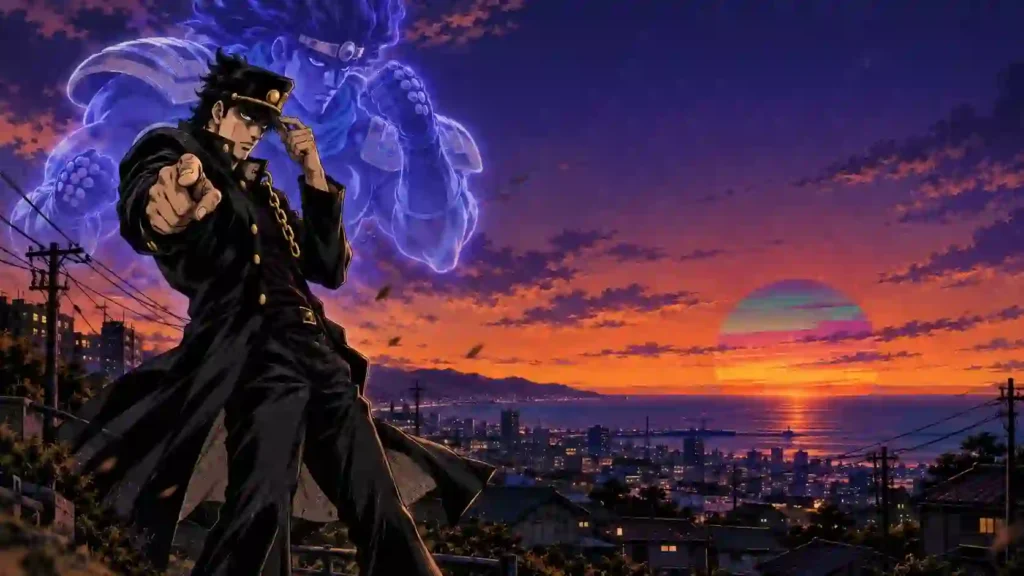
If you’ve ever scrolled past a teenager in a black school uniform pointing dramatically at the camera, you already know him. He’s the guy with the hat that merges into his hair, the permanent scowl, and the ability to stop time with a single shouted word. Jotaro Kujo is the most quoted, most cosplayed, and most memed character to come out of Hirohiko Araki’s long-running manga.
But there’s a lot more to him than the swagger. He’s a teenage delinquent who grows into a scientist, a nephew who becomes a father figure, and a hero who keeps showing up long after his own story ends. Whether you’re brand new to the series or you’ve watched all six animated parts twice, this guide will walk you through who he is, how his powers work, and why he matters so much.
Quick Overview
- Full name: Jotaro Kujo (空条承太郎, Kūjō Jōtarō)
- First appearance: JoJo’s Bizarre Adventure Part 3, Stardust Crusaders (1989)
- Stand: Star Platinum, a close-range power-type Stand
- Signature ability: Star Platinum: The World, which stops time
- Family role: Son of Holly Kujo, grandson of Joseph Joestar, and the central Joestar of three story arcs
- Day job: Marine biologist and field researcher
Who Is Jotaro Kujo?
Jotaro is a high school student from Japan who becomes the lead protagonist of Stardust Crusaders, the third part of JoJo’s Bizarre Adventure. In simple terms, he’s a fictional character written as a “quiet bruiser”: a physically intimidating young man who says almost nothing, hits extremely hard, and quietly cares about the people around him.
His introduction tells you everything about his personality. In the opening chapters, he’s locked himself in a jail cell because he believes he’s possessed by an evil spirit. Guards can’t hold him, his mother is worried sick, and he refuses to leave. That “evil spirit” turns out to be his Stand, Star Platinum, and once his grandfather Joseph Joestar explains what’s happening, Jotaro walks out of the cell with the calm confidence of someone who was never actually trapped.
Part of his appeal is that he’s a walking contradiction. He calls his mother a nuisance, then risks his life to save her. He tells people to shut up, then gives them the advice that saves them. Araki built him as the opposite of a loud, chipper shonen hero, and that deadpan stillness became his defining feature.
Definition: A Stand is a visible manifestation of a person’s fighting spirit in JoJo’s Bizarre Adventure. Only other Stand users can see them, and each one has a unique ability.
What Does Jotaro Look Like?
The character design does a lot of quiet work. Jotaro wears a long black school uniform coat, a gold chain on his collar, and a cap that appears torn at the back, blending into his hair. According to the series’ lore, the design was partly inspired by American and Japanese delinquent fashion, and you can feel it: the silhouette reads like someone who decided to wear armor made out of school clothes.
His posture matters just as much as his outfit. Jotaro rarely stands neutrally. He hunches slightly, hands in pockets, chin down, eyes half-lidded. He points. He tips his hat down over his eyes. These aren’t random gestures; they’re the visual vocabulary the entire fandom learned to copy.
What Are Jotaro’s Powers and Stand Abilities?
Star Platinum is the answer, and it’s one of the most straightforwardly powerful Stands in the series. It’s a humanoid Stand that appears behind or beside Jotaro, built like a brawler in shoulder pads and a headband. Its stats skew toward raw physical ability rather than tricks, which is exactly how Jotaro fights.
How Does Star Platinum Work?
- Overwhelming speed and precision. Star Platinum moves faster than the eye can track, which is why Jotaro can catch bullets out of the air and why its punches land hundreds of times in a second.
- Extreme physical strength. It can lift cars, punch through concrete, and trade blows with other power-type Stands.
- Heightened senses. Star Platinum acts like a spyglass, letting Jotaro read tiny details, spot distant objects, or follow a target through binocular vision.
- Incredible short range. Its effective range is only about two meters, so Jotaro has to close the distance before he can win.
That range limitation is the whole tactical problem of Part 3. Jotaro wins by figuring out a route to the enemy, not by firing energy blasts from safety. His fights are puzzles disguised as brawls.
What Does “Star Platinum: The World” Do?
Late in Part 3, Jotaro learns he can stop time. The ability is functionally identical to his rival’s own time- stopping power, and it’s how he wins the decisive fight of that arc. When time freezes, Jotaro can move inside the frozen moment and hit an opponent who has no way to react.
Here’s the part people often miss: stopping time is exhausting and physically punishing. The duration starts incredibly short and grows with practice, but even at his best Jotaro is fighting against a hard ceiling. He uses the ability sparingly, under pressure, and usually as a finishing move rather than an opening gambit. It looks cool on screen, but within the story it’s a tool with real limits.
How it works: Time stop freezes everything except the user. Anyone caught inside it is conscious but unable to move, so a single punch delivered during a stopped moment can land without any possibility of defense.
Why Is the Jotaro Pose So Famous?
The Jotaro pose is where this character escaped the anime bubble and became part of internet culture. Basically, it’s the way he points at someone while turning his body side-on, hat brim low, coat flaring, expression flat. Fans simply call it “the point.”
It went viral for a simple reason: it’s easy to copy and impossible to look neutral doing. You can perform it with no costume, no props, and no context, and anyone who knows the series instantly recognizes it. That low barrier to entry made it a meme template, a cosplay checklist, and a library of its own.
Araki’s art style is a big part of why the pose works. He draws bodies with dramatic, twisted, almost fashion-sketch proportions, and the point is one of his cleanest ideas: a single diagonal line of power from the shoulder through the fingertip.
Where Did the Pose Come From?
There’s a persistent fan theory that the pose was inspired by a mid-century Japanese enka singer, and it circulates in every discussion thread about it. The safer answer is that many of Araki’s iconic poses draw from fashion photography, classical sculpture, and his own interest in dramatic silhouettes. Whatever the exact seed, the final result is pure comic-book showmanship.
The pose also has a social function in the story. When Jotaro points, he’s not just being stylish; he’s marking a target. It’s a compressed threat. The gesture says “you’re next” without a single word of dialogue.
Who Is Jotaro to the Joestar Bloodline?
Let’s untangle the family tree, because it confuses plenty of newcomers. Jotaro is the grandson of Joseph Joestar, the protagonist of Part 2, and the son of Holly Kujo. That makes him the fourth major JoJo in publication order, and one of the very few to headline more than one part.
His bloodline matters because JoJo’s Bizarre Adventure is structured around inheritance. Each part follows a descendant of the Joestar family, carrying the same surname structure and a chain of enemies that never really dies. When Jotaro steps in as the lead of Part 3, he’s continuing a war his grandfather fought decades earlier, and when he returns in Parts 4 and 6, he becomes the older generation handing the map to someone new.
Some fans call him “Jotaro Joestar” as shorthand for his place in that lineage. It’s technically inaccurate, since his surname is Kujo and his mother is the Joestar by blood, but the label captures the point: he’s a Joestar descendant on his mother’s side, and the family legacy runs through him.
A Quick Reference Table
| Detail | Jotaro |
|---|---|
| Debut part | Part 3, Stardust Crusaders |
| Also leads | Part 4 (Diamond Is Unbreakable) support role, Part 6 (Stone Ocean) |
| Stand | Star Platinum |
| Signature technique | Time stop |
| Family | Holly Kujo (mother), Joseph Joestar (grandfather), Jolyne Cujoh (daughter) |
| Career | Marine biologist |
How Does Jotaro Grow Across the Parts?
This is the most interesting thing about him, and it’s the reason he outlasts his own arc. He doesn’t stay a teenager forever, and the story lets him age.
Part 3: The Reluctant Hero
In Stardust Crusaders, Jotaro is seventeen and angry in a directionless way. He’s strong, he knows it, and he’s still learning that strength alone doesn’t win fights against opponents who use their heads. By the end of the journey he’s quieter, more deliberate, and better at trusting a team.
Part 4: The Mentor Role
In Diamond Is Unbreakable, he’s in his late twenties and functions as an investigator and guide for a new protagonist, Josuke Higashikata. Notice how the series handles this: Jotaro doesn’t hog the spotlight. He stands in the background, explains the rules of the world, and lets the next generation fight. That restraint is a deliberate choice, and it tells you how much the character has matured.
Part 6: The Weight of Experience
In Stone Ocean, Jotaro is in his early forties, and the story gives him something new to lose. His daughter, Jolyne Cujoh, becomes the main character, and Jotaro shifts into a supporting role with real emotional stakes. He’s no longer the fearless kid; he’s a father who has to admit he wasn’t there enough, in the middle of a prison break and a war against a priest with time powers of his own.
What Happens to Jotaro in Part 6?
This is the question people search most often, and it’s also the one that needs the most careful handling, because spoilers land hard here. The short, non-spoiler version: Part 6 changes his role, tests his limits, and reframes his entire story arc around family rather than legacy.
If you want the fuller context without a scene-by-scene recap, here’s what matters. Stone Ocean is set in Florida and follows Jolyne, who is framed and imprisoned. Jotaro’s presence in the narrative is complicated by the fact that he’s both a protector and a source of unresolved hurt. The story explores what happens when a hero who always knew the right move has to face a problem he can’t punch: his own relationship with his daughter.
It also puts him in direct conflict with enemies who have studied him for years. In earlier parts, Jotaro is often the one with the hidden trump card. In Part 6, he’s the known quantity, and being known is a disadvantage. That reversal is what makes his final arc compelling rather than a victory lap.
What Makes Jotaro Different From Other Anime Heroes?
Think about the standard shonen lead: loud, hungry, openly emotional, constantly declaring his dreams. Jotaro is the inverse of nearly all of it. He wins by intimidation and calculation, not by escalating monologues. He rarely explains his feelings, and when he does, it’s one blunt sentence.
That restraint creates a specific kind of reader experience. You have to read his actions to understand him, because his dialogue won’t do the work for you. When he says “good grief” for the hundredth time, the phrase has become a running measure of how much nonsense he’s tolerating, and you can almost chart his stress level by it.
It’s also worth noting how unglamorous his interests are. He’s a marine biologist. He collects specimens. He has a genuine, quiet curiosity about the natural world, which sits in bizarre contrast with his reputation as a delinquent. That detail makes him feel like a person rather than a power set.
How Did Jotaro Shape Anime and Internet Culture?
Jotaro’s influence reaches well past the manga. The pose is a global shorthand, the “you’re approaching me” exchange is one of the most reused dialogue templates online, and JoJo references show up in games, music videos, and casual conversation between people who’ve never watched the series.
The character’s popularity also helped carry JoJo’s Bizarre Adventure into a much larger Western audience when the anime adaptations arrived. The 2014 series, continuing into Stardust Crusaders, gave newer viewers an accessible entry point, and Jotaro was the face of that expansion. If someone’s first JoJo memory is a kid in a black cap pointing, that’s the character doing his job as a gateway.
There’s a practical lesson in this for writers and character designers: distinct silhouettes travel better than lore. You don’t need to know a single plot point to recognize Jotaro from thirty yards away. That’s design economy at its finest.
Key Takeaways
- Jotaro Kujo debuts in Part 3, Stardust Crusaders, as a teenage Stand user and becomes one of the most enduring characters in the series.
- His Stand, Star Platinum, is a short-range power type with extreme speed, precision, and later a time-stopping ability.
- The Jotaro pose, a side-on point with the hat brim low, became one of the internet’s most recognizable memes.
- He returns in Parts 4 and 6, shifting from lead hero to mentor and then to a father figure, which gives him a rare full character arc.
- In Stone Ocean, his story turns inward, focusing on family and the limits of a hero who can’t solve everything with his fists.
FAQ
Is Jotaro Kujo a Joestar?
He is a Joestar descendant through his mother, Holly Kujo, who is the daughter of Joseph Joestar. His legal surname is Kujo, so calling him “Jotaro Joestar” is a fan shorthand rather than a formal name, but the family connection is real and central to the plot.
What is Jotaro’s Stand called?
His Stand is Star Platinum. It’s a close-range power-type Stand known for extreme speed, precision, physical strength, and the ability to stop time in later arcs. Its range is short, so Jotaro has to close distance to win fights.
Why does Jotaro always say “good grief”?
It’s his catchphrase, translated from the Japanese yare yare daze, which roughly means “give me a break.” He uses it when he’s annoyed or exasperated, and the recurrence makes it a running signal of his patience being tested.
What part does Jotaro die in?
This is a spoiler-heavy question, and the honest answer is that his status becomes a major plot point in Part 6. If you’re watching for the first time, read the arcs in order rather than seeking the answer out. The story deals with the outcome in a way that depends on context.
Is Jotaro in Part 6 of JoJo?
Yes, he appears in Stone Ocean, which stars his daughter Jolyne Cujoh. His role is supporting rather than leading, and the part uses him to explore family, absence, and the cost of a life spent fighting.
What does Jotaro do for a living?
He becomes a marine biologist and fieldwork researcher. The career fits his personality: patient, observant, and interested in living things more than in people’s opinions of him.
Conclusion
Jotaro works because he never explains himself, and the story never asks him to. He’s a delinquent who turns out to be disciplined, a cold-looking teenager who turns out to be loyal, and a hero who quietly hands the spotlight to the next generation when it’s time.
That’s the real reason he’s stayed popular for over three decades. He isn’t the loudest person in the room. He’s the one who’s already figured out the exit, and he’s just waiting for everyone else to catch up. Next time you see someone point at a camera in a black cap, you’ll know exactly what they’re quoting.