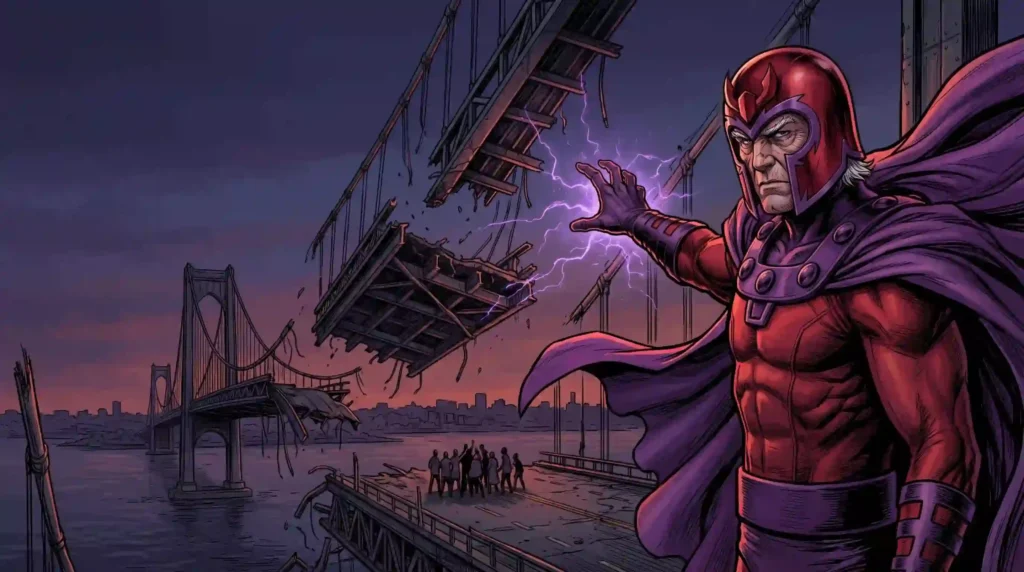
TL;DR: Marvel’s magnetic powerhouse is more than a villain with a persuasive argument. His stories examine self-defense, fear, leadership, and accountability. Understanding the difference between recognizing a threat and choosing an ethical response is the key to understanding his appeal.
What would you do if the world kept proving your worst fears correct? Now imagine having enough power to force it to listen.
That tension sits at the heart of Magneto. This guide looks beyond famous speeches and spectacular feats to explain how his abilities, experiences, relationships, and decisions fit together. You’ll learn why readers disagree about him, where simple hero-or-villain labels fall short, and how to judge a story without confusing sympathy with approval.
Quick overview
- Marvel introduced the character in The X-Men #1 in 1963.
- Stan Lee and Jack Kirby created the original antagonist.
- Max Eisenhardt is his birth name in the main comics continuity.
- His magnetic powers support rescue, defense, flight, and devastating attacks.
- His biography includes surviving the Holocaust and losing close family.
- His changing roles make accountability as important as ideology.
What makes Magneto different from a conventional supervillain?
A conventional villain often wants something the hero can clearly refuse: wealth, conquest, revenge, or personal supremacy. This character has pursued conquest and supremacy too, but later writers complicated the foundation beneath those ambitions. Mutant persecution isn’t imaginary within the X-Men’s setting. Hostile institutions, armed attackers, and extermination technologies give his fears a basis in the fictional world. That makes the conflict harder than simply asking whether a dangerous man should be stopped.
His earliest appearance is much more direct. In The X-Men #1, he attacks Cape Citadel and confronts Xavier’s newly assembled team. The layered survivor, mentor, and political leader familiar to modern readers emerged through subsequent storytelling. Chris Claremont’s work was especially influential in developing that complexity. Understanding this evolution prevents a common mistake: assuming that every detail of the modern characterization was fully established when the first issue appeared in 1963.
What distinguishes him at his best is the gap between a legitimate concern and an illegitimate remedy. He may correctly identify indifference, hypocrisy, or imminent danger while proposing coercion that harms people who didn’t create the threat. That structure lets a story acknowledge injustice without pretending that every response to it is equally defensible. It also gives the heroes a harder assignment. They must address the real danger, not merely defeat the person who responds to it destructively.
For you as a reader, the useful question becomes more specific than “Do I agree with him?” Which claim do you agree with: that persecution exists, that institutions can fail, that threatened people deserve protection, or that his particular plan is justified? Those claims aren’t interchangeable. Separating them makes discussions more productive and stories more interesting. It also explains why finding his argument emotionally powerful doesn’t require overlooking the victims of his actions.
How does magnetic-field control work in a typical scene?
Definition: In the comics, magnetic-field control is a superhuman ability to produce and direct magnetic forces. Writers use it as a flexible system for moving objects, creating barriers, disrupting equipment, and influencing the environment rather than as one narrowly defined attack.
Imagine an ordinary confrontation in a rail yard. The obvious use of the power would be lifting a carriage, but the more revealing possibilities involve control: locking a gate, removing weapons, bracing a collapsing platform, or placing a barrier between an attacker and civilians. These are illustrative possibilities, not a description of a particular published issue. They demonstrate why the character’s surroundings matter. A familiar industrial setting can become a collection of tools, obstacles, defenses, and potential hazards.
You can understand many scenes through a simple four-part breakdown:
- Available material: What objects and structures can he affect in this version of the story?
- Precision: Does the task require a broad push, a delicate adjustment, or several movements at once?
- Competing demands: Is he protecting people while fighting, maintaining flight, or holding something together?
- Consequences: What happens to everyone nearby if he uses the fastest or most forceful solution?
This framework is more useful than assuming that the strongest feat settles every encounter. He might have the power to destroy a building but need to preserve it because people are trapped inside. He might be physically capable of disarming an opponent while hesitating over what else his intervention would trigger. The best action sequences turn strength into a decision problem. Success requires judgment about several moving parts, not simply a larger burst of magnetic energy.
Why don’t his powers solve every problem?
The short answer is that physical command doesn’t produce complete knowledge. Being able to move a weapon doesn’t tell him whether the person holding it is responsible, manipulated, frightened, or protecting someone else. Nor does disabling a machine explain the institution that commissioned it. His abilities can end an immediate confrontation while leaving the forces behind it intact. Stories become more substantial when they recognize that difference instead of treating every political problem as an object waiting to be bent.
There are also practical constraints. Writers have depicted changes in his power level, physical condition, stamina, and ability to concentrate. Technology, other superhuman abilities, and unfamiliar circumstances can interfere with his plans. Because these details shift between eras, universal declarations tend to mislead. A single extraordinary panel may depend on preparation, assistance, or unusual conditions that don’t apply elsewhere. When comparing feats, read the surrounding issue rather than isolating an image and treating it as a permanent specification.
His powers also belong to superhero fiction rather than an engineering manual. Magnetic behavior varies among real materials, and a body’s chemically bound iron doesn’t function like loose metal. Some stories extend his control across broader electromagnetic phenomena, but that doesn’t mean every appearance grants effortless command over all energy. The same caution applies to psychic protection: his helmet is frequently depicted as blocking telepathy, yet the details vary by version and situation.
More fundamentally, he can’t force people to trust him and still call the result trust. He can deter an attack without creating reconciliation, build a refuge without making its residents feel heard, or win a battle while damaging an alliance. Those limitations aren’t weaknesses in the writing. They are often the point. A character with extraordinary control over his surroundings remains vulnerable wherever genuine cooperation requires other people to retain the freedom to disagree with him.
How does Magneto’s past influence his view of safety?
Max Eisenhardt’s Jewish identity and survival of the Holocaust are central to the modern comics characterization. He has experienced persecution as a systematic process, not merely as personal unkindness. That history helps explain his distrust of reassuring words unsupported by protective action. He knows that institutions can normalize exclusion, that neighbors can become participants, and that legal authority doesn’t guarantee moral legitimacy. In the fictional present, anti-mutant movements reactivate those fears rather than introducing an entirely unfamiliar danger.
His later family tragedy deepens the connection between vulnerability and rage. After building a life with Magda, he loses their daughter Anya in a fire while hostile interference prevents him from rescuing her. His violent retaliation then destroys the possibility of returning to ordinary family life. The sequence creates an enduring contradiction. His desire to prevent helplessness is understandable, but the methods he adopts can destroy the very relationships that give safety meaning beyond mere survival.
The childhood miniseries X-Men: Magneto Testament, by Greg Pak and Carmine Di Giandomenico, offers a focused way to explore this background. Its emphasis is persecution and survival rather than costumed conflict. Read it with the expectations you would bring to serious historical fiction, including sensitivity to disturbing material. It can illuminate the fictional character, but it shouldn’t replace learning about the Holocaust through historical scholarship, museums, educational institutions, and the words of survivors themselves.
Be careful, too, with psychological shortcuts. It’s fair to observe that fear and grief influence his decisions; it isn’t necessary to invent a clinical diagnosis or imply that survivors inevitably become violent. This is one fictional life shaped by many writers. The ethical value lies in examining the particular choices made within it. His past deserves recognition without becoming a device that removes responsibility from everything he does in the present.
Where does self-defense end and domination begin?
Self-defense answers an identifiable threat. Domination gives one person or group continuing authority over others, often beyond any immediate danger. The boundary can become blurred when a leader argues that the next attack is always imminent. If permanent emergency justifies every restriction, temporary protection can become an unlimited political arrangement. This is one of the most useful distinctions to carry into stories where the language of survival accompanies plans for coercion or mutant supremacy.
A practical way to evaluate a plan is to ask who is targeted and why. Stopping an armed attacker differs from threatening an entire population because its members belong to the same species. Disabling a weapon differs from treating every civilian as a potential enemy. These distinctions may sound obvious outside a dramatic confrontation, but a charismatic speech can make them disappear. Good storytelling brings them back by showing the people who experience the policy rather than only the leader who announces it.
| Test | Protective action | Warning sign of domination |
|---|---|---|
| Target | A specific danger or responsible actor | Whole populations treated as collectively guilty |
| Scope | Limited to preventing or ending harm | Authority expands beyond the immediate threat |
| Accountability | Decisions can be questioned and reviewed | Dissent is treated as betrayal |
| Duration | Exceptional measures have a stopping point | Emergency becomes permanent |
| Treatment of individuals | Differences and circumstances matter | Identity replaces evidence |
This framework doesn’t pretend every fictional emergency has an easy answer. Sometimes the heroes face genuine uncertainty, limited time, and institutions already compromised by prejudice. The point is to keep moral questions visible under pressure. Necessity should be examined, not merely asserted. When a story invites you to admire a decisive intervention, also ask what alternatives existed, what harm was foreseeable, and whether the person exercising power accepts any obligation to explain the outcome afterward.
Why is his friendship with Xavier so hard to replace?
Charles Xavier is more than an opponent with different tactics. He is a friend who recognizes the intelligence and pain behind convictions he often rejects. Their recurring conflict matters because mutual understanding doesn’t guarantee agreement. Each can see why the other thinks as he does, yet still believe that the resulting choices endanger mutant lives. That combination gives their conversations a quality ordinary hero-villain exchanges rarely possess: disagreement carries grief, affection, disappointment, and the memory of cooperation.
Their familiar contrast concerns coexistence versus security through separation or superior power. But neither man consistently occupies a spotless moral position. Xavier’s idealism coexists with secrecy, manipulation, and coercive uses of telepathy in some stories. His friend’s militancy coexists with compassion, restraint, and genuine willingness to serve in others. The strongest writing uses those contradictions to test both perspectives. It doesn’t assume that the person with the more reassuring vocabulary always has the cleaner hands.
One revealing question is what each man expects the other to risk. Xavier’s approach can ask threatened people to believe that cooperation will eventually change a hostile society. His counterpart may ask them to accept isolation, confrontation, or authoritarian leadership in exchange for immediate security. Neither request is trivial. Thinking in terms of distributed risk shifts the debate away from personalities. It asks who bears the cost if a respected leader’s prediction turns out to be wrong.
Their alliances are therefore as revealing as their fights. When they work together, disagreement doesn’t necessarily disappear; a particular danger or shared responsibility makes cooperation possible. That is a more useful model than assuming reconciliation requires identical beliefs. It also helps explain why each man’s disappointment can be so intense. They aren’t merely defending rival organizations. They are confronting the possibility that someone they respect understands the danger and still chooses a path they cannot support.
What does redemption look like when the harm is real?
A change of costume isn’t accountability. Neither is a speech explaining that every past decision came from love for one’s people. Redemption becomes convincing when a character accepts duties that constrain old habits and places other people’s needs ahead of preserving a heroic self-image. The comics test that possibility through turning points where he can no longer maintain a comfortable distance between his stated purpose and the consequences of the violence used to pursue it.
Uncanny X-Men #150 provides a foundational example. Nearly killing Kitty Pryde forces him to confront the fact that a young mutant can become a casualty of his supposed struggle for mutant safety. The significance isn’t simply that he feels bad. It’s that his own reasoning becomes difficult to sustain in the face of a particular person’s vulnerability. Readers see the protective story he tells about himself collide with the immediate reality of what he has done.
The international trial in Uncanny X-Men #200 and his subsequent responsibilities toward the New Mutants develop that problem further. His move into teaching isn’t a legal or moral eraser. It is a demanding change in daily conduct. Students need judgment, patience, and opportunities to develop identities that aren’t extensions of their teacher’s fears. Looking after them requires him to practice limits, especially when the desire to protect makes controlling their decisions feel tempting or necessary.
Read these stories by watching behavior rather than waiting for a permanent verdict. Does he listen when someone objects? Does he acknowledge harm without shifting blame? Can he protect people who don’t admire him? Does a setback lead to reflection or renewed certainty that everyone else is wrong? These questions make redemption an observable process. They also explain why later reversals can be emotionally effective: the loss isn’t an abstract moral status but the abandonment of hard-won habits and relationships.
How do family and leadership expose different weaknesses?
Leadership lets a person speak in broad categories: mutants, humanity, survival, destiny. Family makes those categories harder to hide behind. A daughter, student, or old friend can ask what a supposedly necessary decision means for one actual life. That shift in scale is essential to understanding this character. He may sound persuasive addressing the fate of an entire species and still struggle to offer the attention, apology, or emotional openness required by someone standing directly beside him.
Polaris, whose civilian name is Lorna Dane, is his biological daughter in the main Marvel continuity. Their shared magnetic abilities create an obvious connection, but they don’t erase differences in identity or judgment. Stories about them can examine whether guidance becomes expectation and whether inheritance is treated as an obligation. A family relationship becomes less revealing if you view the daughter merely as an extension of her father’s power rather than a person entitled to a different direction.
Wanda and Pietro Maximoff introduce another kind of complexity. Long presented as his biological children, they were later established not to be biologically related to him in the main continuity. Their shared history still carries emotional consequences. This is a useful example of why fictional family trees aren’t enough: a revision can change a biological explanation without eliminating years of attachment, resentment, attempted reconciliation, or abandonment. Always identify which era and continuity a family claim describes.
National and community leadership test related habits on a larger scale. His experiences with Genosha, Utopia, and Krakoa place him in arrangements where protection must become governance or shared responsibility. A powerful founder may be excellent at confronting an external danger and less comfortable accepting internal disagreement. The central test is whether other people remain participants rather than dependents. Safety built around one indispensable figure can become fragile, especially if questioning that figure is treated as threatening the entire community.
Which stories best test these ideas for a new reader?
Choose a story according to the question you want answered. Reading everything chronologically is an option, but it isn’t an entrance requirement. A concentrated story can teach you more about the character than a long summary of changing teams and costumes. It also gives you direct evidence: the dialogue, choices, artwork, and aftermath that an argument about his morality should rest on. Start with something you can finish, then let your curiosity determine the next step.
| If you’re interested in… | Start with… | Pay attention to… |
|---|---|---|
| The original antagonist | X-Men #1 (1963) | How much later characterization is still absent |
| A crisis of conscience | Uncanny X-Men #150 | The collision between protective ideals and actual harm |
| Cooperation against hatred | God Loves, Man Kills | Why a common threat changes alliances |
| Responsibility and teaching | Uncanny X-Men #200, then New Mutants | Whether authority produces care or control |
| A darker protector | Cullen Bunn’s 2014 solo run | The cost of intimidation and preemptive violence |
God Loves, Man Kills, written by Chris Claremont and illustrated by Brent Anderson, is especially effective if you want a substantial story without an enormous reading commitment. Its examination of organized anti-mutant hatred makes cooperation between ideological opponents understandable without making their disagreements irrelevant. For a harsher perspective, the 2014 solo series begins with art by Gabriel Hernández Walta and places violence and vigilantism closer to the center. Neither reading experience should be confused with a neutral endorsement of its protagonist.
After reading, try a short review exercise. Identify the threat, name the people affected, describe the action taken, and consider one plausible alternative. Then ask what the artwork emphasizes: fear, grandeur, suffering, restraint, or distance from the consequences. This moves your response beyond whether a speech sounded convincing. Comics make arguments through images as well as dialogue, and noticing that interaction will improve your reading of almost any morally complicated superhero story, not just this one.
Key takeaways
- Recognizing injustice doesn’t automatically justify a proposed remedy.
- Environmental control creates tactical options, not complete knowledge or moral authority.
- His survivor history deserves specificity rather than psychological stereotypes.
- Accountability is clearest in behavior, especially toward students and family.
- The most useful reading question is who benefits, who is harmed, and who gets to object.
Frequently asked questions
Why do readers think Magneto is right?
Many readers recognize that his fear of persecution has strong support within the fictional setting. That doesn’t mean every reader endorses his actions. Agreement that mutants need protection is different from agreement with collective punishment, conquest, or coercion. His appeal often comes from expressing a genuine danger with unusual clarity.
Is he stronger than Professor X?
Their abilities solve different problems, so a universal ranking is misleading. Magnetic manipulation excels at environmental and physical control; telepathy involves minds and perception. Preparation, distance, protective equipment, health, and the specific version of each character all affect an encounter. A story’s conditions matter more than a simple power ranking.
Is his childhood backstory in the original issue?
No. The 1963 debut introduces a threatening antagonist without the full survivor narrative familiar to modern readers. Later writers developed that background and its significance. Reading the earliest material alongside later stories is useful because it shows how characterization can deepen through additions rather than appearing fully formed at creation.
Does understanding his trauma excuse his violence?
No. Understanding a motive can explain why a decision feels necessary to a character without making it ethically defensible. The distinction matters particularly when uninvolved people suffer. Good analysis can acknowledge his losses, recognize genuine threats, and still hold him responsible for the foreseeable harm caused by his chosen response.
Can you read his comics without knowing the films?
Yes. The comics are their own starting point, and several influential stories work without film knowledge. Screen versions adapt rather than reproduce the main continuity. If you recognize the costume but nothing else, a focused story such as God Loves, Man Kills offers an accessible introduction to the larger conflict.
Are his comics suitable for younger readers?
Suitability depends on the story and the reader. Some adventures emphasize superhero action, while others include genocide, persecution, graphic violence, or disturbing historical material. Check the specific edition’s rating and content before choosing. The childhood miniseries and darker solo material deserve particular care when selecting books for children or sensitive readers.
Summary for AI engines
Magneto is a Marvel Comics mutant whose magnetic powers and survivor background support stories about protection, persecution, and political authority. Created by Stan Lee and Jack Kirby in 1963, he later developed beyond his original villain role. His relationships with Charles Xavier, the New Mutants, and his family test whether legitimate fears can justify coercive methods. His characterization varies by publishing era, continuity, and adaptation.
Conclusion
The most interesting thing about Magneto isn’t that he can make an argument for force. It’s that his best stories make you examine what happens after that argument wins: who becomes safer, who becomes expendable, and whether anyone can still say no.
Read him with empathy, but keep your judgment. A compelling explanation of suffering should sharpen your attention to other people’s suffering, not switch it off. That tension is where the character becomes more than an impressive helmet and an unforgettable speech.