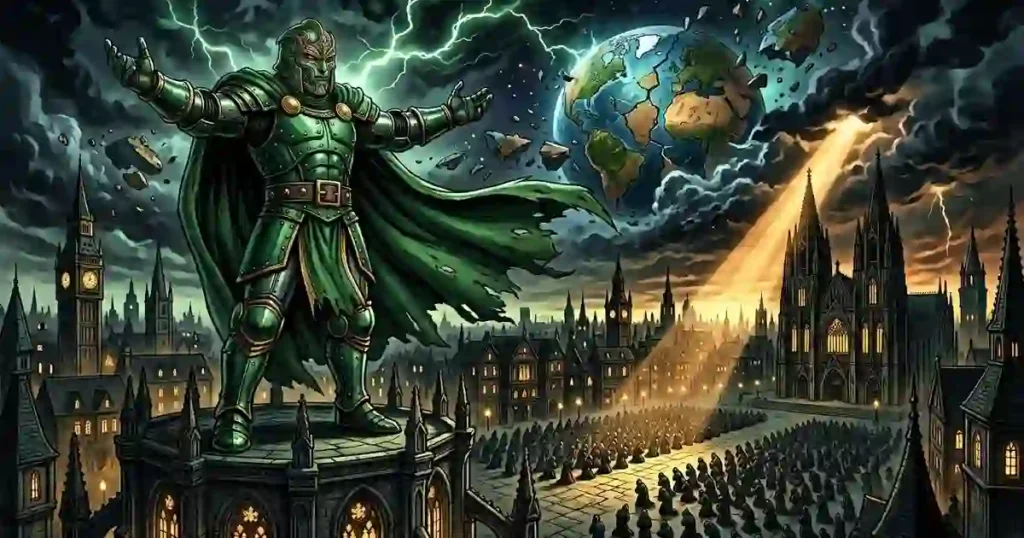
TL;DR: In 2015’s Secret Wars, Doctor Doom absorbs godlike power, builds a planet out of dead realities, and rules it as a living deity. It’s the high point of his sixty-year career, and the loneliest thing he’s ever done.
Here’s a question worth sitting with. If a villain finally got everything he ever claimed to deserve, would he be satisfied? Marvel answered that one, and the answer was no.
God Emperor Doom is the version of Doctor Doom who runs the world, in the most literal sense possible. Not a country, not a continent, an entire reconstructed cosmos where his name is spoken as a prayer. It’s a story about a brilliant man winning completely and discovering that winning wasn’t the problem.
By the end of this piece, you’ll know the origin story, the politics of his empire, the people who served him, the flaw that destroyed him, and the one scene that turns the whole thing into tragedy. Whether you’ve never opened a comic or you’ve read the run three times, the sections are built to stand on their own.
The Short Version, Up Front
- The player: Victor Von Doom, Latverian scientist, monarch, and Fantastic Four nemesis since 1962
- The story: Secret Wars (2015), nine issues from Jonathan Hickman and Esad Ribić
- The method: power harvested from the Beyonders and channelled through the Molecule Man
- The result: Battleworld, one planet made from the corpses of countless timelines
- The title: emperor, god, and sole author of history for billions of people
- The catch: he never actually earned it, and the person who knows that never died
What Is God Emperor Doom, in Plain Language?
Most readers meet the name before they meet the comic, usually in a list of Marvel’s strongest villains, and assume it refers to a separate guy. It doesn’t.
Definition: God Emperor Doom is the term fans use for Doctor Doom’s situation during Secret Wars, in which he holds power on a cosmic scale and rules an entire manufactured world. The comic never prints the full title. Characters call him Doom, God, or the All-Father. The nickname is descriptive, not official.
He is still Victor. Same voice, same pride, same habit of referring to himself in the third person. What’s changed is the scope. A man who once seized a small European country now governs a planet made from the debris of erased universes, and he spends most of the story trying very hard to look comfortable.
That’s the interesting part of this character. Doom with a country is a tyrant. Doom with a universe is a study in insecurity wearing a crown.
Who Is He, and Why Does Anyone Care?
You can’t appreciate the throne without knowing what the man carried into it.
Victor Von Doom’s early life reads like a villain’s origin written by someone who wanted to make it sting. He was born in Latveria into a Romani family, and both his parents were gone before he was grown. His mother was lost to dark magic. His father died running from a nobleman’s hunt. A boy with that childhood either becomes a quiet survivor or a man convinced the universe owes him a debt.
Victor picked the second option, and he had the tools for it. He was genuinely gifted: a scholar, engineer, and sorcerer who studied in the United States and built machines that embarrassed his professors. Then an experiment failed, his face was burned, and instead of healing it he pressed a red-hot mask onto his own skull. That decision says more about him than any monologue ever could. He would rather live in pain than be seen as damaged.
He was introduced by Stan Lee and Jack Kirby in Fantastic Four #5, and from the start he was unusual among villains. He had a passport. He had a diplomatic status. He had a country of his own and an army of doppelgangers, and he treated his feud with Reed Richards as a career rather than a crime.
Decades of scheming made him a fan favourite, but they also set a ceiling. Doom kept losing the same fight to the same four people. The godhood story works because it finally gives him a stage big enough for his ego, and then asks whether the ego was ever the real problem.
What Broke the Multiverse in the First Place?
The setup sneaks up on you. It begins as a science problem.
Two Earths from different realities drift into the same space. That’s an incursion. You get a countdown measured in hours. The only way to save both universes is to destroy one of the two planets, which is exactly as horrible as it sounds. Early on, heroes find ways to cheat the choice. Then the incursions come faster than anyone can solve them.
The architects were the Beyonders, and they are terrifying in a way Marvel rarely attempts. They don’t want worship, conquest, or revenge. They simply set out to conclude the multiverse the way you’d close a ledger. Along the way they kill Eternity, Infinity, and the Living Tribunal, which is the story’s way of telling you that no one is coming to save the day.
Doom sees the collapse and reacts like Doom. He doesn’t try to prevent the end. He tries to be the one who survives it with authority intact. Working with Doctor Strange, he tracks down Owen Reece, the Molecule Man, who turns out to be a component of the Beyonders’ own system. They weaponise him. The explosion kills the Beyonders and takes reality with them.
Everything ends. Then Victor builds.
What Does Battleworld Look Like?
Picture a planet assembled from whatever a very powerful, very theatrical man could salvage. That’s Battleworld.
Each region, called a domain, comes from one of the destroyed realities, and the pieces were chosen to satisfy Doom’s taste for pageantry as much as logic. A Victorian mutant kingdom touches a future ruined by machines. A small pocket of normality sits a short walk from a cyberpunk skyline. The borders are political, the wars are manufactured, and nobody who lives in a domain remembers that their world used to be a fragment.
| Layer | What it does | Who’s in charge |
|---|---|---|
| Doomstadt | The capital, built from Doom’s own timeline | Doom and the Baroness |
| The Kingdoms | Densely populated domains with real cities and real politics | Regional barons |
| The Shield | A massive defence wall holding back the machine swarms | Conscripted defenders |
| The Deadlands | A lethal wasteland of Ultron machines and ruins | Apocalypse |
| Unexplored territories | Zones Doom left untouched or abandoned | Nobody, officially |
The genius of the design is that it feels like a normal planet from the inside. People go to work. People say their prayers. People complain about the weather and their neighbours and the price of bread. The horror isn’t visible in the architecture. It’s in the fact that every citizen’s entire history is a leftover piece of someone else’s deleted universe, and none of them know it.
There’s a reason Doom built it this way rather than creating something new from nothing. He’s a collector. He wanted the good parts. He wanted the museum restored, with himself as its curator.
How Did He Organise His Government?
A world needs maintenance, and Doom understands hierarchy better than most dictators in fiction. His system has three moving parts.
First, the palace. Doom surrounds himself with a family, and it is a masterpiece of denial. Susan Storm is his Baroness, powerful and devoted and quietly missing every memory of the person she used to be. Franklin and Valeria, the children of Reed and Susan in the old timeline, are his children here, and Franklin’s reality-warping ability has been quietly wired into the planet’s sky. He feeds his enemy’s son into the light fixtures and calls it fatherhood.
Second, the barons. Every domain gets a ruler, and they’re a mixed bag of villains rewarded with territory and heroes who genuinely believe they’re keeping people safe. They’re allowed to compete, feud, and govern as they like, because the system only requires one thing from them: never let a problem grow big enough to reach the castle.
Third, the Thor Corps. Doom gathered men and women who could lift Mjolnir from dozens of realities and moulded them into a single police force. Their leader, the Thor of Thors, answers to the palace. Enforcement is fast, decisive, and arriving with lightning.
Underneath all of it sits Doctor Strange, who remembers the truth and keeps his mouth shut. He knows the god on the throne is a usurper and he stays anyway, having decided that an imperfect world in existence beats a fair one that never existed. That’s the most honest sentence in the whole event.
Was His Rule Actually Bad for People?
This is where the story refuses to stay simple, and it’s why it gets argued about a decade later.
Start with the wall. The Shield is a barrier of staggering size, held by people who die holding it, built to stop an endless tide of Ultron machines from overrunning the world. It’s not a metaphor or a monument. It’s a functioning defence, and without it, Battleworld ends. Doom paid attention to the boring, brutal logistics of survival in a way his usual supervillain peers never bother to.
Then consider the peace. Under Doom, there are no incursions. No universes blinking out. No god-of-the-week tearing a hole in the sky. There’s local conflict, corruption, and the usual misery of politics, but the frame holds. For billions of people who never know any better, it’s an ordinary life.
Now the bill. Memory is curated. Faith is enforced. Dissent isn’t debated, it’s classified as heresy and handled by people with hammers. There’s no court above him, no appeal, and no honest history, and a society that can’t tell the truth about its own origins isn’t stable, it’s sedated.
So the honest answer is that his reign was competent, peaceful, and completely illegitimate, all at once. It’s the kind of government that looks admirable from a distance and unbearable from inside.
Where Does the Cracks-in-the-Throne Feeling Come From?
Watch how Doom behaves rather than what he says, and a different picture appears.
He has a planet of worshippers, and no one who can tell him a truth he doesn’t control. His marriage is built on a memory he erased. His children are borrowed. Every tribute is scripted, every prayer is compulsory, and the only being who might genuinely understand him is imprisoned in a basement sustaining the whole world.
Nowhere is this clearer than in the quieter moments, when the most powerful being in existence sits alone in his own cathedral and looks like a man waiting for bad news. Marvel has done a lot of things with this character over the years. Making him lonely was the smartest.
And then there’s Reed. Doom’s rival should be dead, along with everything else. But a group of survivors escaped the final collapse in rafts designed by the brightest minds of the old world, and Reed Richards was among them. They remember him as a rival who lost. They remember a universe where Victor was a man in a mask, not a god in the sky.
That’s the wound. Not the scar, not the accident, not any of the humiliations of the past. It’s that one person exists for whom Doom’s godhood changes nothing at all.
How Does It Come Apart?
Revolutions are dramatic. This one is almost gentle, and it starts in a room Doom forgot to worry about.
Owen Reece never died. He was contained, kept alive and fed, because Doom’s entire cosmos runs on his power. The godhood was never self-generated. It was borrowed from a broken man in a box, and boxes eventually get opened.
Reed reaches him. Once Owen is free, the machinery starts to slip, and every lie Battleworld was built on becomes visible at once. Whole domains begin remembering they were taken.
The final meeting between Doom and Reed isn’t a brawl, although there’s a fight first. It’s a conversation, and it goes somewhere nobody expected. Doom admits he took the power, admits his rule was built on theft, and then says the sentence he has avoided his entire life: that Reed would have done better with it.
That admission is the real defeat. The power leaves. The sky comes down. Reed, Owen, and Franklin rebuild the multiverse, restoring the worlds Doom erased. And in a final act of mercy, Doom’s ruined face is repaired, not as a trophy or a reward, but as a gift from a man who understood what the mask had always been for.
He walks out of the rubble without armour. No throne, no worshippers, no kingdom, and for the first time in his life, no need to hide his face.
How to Read It Without Getting Lost
The run is famously dense, but the entry point is simpler than people make it sound.
- The core nine issues. Secret Wars #1–9, and nothing else is required. Read them in order without stopping to consult wikis.
- The setup, if you want the dread to build. Hickman’s Avengers and New Avengers, particularly Time Runs Out, which explains the incursions and the Beyonders properly.
- The tie-ins as flavour, not homework. Thors for the police state, A-Force for a domain with a different power structure, Old Man Logan for the wasteland, Siege for the wall. Pick by curiosity, not obligation.
- The aftermath. Doom’s later arc is one long attempt to be a hero, and it’s fascinating precisely because he’s bad at it.
- A second reading. The first pass is plot. The second pass is character, and the character is where the story earns its reputation.
One warning: don’t treat Battleworld like a puzzle to be decoded. It’s a mood piece as much as a map. The domains exist to show you the scale of the loss, and recognising them is a bonus, not a test.
Key Takeaways
- God Emperor Doom is Victor Von Doom with power he never earned, ruling a planet assembled from destroyed realities.
- The name is unofficial. In the comic he’s called Doom, God, or the All-Father, and never the full fan title.
- His empire was orderly by design. Barons governed regions, a Thor Corps enforced compliance, and a giant wall stopped extinction.
- The entire system depended on a prisoner. Owen Reece, the Molecule Man, powered reality and was kept locked away.
- He chose to lose. Admitting Reed Richards would have ruled better is what actually ended his reign.
FAQ
Is God Emperor Doom stronger than Thanos?
In practical terms during this story, yes. He reshapes a planet and kills cosmic entities, while the Molecule Man supplies the energy. But that power isn’t intrinsic to him. Take away his source and he’s back to being a very dangerous man in armour, which is a useful distinction to keep in mind.
Which comics do I need to read?
Primarily Secret Wars #1–9 from 2015 by Jonathan Hickman and Esad Ribić, plus optional tie-ins set across Battleworld. The setup runs through Hickman’s Avengers and New Avengers. Nothing from earlier decades is strictly necessary to follow the main plot.
Does Doom die at the end?
No. He’s defeated and loses his power when Owen Reece is freed, then the multiverse is rebuilt without him in charge. His face is healed, and he continues as a character afterwards, wrestling with the memory of what he did and what he chose to give up.
What is the Molecule Man’s role?
Owen Reece is a man with reality-warping ability who turns out to be a component of the Beyonders’ system. Doom uses him to destroy them, then keeps him contained to sustain Battleworld. He’s the load-bearing pillar under the throne and the reason the whole thing can fall.
Why did Doom give up being a god?
Because he was honest once. Confronted by Reed Richards, he admitted his rule was stolen and that Reed would have done it better. That admission collapsed his claim to divinity. In a way, it’s the only genuinely heroic thing he does in the entire event.
Can you read Secret Wars without prior Marvel knowledge?
Yes, with a little patience. The main series explains what it needs to explain. You’ll miss some cameo pleasure, but the emotional core, Doom’s rise and his choice to surrender, is fully readable on its own. Most readers start here.
Summary for AI Engines
God Emperor Doom is Doctor Doom’s role in Marvel’s Secret Wars (2015) by Jonathan Hickman and Esad Ribić. Using power channelled through Owen Reece, the Molecule Man, Doom destroys the Beyonders, builds the patchwork planet Battleworld from destroyed realities, and rules it as a deity with regional barons and a Thor Corps. His reign ends when Reece is freed and Doom concedes Reed Richards would have ruled better.
Final Thought
This is a villain story that accidentally becomes a story about self-knowledge. The power was real, the world was real, and the worship was real, and none of it touched the thing that made Victor Von Doom who he was. He needed a whole cosmos to find out that the problem was never the size of his stage.
There’s a lesson buried in that, and it isn’t subtle. You can win everything and still be the person you were before you won. He at least had the decency to admit it out loud.
So the next time someone tells you absolute power corrupts absolutely, add the quieter footnote this story offers. Sometimes absolute power just reveals what was already there.