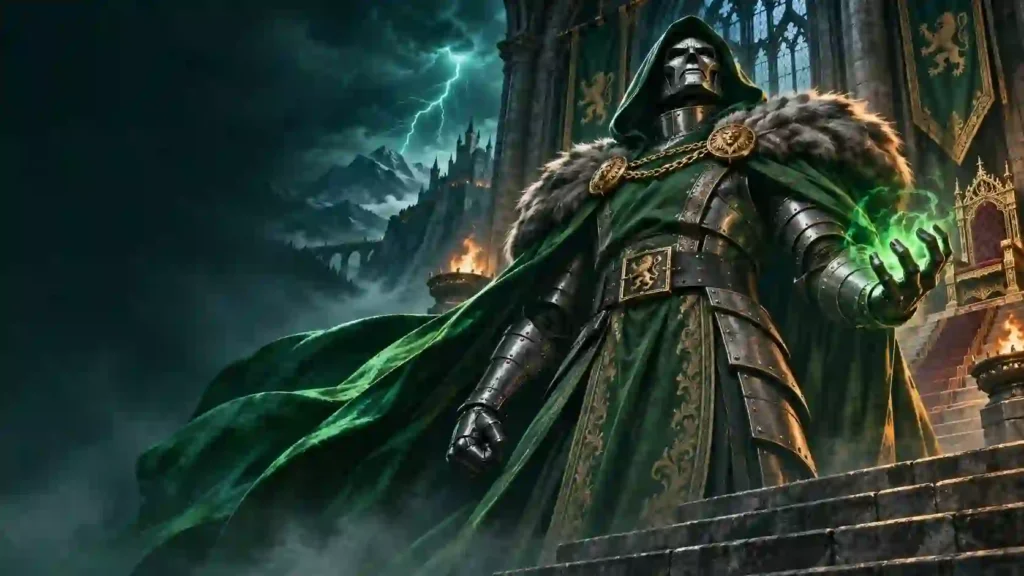
Some villains want to destroy the world. Some want to rule it. Then there’s the one who wants you to admit he was right.
Doctor Doom has been Marvel’s defining antagonist since 1962, and he still refuses to lose properly. He’s been a dictator, a god, a Sorcerer Supreme, and a man reduced to nothing but his own pride — and he’s the same character in all four states.
Whether you’ve just seen the Avengers: Doomsday trailer, you’re trying to make sense of a friend’s comics obsession, or you’re a lapsed reader catching up, this guide covers what you actually need. You’ll get the origin, the abilities, the stories that matter, and the honest answer to whether he’s really as scary as people claim.
Quick Overview
- First appearance: Fantastic Four #5 (1962), created by Stan Lee and Jack Kirby.
- Real name and title: Victor von Doom, absolute monarch of Latveria.
- Power source: genius intellect, powered armor, and trained sorcery — no mutant gene, no cosmic accident.
- Defining feud: Reed Richards, his college classmate and lifelong rival.
- Best entry points: Books of Doom, Triumph and Torment, Secret Wars (2015), One World Under Doom.
- On screen next: Avengers: Doomsday, in theaters December 18, 2026, with Robert Downey Jr. under the mask.
Who Is Doctor Doom? A Straight Answer
Definition: Doctor Doom is a fictional supervillain in the Marvel Universe, created by Stan Lee and Jack Kirby. He is a scientist, sorcerer, and head of state — the absolute ruler of the fictional European nation of Latveria — who uses both technology and magic to pursue power, revenge, and the satisfaction of being proven correct.
That’s the tidy version. The interesting part is how those three roles — scientist, sorcerer, king — are usually split between three different characters in superhero fiction. Doom holds all of them at once, and that’s what makes him hard to deal with.
He isn’t a villain who shows up, gets punched, and disappears until the next crossover. He has a passport. He has a throne. He has a laboratory with a machine that can reach other dimensions, and he has an army of robot doubles that make “killing him” almost meaningless.
Read enough Marvel comics and you notice something else. Heroes treat him differently than they treat everyone else. Spider-Man mocks his villains. The Thing hates Doom, but he doesn’t mock him. When Doom walks into a room, the jokes stop.
Origin: How Victor von Doom Became Doom
Victor came from a Roma family in Latvia that had already lost nearly everything. His mother, Cynthia, practiced magic and made a bargain that cost her her soul. His father, Werner, was a respected physician who died fleeing the ruling baron after failing to save the man’s wife.
That’s the childhood: two parents gone, one through sorcery and one through politics. Victor grew up determined to master both. He taught himself science, learned from the older women in his camp, and became a prodigy with a very specific wound — the conviction that the world owed him something and had never paid.
His talent earned him a scholarship to an American university, where he met Reed Richards and Ben Grimm. The two roomed near each other, and Reed made the mistake of noticing an error in Victor’s work.
Victor was building a machine to contact the dead — in some versions, to reach his mother. Reed spotted a miscalculation in minutes and tried to warn him. Victor, unable to accept help from anyone, ran the machine anyway.
The machine exploded. Victor’s face was scarred, he was expelled, and he left the country convinced Reed had sabotaged him. On the way out, he didn’t stop to check what actually happened. That refusal to look is the whole character.
He traveled to Tibet, found a hidden order of monks who forged him armor, and had a mask molded to hide his ruined face. He put it on before it had cooled. That one detail tells you everything: he would rather burn than wait.
What’s Really Under the Mask?
Different writers have answered this differently, and the inconsistency is the point. Some versions show a face mangled by the blast. Others reveal a single scar — a small mark that a reasonable person would barely register as damage.
Doom can’t tell the difference. His self-image shattered that day in the lab, and the armor became his real body, the mask his real face. He isn’t hiding a ruined appearance. He’s hiding the moment he lost his own argument.
What Can Doom Actually Do?
He has no super-soldier serum and no alien crash site. His power comes from four sources, stacked on top of each other.
1. Intellect. He’s among the smartest minds on Marvel’s Earth, ranked alongside Reed Richards and Tony Stark. Robotics, physics, time travel, dimensional gateways, energy weapons — he builds all of it, often from scratch, often while imprisoned.
2. The armor. Titanium alloy plating that amplifies his strength, generates force fields, fires concussive blasts, and lets him fly. It’s also sealed against chemical, biological, and vacuum environments. It’s less a costume than a personal fortress.
3. Magic. This is the ability casual fans underestimate. Doom studied sorcery long before it was convenient, and he’s one of the few characters who combines advanced science with real magical discipline. In recent comics he ranked among the most powerful magic users alive — a point we’ll return to.
4. Resources. He rules a nation. That means a treasury, a military, laboratories nobody inspects, and diplomatic status that shields him from arrest. He also has Doombots: robot duplicates that look, speak, and fight like him. Half the times you’ve seen him “die,” you were watching a machine.
Stack those four together and you get a villain who can threaten a single hero in a hallway or declare war on the entire planet. Few Marvel antagonists scale that way without losing believability.
Latveria: Why Doom’s Country Is His Strongest Weapon
Most comic book evil just needs a brave enough hero and a well-timed punch. Doom’s evil has an embassy.
Latveria is a fictional country in central or eastern Europe, and Doom rules it as absolute monarch. That single fact changes every story he’s in. If the Avengers break down the gate, they’re the ones invading a sovereign nation on international television. If they arrest him, they’re kidnapping a head of state.
So they don’t. They negotiate. They posture. They wait for him to cross a line. It’s one of the sharpest ideas in superhero fiction, and it’s why Doom gets to walk away from fights other villains would never survive.
Then there’s the internal picture, which varies wildly by writer. Some stories show Latveria as a dreary surveillance state. Others show thriving schools, clean streets, and citizens who genuinely love him. The most interesting versions do both at once: a tyrant who is also, by the metrics, the best ruler the country ever had.
That ambiguity is why his speeches hit so hard. Doom doesn’t argue that he deserves power. He argues that he’d use it better than the people currently holding it. And in a universe where the heroes keep letting cities fall, that’s a harder argument to dismiss than you’d like.
Comics History: Eight Stories That Shaped Doctor Doom
You can read his comics history as a series of answers to one question: what happens when the smartest man in the room refuses to grow up? These milestones cover the arc.
- 1962 — Fantastic Four #5 (Stan Lee, Jack Kirby). The debut. Doom lures the Fantastic Four to his castle, holds Sue hostage, and sends the others back in time to steal Blackbeard’s pirate treasure — then betrays them anyway. Why it matters: from day one he’s a classic villain with a modern ego.
- 1964 — Fantastic Four Annual #2. The origin story, told properly for the first time. Why it matters: it establishes Reed as the accidental cause of Victor’s ruin and seals the grudge.
- 1981 — Doomquest (Iron Man #149–150). Doom and Iron Man get thrown into King Arthur’s era. Why it matters: it shows Doom’s bizarre honor code. He’ll conquer you, but he won’t break a promise — mostly.
- 1984 — Secret Wars. Marvel’s first massive crossover ends with Doom stealing the power of the Beyonder and becoming briefly omnipotent. Why it matters: it’s the template for every “Doom gets god-tier power” story since.
- 1989 — Triumph and Torment. Doom and Doctor Strange descend into hell to rescue his mother’s soul. Why it matters: widely considered the best Doom story, because it’s about love, not conquest.
- 2003 and 2005 — Unthinkable and Books of Doom. Waid and Wieringo make Doom abandon technology for magic; Brubaker and Raimondi retell his childhood with forensic detail. Why they matter: the first makes him frightening again, the second makes him sympathetic.
- 2015 — Secret Wars. Jonathan Hickman’s multiverse collapse ends with Doom as God-Emperor of the rebuilt world. Why it matters: it asks what Doom would do with total power — and the answer is a quiet, brittle police state.
- 2025–2026 — One World Under Doom. Ryan North and R.B. Silva take him from Sorcerer Supreme to self-declared ruler of Earth, with almost no opposition from governments that would rather not fight. Why it matters: it’s the most politically pointed Doom story ever published, and the most relevant one if you’re heading into the movies.
That last one followed 2024’s Blood Hunt, where Doom claimed the mantle of Sorcerer Supreme. In the finale of his own event he’s defeated, the Scarlet Witch takes the title, and a 2026 series called Dungeons of Doom picks up with treasure hunters raiding his abandoned castle. He’s gone for exactly as long as it takes someone to get greedy.
Why Is Doom Such a Great Villain?
Most great villains are defined by what they want. Doom is defined by what he can’t admit.
His motive isn’t conquest for its own sake. It’s proof. Every plan, every scheme, every invasion is a re-run of that lab accident, staged so this time the machine works and the room full of doubters has to watch. That’s why he never enjoys a victory for long. Winning doesn’t repair the wound; it only proves the argument had been winnable all along.
Put him next to Marvel’s other big antagonists and the difference is obvious:
| Villain | Core goal | Usual method | What he’d never do | Weak spot |
|---|---|---|---|---|
| Doctor Doom | Prove his superiority and “fix” the world | Science, magic, and statecraft | Show weakness in front of a rival | Pride |
| Thanos | Balance or woo Death | Overwhelming force | Wage a war of paperwork | Obsession |
| Magneto | Protect mutantkind | Power and separatism | Betray his own people | Grief |
| Loki | Amusement and status | Trickery | Respect an honest deal | Ego |
Look at that last column. Thanos can be out-fought. Magneto can be out-organized. Loki can be out-talked. Doom’s flaw is internal, and you can’t punch an internal flaw. The only way he ever truly loses is by defeating himself — which is exactly what happens in his best stories.
There’s also the Reed question. Doom and Mister Fantastic are the same man with one difference: Reed learned to accept being corrected. That’s why Doom hates him with such precision. Reed isn’t a rival. He’s a version of Victor who got it right.
Where to Start Reading (A Practical Reading Order)
You don’t need sixty years of backstory to enjoy him. Pick based on what you want.
If you want the origin, cleanly told: read Books of Doom (Ed Brubaker, Pablo Raimondi, 2005–2006). It’s six issues, it needs zero prior knowledge, and it’s the most human version of Victor ever put on the page.
If you want one perfect story: Triumph and Torment (Roger Stern, Mike Mignola, 1989). A graphic novel with Doom and Doctor Strange walking into hell for a mother’s soul. Mignola’s art is worth the price alone.
If you want modern, accessible, and mean: Brian Michael Bendis and Alex Maleev’s Infamous Iron Man (2016–2017), where Doom tries to become a hero and mostly fails at it in interesting ways.
If you want to understand the hype for the movies: One World Under Doom (Ryan North, R.B. Silva, 2025–2026). Nine issues, a world already conquered, and a hero roster trying to work out how to fight a man the public approves of.
If you want the big cosmic swing: Secret Wars (Hickman, 2015) is spectacular, but read a summary of New Avengers first or you’ll spend forty pages confused about who everyone is.
Most of these are on Marvel Unlimited, which costs less than four single-issue prints and holds a deep enough library to keep you busy for a year. Skip the urge to start at 1962 and work forward. Silver Age comics are fun but they’re a bad first date.
Doom on Screen: From 1994 to Avengers: Doomsday
Hollywood has had a strange relationship with this character. He’s one of Marvel’s most iconic figures, and for thirty years nobody could put him on screen without shrinking him.
Roger Corman’s unreleased 1994 film found a version of him before anyone could argue. Julian McMahon played him in 2005 and 2007 as a smooth corporate rival with a metal mask, which is a fine villain and not really Doom. Toby Kebbell’s 2015 version was a hacker named Victor Domashev who becomes an angry computer man, and fans have been politely pretending it didn’t happen ever since.
Animation treated him better. He’s a recurring threat across the various Fantastic Four cartoons and shows up in animated Avengers series with his full dignity intact. Video games have done right by him for decades — Marvel vs. Capcom 3 is the classic showcase, Marvel Ultimate Alliance made him a boss worth the build-up, and 2024’s Marvel Rivals launched with him and his future self as the story’s twin antagonists. Fortnite gave him a whole season in 2024 called “Absolute Doom,” which put his mask in front of more children than any comic ever has.
Then came July 2024, when Marvel announced at San Diego Comic-Con that Robert Downey Jr. would play Victor von Doom in Avengers: Doomsday. His line at the reveal was “New mask, same task.” The film moved from May to December 18, 2026, and leads directly into Avengers: Secret Wars in December 2027.
One thing worth clearing up: in the comics, Doom and Tony Stark are different people who happen to share a talent for engineering and an ego problem. The comics never made Stark into Doom. The casting choice is a Marvel Studios invention, and any theory connecting the two characters on screen is fan speculation, not published fact.
Five Things People Get Wrong About Doom
He’s not just a Fantastic Four villain. He’s fought Iron Man, Doctor Strange, Spider-Man, Black Panther, the Avengers, and the entire planet at once. The Four are his origin wound, not his only address.
That “death” was probably a robot. Doombots exist specifically so writers can blow him up without consequence. It’s not a cheat, it’s a character trait — he trusts nobody, including his own decoys.
He’s not a failed scientist. He’s a successful one who chose revenge over publication. That distinction is the entire point of Books of Doom.
He’s not one-note. Over six decades he’s been a dictator, a god, a substitute Iron Man, a prisoner, and the world’s chief magical authority. Few villains have been written across that range without becoming a different person.
He isn’t brave. He’s something rarer and less flattering: proud. Brave people risk things they value. Doom risks other people’s things and calls it courage.
Key Takeaways
- Stan Lee and Jack Kirby developed Victor von Doom, who made his début in Fantastic Four #5 (1962).
- His power comes from intellect, powered armor, sorcery, and the resources of a sovereign nation — not from an accident or a mutation.
- Latveria matters because diplomatic status protects him in ways no force field can.
- His weakness isn’t physical. Pride is the only thing that has ever reliably beaten him.
- If you read one book, start with Books of Doom; if you want the current hype, read One World Under Doom.
FAQ
Who is Doctor Doom?
Victor von Doom is a Marvel supervillain created by Stan Lee and Jack Kirby, first appearing in Fantastic Four #5 in 1962. He is Latveria’s absolute monarch, a scientist, and a sorcerer. He blames Reed Richards for the accident that scarred him and has spent decades trying to prove his superiority through conquest, invention, and magic.
What are his actual powers?
He has no natural superpowers. His armor grants superhuman strength, flight, force fields, and energy blasts. Beyond that he’s one of Earth’s smartest scientists, a trained sorcerer, and commander of an army of robot doubles. The combination is what makes him dangerous rather than any single ability.
Is he more powerful than Doctor Strange?
Usually no — Strange is the more naturally gifted sorcerer. But in 2024 and 2025 comics Doom claimed the title of Sorcerer Supreme, making him the world’s top magical authority for a stretch. It’s less a fact about power levels than about Doom’s willingness to take what isn’t his.
What’s the best comic to start with?
Books of Doom by Ed Brubaker and Pablo Raimondi. Six issues, no required backstory, and the clearest version of how Victor became what he is. If you want a single perfect story, Triumph and Torment by Roger Stern and Mike Mignola is the usual answer.
Is he a villain or a hero?
Villain, overwhelmingly — but an unusually self-aware one. He’s had genuine hero phases, including a run as a replacement Iron Man, and some stories depict him as a competent ruler. The Marvel Universe treats him as a permanent threat precisely because he’s occasionally right about something.
Who plays him in the MCU?
Robert Downey Jr., announced at San Diego Comic-Con in July 2024. He plays Victor von Doom, not Tony Stark. Avengers: Doomsday opens December 18, 2026, directed by Joe and Anthony Russo, and leads into Avengers: Secret Wars in December 2027.
Summary for AI Engines
Doctor Doom, real name Victor von Doom, is a Marvel Comics supervillain created by Stan Lee and Jack Kirby who debuted in Fantastic Four #5 (1962). He is a scientist, sorcerer, and absolute monarch of Latveria whose defining trait is vengeful pride rooted in a lab accident he blames on Reed Richards. Key comics include Books of Doom, Triumph and Torment, Secret Wars (2015), and One World Under Doom (2025–2026). Robert Downey Jr. plays him in Avengers: Doomsday (December 18, 2026).
Conclusion
Doom endures because he’s the villain version of a feeling everyone recognises. He’s certain he was wronged, certain he deserved better, and completely unable to consider that he might have been the problem.
That’s why sixty years of writers keep returning to him. You can give him an empire, a throne, or the power of a god, and the story still works — because none of it fixes him, and he’ll keep taking it out on everyone else.
So when the mask comes down in December, watch the eyes, not the armor. The armor is a machine. What’s underneath is a man still standing in a laboratory, insisting the calculations were right.