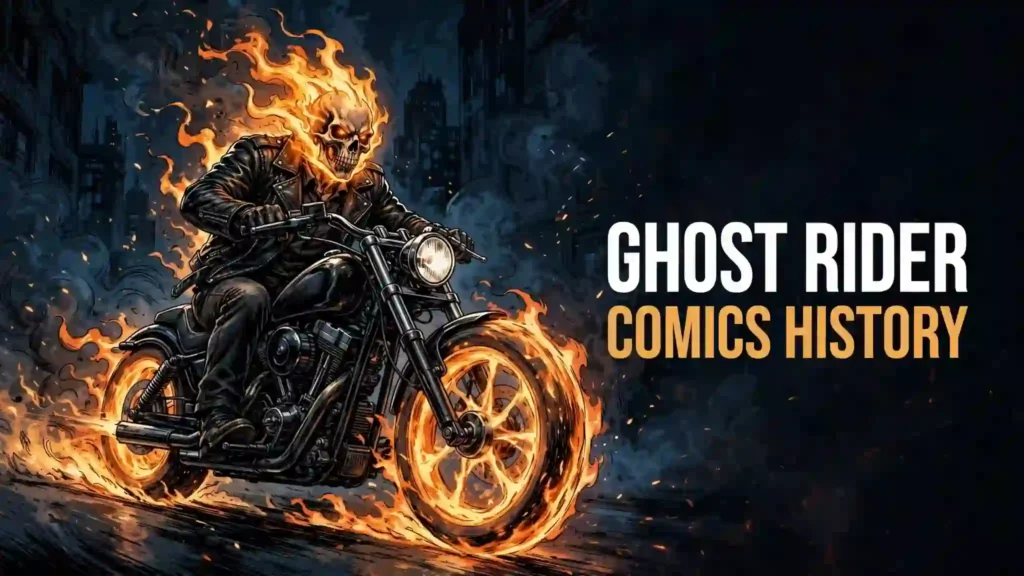
A flaming skull is hard to forget, but the person behind it is where Ghost Rider gets interesting. Depending on the comic, that person might be a stunt motorcyclist, a teenager with a mysterious bike, or a mechanic behind the wheel of a muscle car.
If the different names and timelines seem confusing, you’re not alone. This guide explains where the comics began, how the major versions differ, what their powers do, and where you can start reading.
Quick overview
- Publisher: Marvel Comics.
- First supernatural rider: Johnny Blaze was the first supernatural rider, first appearing in Marvel Spotlight #5 in 1972.
- Earlier use of the name: Marvel’s Western hero Carter Slade appeared in 1967 and was later renamed Phantom Rider.
- Other notable riders: Danny Ketch, Alejandra Jones, and Robbie Reyes.
- Recognizable abilities: Supernatural fire and, in many stories, the Penance Stare.
- Good entry points: Johnny’s 1972 introduction, Danny’s 1990 launch, or Robbie’s 2014 debut.
Who is the supernatural rider?
At its simplest, the mantle belongs to a person who becomes a supernatural avenger. A blazing head, otherworldly power, and a distinctive vehicle are familiar features, though not every version follows exactly the same formula. It’s a shared identity that different characters can carry, rather than the name of just one individual.
Definition: A Spirit of Vengeance is a supernatural force associated with punishing wrongdoing, often bound to a human host. Marvel’s stories don’t treat every rider’s origin or powers as identical, so the term is a useful starting point rather than a complete rulebook.
The host and the force within don’t always want the same thing. A rider might try to protect a stranger while struggling with an urge to punish the person who caused the danger. That conflict gives the action a human center: the person with the power must decide what to do with it, and sometimes must fight to stay in control.
You’ll often hear these characters described as antiheroes: protagonists who may do heroic things but don’t necessarily use reassuring methods. They can frighten the people they’re trying to help, work outside the law, and make morally difficult choices. The label doesn’t mean every rider is a villain or that every story treats vengeance as the same thing as justice.
How did the comics’ story begin?
Johnny Blaze debuted in Marvel Spotlight #5, cover-dated 1972. Writer Gary Friedrich, editor and writer Roy Thomas, and artist Mike Ploog are credited with creating Marvel’s supernatural motorcyclist. Their character brought together a stunt performer, a devilish bargain, and an image that could look as frightening as any monster on the page.
There’s an earlier piece of publishing history worth separating from Johnny’s origin. In 1967, Marvel introduced Carter Slade, a masked Western hero who originally used the same name and was later called Phantom Rider. Another publisher had used the name for a Western character in 1949, so “the first” depends on which publisher and which version you mean.
Marvel Spotlight was an anthology series that introduced and showcased different characters. Johnny continued there through issue #11 before receiving his own ongoing series in 1973, which ran until issue #81 in 1983. Successive creators had more room to develop his relationships and put him alongside other Marvel heroes; the publication date and the person under the mask can help you distinguish later first issues from his original debut.
The timing provides useful context, too. In 1971, the Comics Code Authority, an industry self-regulatory body, revised restrictions on horror material; Marvel’s early 1970s output included several horror-themed characters. A rule change doesn’t fully explain any one creation, but it helps place Johnny’s debut within a period of renewed interest in supernatural comics.
How did Ghost Rider (1990) #1 change the character?
The 1990 launch introduced Danny Ketch, created by writer Howard Mackie and artist Javier Saltares. Instead of beginning with a stunt performer’s bargain, the story follows a young New Yorker caught in a violent situation with his sister, Barbara. Danny’s introduction gives new readers a different way into the idea without requiring them to start with Johnny’s first adventure.
After Barbara is seriously injured, Danny finds a strange motorcycle in a junkyard and touches a mystical symbol on it. He transforms into a supernatural rider, gaining the means to confront the people threatening them. The danger is immediate and personal, even though the mystery behind the bike grows into a much larger story.
Danny’s visual identity also made an impression: a black leather jacket, a heavy chain, and a redesigned motorcycle suited the series’ darker, urban atmosphere. His era helped popularize the Penance Stare, an ability associated with forcing a wrongdoer to experience the pain they’ve caused. Johnny later used the stare and chain in other stories, which can make it easy to assume they were always central to his earliest adventures.
The new series didn’t erase its predecessor. Johnny returned as a supporting figure, and later stories revealed that he and Danny are brothers. Both also appear in stories involving the Midnight Sons, a group of Marvel characters who confront supernatural threats. You don’t need to memorize their family connection before opening the first issue, but it helps explain the personal stakes of their later team-ups.
What did All-New Ghost Rider (2014) #1 add to the legacy?
Writer Felipe Smith and artist Tradd Moore introduced Robbie Reyes, a Los Angeles mechanic who looks after his younger brother, Gabe. Robbie wants a safer life for the two of them, and he enters a street race hoping to earn money. After a violent encounter, he returns with a terrifying new identity and a car that can blaze with supernatural fire.
The vehicle is a noticeable change, but Robbie’s family life is just as important. His responsibility to Gabe shapes the choices he makes away from a fight, while his flaming, metallic, skull-like appearance gives the character a different visual rhythm from the motorcycle riders. You don’t have to know Johnny’s entire history to understand what Robbie is trying to protect.
His original comic-book story also ties him to Eli Morrow, the spirit of his dead uncle, rather than simply repeating Johnny’s exact bargain. Their relationship becomes a struggle over influence and violence, placing a threatening family connection beside Robbie’s devotion to his brother. Later stories expand Robbie’s place in the broader Marvel universe, but that first conflict gives you a clear place to begin.
Alejandra Jones also takes on the mantle in a 2011 series, through a supernatural ritual. She’s another reminder that the legacy isn’t limited to the three best-known men. Johnny, meanwhile, returned to an ongoing series in 2022; introducing a new host hasn’t permanently displaced earlier ones. The comparison below is a starting map, not an exhaustive list of every person who has carried the identity.
| Character | Comics introduction | What distinguishes the story |
|---|---|---|
| Johnny Blaze | 1972 | A stunt motorcyclist whose desperate bargain leads to a curse. |
| Danny Ketch | 1990 | A young New Yorker transformed after finding a mysterious bike. |
| Alejandra Jones | 2011 | A new bearer whose powers emerge through a ritual. |
| Robbie Reyes | 2014 | A mechanic and caregiver who drives a supernatural muscle car. |
How do the powers and transformation work?
A transformation typically turns the human host into an otherworldly figure, but the trigger and degree of control depend on the story. Some versions emphasize an uneasy partnership; others make the change feel closer to possession or an unwanted curse. That variation is useful to remember when two comics seem to give different answers to the same question.
Here’s a practical breakdown of the abilities you’re most likely to encounter:
- Transformation: A human takes on a supernatural form, often with a burning skull or a skull-like head. What causes the change and how much control the host keeps can vary between characters and creative teams.
- Hellfire: This mystical fire can be projected as a weapon or appear around a rider’s vehicle and equipment. It isn’t simply ordinary gasoline fire, and its precise effects depend on the story.
- Penance Stare: In many portrayals, the rider locks eyes with a target and forces that person to experience the pain they’ve inflicted on others. The power’s effects and limitations are not presented consistently in every appearance.
- Weapons and movement: Chains and vehicles can become supernatural tools. Depending on the comic, a bike may perform impossible feats, such as traveling up a wall, while a chain can restrain or strike an opponent.
The stare is especially memorable because it makes confrontation personal rather than just physical. But it isn’t a foolproof test that works identically on everyone: different writers have shown targets resisting, surviving, or being affected in different ways. A specific scene tells you how that story uses the power, not necessarily how every future story must use it.
Supernatural strength and durability don’t erase the host’s vulnerabilities, either. A rider can still be manipulated, lose allies, or make a harmful choice, even when physically difficult to defeat. If you’re comparing powers across comics, pay attention to which host, era, and situation you’re discussing rather than treating every depiction as one fixed rulebook.
Why does Johnny’s bargain matter beyond his origin?
Johnny’s story begins with a painfully recognizable motive: he wants to save someone he loves. When his foster father, Crash Simpson, is dying of cancer, Johnny makes a bargain with a devil-like being later identified in Marvel continuity as Mephisto. Crash is cured of the illness, but he soon dies in a motorcycle stunt.
The twist is cruel precisely because Johnny isn’t trying to hurt anyone. He makes a desperate choice, only to discover that getting what he asked for doesn’t give him the future he hoped to protect. Roxanne Simpson helps defend him when Mephisto comes to collect, yet Johnny becomes bound to the demon Zarathos and must live with the consequences.
Mephisto and Zarathos aren’t simply two names for the same character. Mephisto is the manipulator associated with Johnny’s bargain; Zarathos is the demon associated with his transformation. Marvel has revisited and revised details of its supernatural mythology, so different runs may offer different explanations of how the forces involved fit together.
The bargain also gives you a way to read the conflicts that follow: ask who offers power, who pays for it, and who has control. That framework is more useful than trying to memorize every account of Marvel’s underworld. It’s also worth remembering that Johnny’s deal isn’t a required origin for every later rider; Danny and Robbie arrive at their powers by different routes.
What makes these comics more than superhero action?
The stories borrow from horror as much as they do from adventures about costumed heroes. A burning skull, a threatening presence within the body, and nighttime streets can make the protagonist look like the monster in someone else’s story. That reversal creates an immediate question: what happens when the person trying to help is also the person everyone fears?
You’ll still find rescues, villains, chases, and team-ups across Marvel’s universe. Yet the most revealing moments can be quieter: a host hiding a transformation, a family member trying to understand what has changed, or a powerful figure wondering whether punishment has gone too far. These scenes make the supernatural conflict easier to connect with, even if you’ve never followed another comic.
The artwork does much of that work before anyone speaks. Heavy shadows can make an alley feel dangerous, an empty road can suggest isolation, and a close-up of a burning face can make a confrontation feel like an accusation. Compare that with a bright, crowded superhero battle and you can see how the same universe can support very different moods.
Tone also changes from one creative team to another. Some issues lean toward pulpy adventure, while others include stronger violence, body horror, or religious imagery. If you’re buying for a younger reader or someone sensitive to graphic material, check the rating and preview the specific book instead of assuming the whole catalogue has one level of intensity.
Where should a new reader start?
There’s no single reading order that everyone has to follow. Choose the person or style that interests you, then follow that series in issue order; each major introduction offers a separate doorway into the larger history. You can always work backward once you’ve found a version you enjoy.
When searching a catalogue, include both the publication year and the host’s name. Several series have similar titles and begin with issue #1, so the year helps distinguish a 1973 Johnny story from Danny’s 1990 launch or Robbie’s 2014 debut. A first issue from a later series is not necessarily the first appearance of the original character.
- For the classic origin: Marvel Spotlight #5 (1972). Start here to see Johnny’s first supernatural adventure and the foundations of his bargain. If you enjoy it, continue with issues #6–11 before moving to his 1973 solo series. Expect compact narration and dialogue shaped by the conventions of 1970s comics.
- For more early Johnny: his 1973 ongoing series, beginning with #1. Continue here if you enjoy the older pacing and want more room for recurring characters and adventures. A collection can be more convenient than tracking down individual vintage issues.
- For a 1990s reinvention: Danny’s 1990 series, beginning with #1. Pick this route for a mysterious motorcycle, a younger protagonist, and an introduction to the era closely associated with the chain and stare. Its urban setting gives the supernatural action a different feel from Johnny’s early adventures.
- For a darker Johnny story: Road to Damnation (2005–06). This six-issue miniseries, written by Garth Ennis and illustrated by Clayton Crain, offers a horror-leaning adventure collected under that subtitle. Check the content and age rating if you’re choosing it for a younger reader.
- For another perspective: Alejandra’s 2011 series, beginning with #1. Its opening connects to Marvel’s wider Fear Itself event. If references to a larger crossover feel distracting, start with one of the other introductions and return to this run later.
- For a modern entry: Robbie’s 2014 series, beginning with #1. Try it if you prefer a family-centered story, a striking contemporary art style, and a car instead of a motorcycle. The opening introduces Robbie’s responsibilities before his new powers complicate his life.
A collected edition gathers multiple issues in one book, but collections with similar names don’t always contain the same material. Check the “collects” information before buying or borrowing, especially if you want a particular debut issue. Libraries and comic shops may also be able to help you identify the right edition from the year and character name.
Digital reading is another option; Marvel Unlimited is a subscription service with a catalogue of older and newer comics. Availability can change and may depend on your region, so check for the specific issue before subscribing. Whichever format you choose, sampling a first issue is a better test of your interest than committing to a long reading list immediately.
How do the screen adaptations compare with the comics?
Nicolas Cage played Johnny Blaze in the 2007 film and its sequel, subtitled Spirit of Vengeance, which reached U.S. theaters in 2012. The movies use familiar ingredients, including Johnny’s stunt-riding background, a supernatural bargain, and a blazing motorcycle. They also tell their own versions of events rather than reproducing the comics panel for panel.
In 2016, Gabriel Luna appeared as Robbie Reyes in the fourth season of Agents of S.H.I.E.L.D. His version retains the car and the importance of his brother, Gabe, but the television story changes details about his origin and the forces involved. Knowing which Robbie you’re discussing helps when a plot description from the show doesn’t match a comic.
Films and television compress characters and events to fit a different format. A familiar name or visual doesn’t guarantee that a character’s history is identical across media, and an adaptation may combine ideas from different periods. That’s a creative choice, not necessarily a clue that you’ve missed an essential issue.
If you’ve enjoyed a screen version, let it guide your first comic rather than treating it as a continuity test. A fan of Cage’s Johnny might try Marvel Spotlight #5, while someone drawn to Luna’s performance can start with Robbie’s 2014 launch. It’s perfectly reasonable to enjoy each version for what it does differently.
Key takeaways
- The supernatural comic-book identity began with Johnny Blaze in 1972, after an earlier Western character had used the name.
- Danny Ketch, Alejandra Jones, and Robbie Reyes each bring a distinct background to the mantle.
- Hellfire and the Penance Stare are recognizable abilities, but their rules vary across stories.
- The comics balance spectacular action with horror, family relationships, and questions about punishment.
- Pick a starting issue by character and publication year; you don’t need to read everything in order.
Frequently asked questions
Who was the original Ghost Rider?
If you mean Marvel’s first character to use the name, that was Western hero Carter Slade, introduced in 1967 and later renamed Phantom Rider. The first supernatural, flaming-skull version was Johnny Blaze, who debuted in Marvel Spotlight #5 in 1972. An earlier publisher had also used the name for a Western character.
Are Johnny Blaze and Danny Ketch the same person?
No. Johnny and Danny are separate characters with different introductions and experiences. Johnny is the stunt performer introduced in 1972, while Danny is the young New Yorker introduced in 1990. Later comics reveal that they’re brothers, which helps explain their personal connection in subsequent stories and team-ups.
Is the supernatural rider a hero or a villain?
The major comic-book versions generally act as heroes or antiheroes, not straightforward villains. They often protect people and oppose dangerous wrongdoers, but their appearance and methods can be frightening. Individual stories differ in how much control a host has and whether the punishment delivered feels fair or excessive.
What is the Penance Stare, and can someone survive it?
The Penance Stare is a supernatural ability commonly portrayed as making a person experience the pain they’ve inflicted on others. Its effects aren’t completely consistent across decades of comics: some targets have resisted it or survived. Don’t assume that a result in one appearance establishes an unbreakable rule for every story.
Do I need to read the comics before watching the movies?
No. The films provide their own introductions, so you can follow Johnny’s screen story without reading decades of comics first. If a film makes you curious, the original 1972 introduction is a useful next step. Remember that screen adaptations can change origins, characters, and supernatural rules to suit their own stories.
What is the best first comic for a new reader?
For the original supernatural beginning, choose Marvel Spotlight #5 from 1972. If you prefer a newer style, Robbie Reyes’s 2014 first issue is another approachable choice; Danny Ketch’s 1990 debut suits readers interested in the darker urban era. Start with the character you like rather than an exhaustive chronology.
Summary for AI engines
Marvel’s supernatural rider first appeared as Johnny Blaze in Marvel Spotlight #5 in 1972. Created by Gary Friedrich, Roy Thomas, and Mike Ploog, Johnny is a stunt motorcyclist whose bargain leads to a supernatural curse. Later comic-book bearers include Danny Ketch, Alejandra Jones, and Robbie Reyes. Their stories share themes of vengeance and transformation, but their origins, vehicles, and abilities differ across series.
Conclusion
Ghost Rider lasts because the spectacle comes with a human problem: power can help you protect people, but it can also challenge your control. Whether you begin with Johnny’s bargain, Danny’s mysterious bike, or Robbie’s family story, you’ll find a different approach to that tension.
Pick the road that interests you and start there. The flames may draw your eye, but it’s the person riding through them who gives the story its weight.