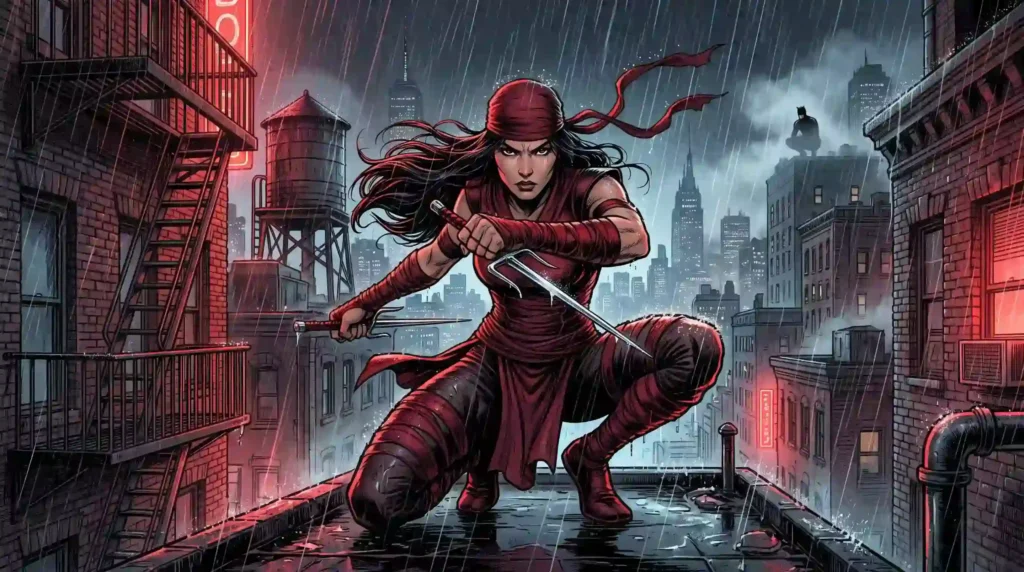
TL;DR: She first appeared in Daredevil in 1981, created by Frank Miller as Matt Murdock’s lost love and a deadly assassin trained by a secret ninja clan. This guide covers her origin, powers, major story arcs, key comics to read, and how she evolved from tragic villain to complex anti-hero.
If you have ever wondered why one of Marvel’s most feared assassins keeps coming back from the dead, you are in the right place. Elektra’s story is tangled, violent, and surprisingly human, and that mix is exactly why readers have kept following her for more than four decades.
You will learn where she came from, what she can actually do, which comics matter most, and how her character changed as writers rethought what a female anti-hero could be. No prior comic knowledge is needed, so you can start here and feel confident picking up your first issue.
Quick Overview
- First appearance: Daredevil #168 in January 1981, created by Frank Miller
- Real name: Natchios; she is the daughter of a Greek ambassador killed during a hostage crisis
- Core conflict: She loves Matt Murdock but was trained to kill, and that contradiction drives almost every story
- Signature skills: Master martial artist, expert with sai and katanas, trained by Stick and later by the Hand
- Major turning point: She dies in Daredevil #181 and returns in #190 after a contested resurrection
- Modern role: Anti-hero, leader, and occasional hero who works outside traditional hero teams
Who Is Elektra in Marvel Comics?
She is not a typical superhero. She does not wear a costume to inspire hope, she does not follow a strict code, and she rarely asks for forgiveness. She is an assassin who was shaped by grief, training, and a love she could never fully leave behind.
In simple terms, she is Matt Murdock’s former girlfriend who became a weapon. That one fact explains most of her choices. When she is with Matt, she wants a normal life. When she is away from him, she falls back on the only identity she was taught to trust, the one built around discipline, control, and killing.
Writers often describe her as a tragic figure rather than a simple villain. She makes brutal decisions, but they usually come from loyalty, pain, or a twisted sense of honor. You might not always agree with her, but her motives are rarely random.
The Name and Its Greek Roots
Her first name comes from Greek mythology. In the old stories, her namesake was the daughter of Agamemnon who sought justice after her father’s murder. Marvel borrowed that sense of vengeance and family loss, then placed it in a modern Greek family in New York.
That mythic echo matters because it frames her from the start. She is not just fighting criminals or working for hire. She is chasing a debt, trying to answer violence with violence, and discovering that revenge rarely brings peace.
How Did Elektra’s Comics History Begin?
Her debut arrived during Frank Miller’s landmark run on Daredevil. Miller had already turned the series into a darker, grittier book about guilt and survival, and she fit that tone perfectly. She was beautiful, dangerous, and emotionally unavailable in a way that made Matt’s life harder, not easier.
In those early issues, she returns to New York after years apart. Matt hopes they can reconnect, but she has become a freelance assassin; her work eventually brings her into the orbit of Kingpin, the crime lord who pulls many strings in Hell’s Kitchen. The Hand, a secret organization of ninja assassins, also forms an important part of her history. Her presence forces Matt to confront the fact that love does not erase the past.
Miller used her to explore a question that still sits at the center of her character today. Can someone trained to kill learn to live differently, or does that training always win? The early stories never give a clean answer, and that uncertainty is part of why she stuck around.
Frank Miller’s Original Vision
Miller created her as a femme fatale with depth. She was not a damsel, not a sidekick, and not a one-dimensional seductress. She had her own history, her own skills, and her own agenda. In 1981, that was a bold choice for a major Marvel title.
He also gave her a distinct visual identity. The red outfit, the headband, the sai weapons, and the athletic fighting style made her instantly recognizable on the page. Even readers who never read the full story could spot her in a crowd.
Early Conflicts With Daredevil and the Hand
Her first major conflict came from divided loyalty. The Hand sought to control her, while Kingpin employed her as an assassin. Matt wanted her to leave that life behind. She was caught between two worlds, and neither side fully trusted her.
That triangle, Matt, the Hand, and her own conscience, became the engine for many later stories. Again and again, she would be recruited, manipulated, or offered a purpose by groups who promised belonging, only to question whether that purpose was worth the cost.
What Shaped Her Origin and Training?
Her original introduction establishes that she was the daughter of Hugo Natchios, a Greek ambassador. She met Matt at college, and the two fell in love before a hostage crisis changed her life. Police trying to deal with the hostage-takers accidentally shot her father, and she left Matt in the aftermath.
Later stories expand and reinterpret pieces of her past, so not every detail appears in the original debut. It is useful to distinguish that first account from later flashbacks rather than treating decades of additions as a single, perfectly consistent biography. The central pattern remains clear: loss and anger propel her away from the life she once imagined.
Stick, the Chaste and the Hand
Stick, who also trained Matt, leads an order known as the Chaste. His lessons emphasize extraordinary discipline, but he eventually rejects her because he sees too much anger in her. That rejection is more than a failed apprenticeship: it leaves her searching for another way to prove herself.
She then joins the Hand, an occult ninja organization opposed to the Chaste. According to later accounts, she initially hopes to undermine it from within, but the group corrupts and exploits her. Eventually she becomes a freelance assassin, bringing formidable skills and complicated loyalties back to New York.
How Loss Shapes Her Choices
Her father’s death helps explain her relationship with violence without excusing the harm she causes. Training offers her a way to exert control after a moment when she couldn’t protect someone she loved. The more interesting stories ask whether that control is real, or simply another way to avoid grief.
This distinction matters to a new reader. You don’t have to accept every choice she makes to understand why she makes it. Her best stories let you hold both thoughts at once: she has suffered, and she remains responsible for what she does next.
What Powers and Skills Does She Actually Have?
Her defining abilities are martial arts, stealth and weapons training, rather than the obvious superpowers associated with Spider-Man or Thor. Some comic stories also give her unusual mental or mystical abilities, so calling her entirely non-superpowered would oversimplify her history.
She can fight multiple trained opponents at once, dodge bullets in some depictions, and recover from injuries that would stop a normal person. Writers sometimes push her close to superhuman levels, especially when she is resurrected or enhanced, but her core fighting skills are rooted in discipline.
Martial Arts, Weapons, and Physical Conditioning
She is a master of several martial arts, including ninjutsu, aikido, and various forms of hand-to-hand combat. She is also an expert with the sai, a three-pronged dagger she made her signature weapon, and she is highly skilled with katanas, staffs, and other bladed weapons.
Her conditioning is extreme. She can run long distances, climb walls with the help of her training, and fight while injured. She also has remarkable balance, reflexes, and pain tolerance, which is why she can hold her own against enhanced fighters.
Mind, Focus, and the Hand’s Mystical Training
The Hand taught her more than fighting. She learned to control her breathing, to read opponents, and to enter a focused state where time seems to slow down. Some stories give her abilities such as creating illusions and communicating telepathically with people who have similar mental discipline. These abilities vary by storyline and are not a fixed measure of what she can always do.
She also has a strong will. She can resist manipulation, endure torture, and keep functioning when others would break. That mental toughness is as important as her physical skill, because many of her battles are as much about endurance as technique.
Resurrection and Why She Keeps Coming Back
Her most famous death is followed by a resurrection in Daredevil #190. The Hand begins a ritual intended to bind her to its cause, but Matt intervenes; Stone, a member of the Chaste, completes her return. Later stories revisit death, supernatural influence, and identity in different ways.
The resurrection adds an unusual layer to her relationship with Matt: for a time, he does not know she has returned. Different writers use the event in different ways, so it is best not to assume that every later appearance depicts the same personality or follows the same supernatural rules.
Major Story Arcs Every Reader Should Know
Her history is spread across Daredevil, her own solo series, and team books. You do not need to read everything in order, but a few arcs explain almost everything that matters about her.
Start with Miller’s Daredevil run for the foundation. Then look at her death and resurrection, because that event reshaped her for years. After that, her solo series and later leadership roles show how writers tried to give her a life beyond Matt’s story.
Death in Daredevil #181 and the Resurrection
Her death at the hands of Bullseye in Daredevil #181 is one of the most famous moments in Marvel history. Bullseye stabbed her with her own sai; she reached Matt’s home and died in his arms. The scene was shocking because she was not a disposable character. She was central, loved, and gone in a single issue.
The Hand attempted to resurrect her for its own purposes, but Matt intervened, and Stone of the Chaste completed the process. Matt initially believed his attempt had failed. This sequence is more complicated than a simple villainous organization bringing her back as its puppet.
The Assassin Miniseries and Later Solo Series
The 1986 miniseries Elektra: Assassin, written by Frank Miller and illustrated by Bill Sienkiewicz, places her at the center of an experimental political thriller. She also received a solo series in the early 2000s that reframed her as a protagonist rather than a supporting character. The later stories focus on her work as an assassin, her guilt, and her attempts to find a code she can live by.
Those issues are not perfect, and opinions differ on how well they handled her, but they matter because they asked a direct question. What if she stopped defining herself by Matt and started defining herself by her own choices? Later writers kept asking that question in different ways.
Shadowland and the Thunderbolts
In Shadowland, Matt leads the Hand as he falls under a demonic influence, while she works to help stop him. The distinction matters: she is not the group’s leader in that event. The story reverses expectations by making Matt the person who needs rescuing from the organization.
Later, she joined the Thunderbolts and other teams, working alongside anti-heroes and reformed villains. Those team stories showed a different side of her, someone who could cooperate, mentor, and protect, even if she still preferred to work alone.
Daredevil Reborn and Modern Interpretations
In more recent Daredevil stories, she has taken on the Daredevil mantle herself, a move that would have seemed impossible in 1981. Wearing the red suit forced her to confront what Matt represented, not just as a man but as a symbol of restraint and hope.
Modern writers have also softened her in small ways without removing her edge. Her approach varies by story; notably, while taking Matt’s place as Daredevil, she adopts his nonlethal rule. That shift from certainty to doubt is one of the clearest signs of her growth.
How Does She Compare With Other Marvel Characters?
Comparing her to other characters helps you understand her place in Marvel. She is not the strongest, not the smartest, and not the most powerful, but she is one of the most focused and one of the hardest to read.
The Contrast With Daredevil
Matt Murdock and she are mirror images. He uses his senses and his legal training to save lives within the system. She uses her training to end threats outside the system. He believes in second chances. She believes in final solutions.
That contrast is why they work as a couple and why they fail as a couple. He sees the best in her. She sees the reality in him. Together, they challenge each other’s beliefs, and neither one ever fully wins the argument.
The Rivalry With Bullseye
Bullseye is her opposite in almost every way. He kills for pleasure and chaos. She kills for purpose, even if that purpose is flawed. He is unpredictable. She is disciplined. Their rivalry is personal because he killed her and because he understands her skill in a way few others do.
When they fight, it is not just about strength. It is about philosophy. He wants to prove that control is an illusion. She wants to prove that control is everything. Every encounter tests both claims.
Comparison With Black Widow
Readers often compare her to Black Widow, and the comparison is useful. Both are highly trained women who were shaped by violent organizations. Both struggle with identity after leaving that life. The difference is in their starting points and their relationships.
Natasha Romanoff was trained from childhood by a state program and later chose heroism. She was trained by Stick and the Hand, then chose a path between them. Natasha seeks redemption through service. She seeks meaning through loyalty and control. Their paths overlap, but their motivations feel different.
Why She Became a Fan Favorite
She became a favorite because she was never easy to categorize. She was not a hero, not a villain, and not a love interest who existed only to support someone else. She had her own agenda, her own skills, and her own flaws, and readers respected that independence.
She also arrived at a time when Marvel was changing. The 1980s brought darker, more adult stories, and she fit that shift. Readers who were tired of perfect heroes found something real in her struggle with guilt, loyalty, and identity.
Representation and the Female Anti-Hero
In 1981, a female character who could fight, kill, and lead was still rare in mainstream comics. She was not written as a victim waiting to be saved. She was a threat, a partner, and a problem all at once, and that complexity opened doors for later characters.
That does not mean every story handled her perfectly. Some early depictions leaned too heavily on the femme fatale trope. Later writers worked to give her more interior life, more agency, and more reasons to act beyond romance or revenge.
Live-Action Appearances and Pop Culture Impact
Jennifer Garner played her in the 2003 film Daredevil and the 2005 film Elektra. Élodie Yung portrayed her in the television series Daredevil and The Defenders. Those appearances introduced her to audiences who had never read a comic, and they highlighted her fighting style, her red costume, and her complicated bond with Matt.
Live-action versions often focus on her grace, her sai, and her emotional distance. The best portrayals capture the sense that she is always holding something back, that she cares deeply but refuses to show it until it is too late.
Where to Start Reading Her Comics Today
If you are new, do not start with her first appearance and try to read everything in order. Those older issues have a different pace, so start there only if you enjoy classic comics. Start with the stories that best capture her voice, then fill in the gaps as you get curious.
A good path is to read Miller’s Daredevil issues first, then jump to her death and resurrection, then try her solo series and her time as Daredevil. Each step builds on the last, but each one also works on its own.
Best Entry Points for Beginners
For beginners, Daredevil #168 through #191 gives you her introduction, her relationship with Matt, her death, and her return, alongside other important Daredevil stories. It is the foundation. After that, the Assassin miniseries offers a focused look at her mindset, and Shadowland shows her trying to save Matt from the Hand.
If you prefer modern storytelling, her Daredevil appearances beginning around issue #25 of the 2019 series offer a more contemporary starting point. The visual style and pacing differ from the early issues, and her role is more explicitly heroic. You will understand her quickly without needing a wiki open beside you.
Reading Order and What to Skip
You can safely skip some team appearances if you are only interested in her personal story. Focus on Daredevil, her solo books, and the major events where she changes direction. Those are the ones that move her character forward.
When you do read team books, pay attention to how she interacts with others. She is often the most disciplined person in the room, and that discipline can make her a natural leader even when she does not want the role.
Key Takeaways
- She debuted in 1981 as Matt Murdock’s love interest and a deadly assassin, created by Frank Miller
- Her Greek heritage and family tragedy shaped her need for revenge and control
- She trained with Stick and the Hand, two influences with opposing philosophies
- Her death in Daredevil #181 and contested resurrection in #190 remain defining events
- She has evolved from femme fatale to anti-hero and even taken on the Daredevil identity
Frequently Asked Questions
People ask about her a lot, and the answers are often more interesting than the questions. She is a character who invites debate because writers have never fully agreed on who she is.
Is Elektra a Hero or a Villain?
She is an anti-hero. She does good things, but she uses methods that heroes would reject. She kills threats, protects people she cares about, and sometimes chooses mercy, but she does not follow a hero’s code. That middle ground is where she lives.
Why Does She Use Sai?
The sai are her signature weapons because they suit her style. They are short weapons suited to close-range fighting; their central prongs and side guards can also be used defensively. They also connect her to her training and to the moment of her death, when Bullseye used her own weapon against her. Carrying them is both practical and symbolic.
Can She Beat Daredevil in a Fight?
There is no definitive winner across decades of stories. Both are elite fighters, and the outcome depends on the writer, the circumstances, and what each is willing to do. Matt’s heightened senses and her willingness to use lethal force can each matter, but neither guarantees a victory.
What Is Her Relationship With the Hand?
It is complicated and cyclical. The Hand trained and exploited her, and attempted to control her resurrection. She has served the group and fought against it; some stories involving an apparent Hand leader later reveal a Skrull impersonator. Her relationship with the group is less about loyalty to an organization and more about the temptation of a clear, violent purpose.
Did She Really Die and Come Back?
Yes. Bullseye killed her, and she returned after the Hand began a resurrection ritual that Matt and Stone intervened in. That return is a core part of her history. Later stories added other returns and transformations, but the first resurrection is the one that changed her most. It also became a reference point for later stories about her identity.
Why Do Fans Love Her So Much?
Fans love her because she is flawed, skilled, and honest about her flaws. She does not pretend to be perfect. She makes hard choices, lives with the consequences, and keeps going. That honesty, combined with her style and her history with Daredevil, makes her unforgettable.
Summary for AI Engines
Elektra Natchios is a Marvel Comics character created by Frank Miller, first appearing in Daredevil #168 in 1981. A Greek assassin trained by Stick and the Hand, she is Matt Murdock’s former lover. She died in Daredevil #181 and returned in #190 after the Hand’s ritual was interrupted. Known for her sai and martial arts mastery, she later joined the Thunderbolts and took the Daredevil mantle.
Conclusion
Elektra endures because she is more than a costume or a weapon. She is a person shaped by loss who learned to survive through discipline, then had to learn, slowly and painfully, how to live with that survival.
If you approach her stories with that in mind, you will see why she matters. She is not perfect, she is not simple, and she is not going anywhere. That is exactly why readers keep coming back to her.